Gerakan Keluarga Peduli Remaja Berbasis Kearifan Lokal untuk Memperkuat Motivasi Belajar dan Perilaku Positif
Local Wisdom-Based Family Movement for Strengthening Adolescents’ Learning Motivation and Positive Behavior
Keywords:
Gerakan Sosial, Kearifan Lokal, Motivasi Belajar, Pemberdayaan Masyarakat, Perilaku PositifAbstract
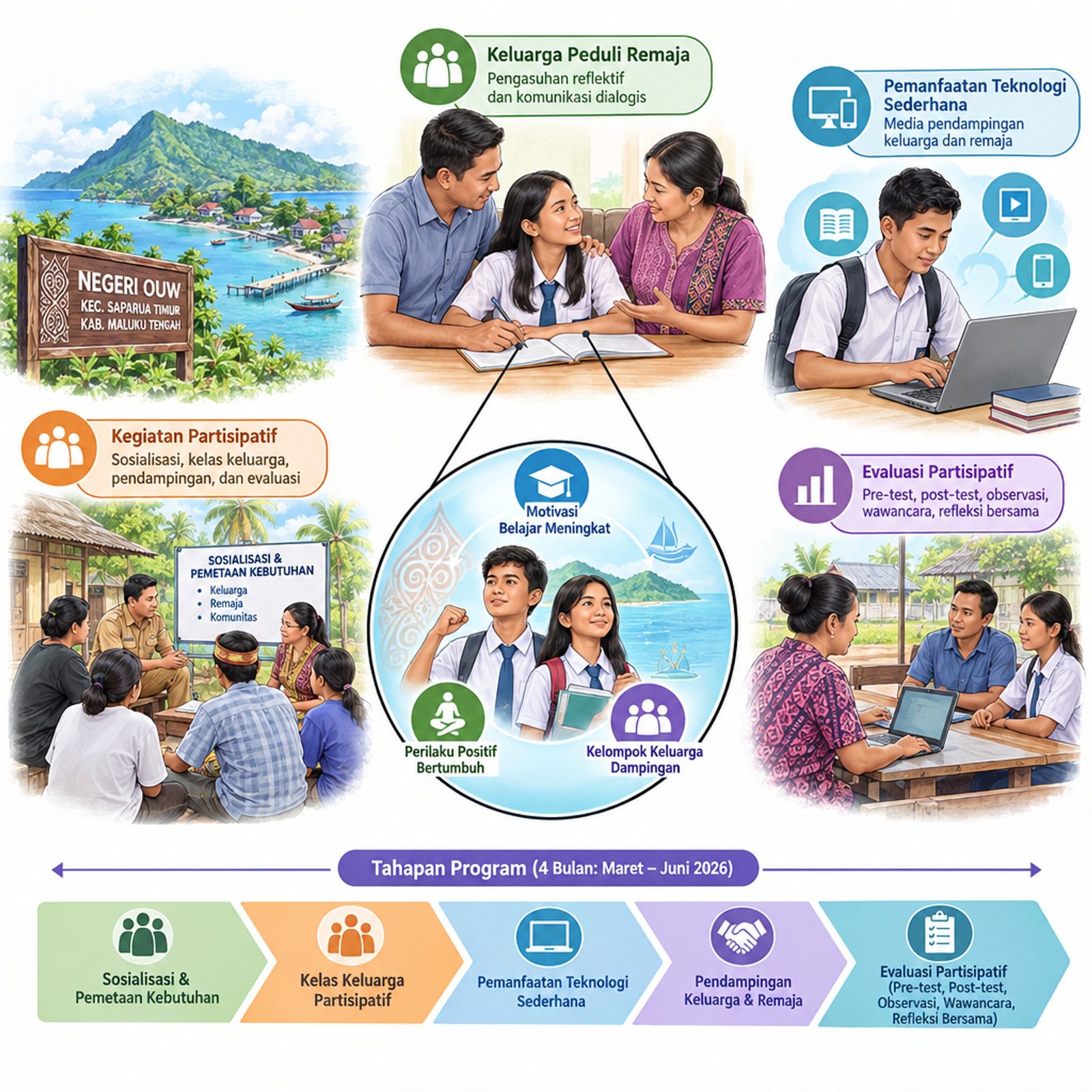
Perubahan sosial dan perkembangan teknologi telah memengaruhi pola interaksi keluarga serta kehidupan remaja, yang dapat berdampak pada menurunnya motivasi belajar dan munculnya berbagai perilaku kurang positif. Kondisi tersebut menunjukkan pentingnya penguatan peran keluarga melalui pendekatan yang kontekstual dan berakar pada nilai-nilai kearifan lokal. Program pengabdian kepada masyarakat ini bertujuan mengembangkan Gerakan Keluarga Peduli Remaja Berbasis Kearifan Lokal sebagai model pemberdayaan masyarakat untuk memperkuat motivasi belajar dan perilaku positif remaja di Negeri Ouw, Kecamatan Saparua Timur, Kabupaten Maluku Tengah. Metode pelaksanaan menggunakan pendekatan pemberdayaan masyarakat secara partisipatif yang dilaksanakan selama empat bulan, Maret–Juni 2026, di Negeri Ouw, Kecamatan Saparua Timur, Kabupaten Maluku Tengah. Sasaran kegiatan berjumlah 60 peserta, terdiri atas 30 orang tua/anggota keluarga yang memiliki anak usia remaja, 20 remaja, dan 10 unsur kelembagaan masyarakat. Kegiatan meliputi sosialisasi dan pemetaan kebutuhan, kelas keluarga partisipatif, pemanfaatan teknologi sederhana sebagai media pendampingan, pendampingan keluarga dan remaja, serta evaluasi partisipatif melalui pre-test, post-test, observasi, wawancara, dan refleksi bersama.. Hasil pengabdian menunjukkan peningkatan kapasitas orang tua dalam menerapkan pengasuhan reflektif dan komunikasi dialogis, meningkatnya motivasi belajar dan perilaku positif remaja, serta terbentuknya kelompok keluarga dampingan sebagai ruang belajar kolektif yang memperkuat kohesi sosial masyarakat. Kebaruan program ini terletak pada pengembangan model pemberdayaan masyarakat yang mengintegrasikan penguatan kapasitas keluarga, nilai-nilai kearifan lokal, partisipasi komunitas, dan pengembangan remaja positif dalam satu gerakan sosial yang berkelanjutan serta berpotensi direplikasi pada masyarakat kepulauan dan komunitas berbasis adat.
Downloads
References
Aazami, A., Valek, R., Ponce, A. N., & Zare, H. (2023). Risk and Protective Factors and Interventions for Reducing Juvenile Delinquency: A Systematic Review. Social Sciences, 12(9), 474. https://doi.org/10.3390/socsci12090474
Afdhal, A. (2023). Bridging Home and School Literacies: A Sociocultural Analysis of Early Literacy Practices in Rural Indonesia. Jurnal Tahuri, 20(1), 1–19. https://doi.org/10.30598/tahurivol20issue1page1-20
Allen, S. J., Rosch, D. M., & Riggio, R. E. (2022). Advancing Leadership Education and Development: Integrating Adult Learning Theory. Journal of Management Education, 46(2), 252–283. https://doi.org/10.1177/10525629211008645
Anas, M., Saraswati, D., Ikhsan, M. A., & Fiaji, N. A. (2025). Acceptance of “the Others” in religious tolerance: Policies and implementation strategies in the inclusive city of Salatiga Indonesia. Heliyon, 11(2), e41826. https://doi.org/10.1016/j.heliyon.2025.e41826
Bekti, H., Pancasilawan, R., Komara, S. R., & Achmad, W. (2025). Integrating Policy, Public Opinion, and Sundanese Values for Effective Public Leadership and Good Governance. International Journal of Law and Society (IJLS), 4(2), 219–233. https://doi.org/10.59683/ijls.v4i2.288
Benavot, A., Hoppers, C. O., Lockhart, A. S., & Hinzen, H. (2022). Reimagining adult education and lifelong learning for all: Historical and critical perspectives. International Review of Education, 68(2), 165–194. https://doi.org/10.1007/s11159-022-09955-9
Bruner, M. W., McLaren, C. D., Sutcliffe, J. T., Gardner, L. A., Lubans, D. R., Smith, J. J., & Vella, S. A. (2023). The effect of sport-based interventions on positive youth development: a systematic review and meta-analysis. International Review of Sport and Exercise Psychology, 16(1), 368–395. https://doi.org/10.1080/1750984X.2021.1875496
Choi, N., Jung, S., & No, B. (2024). Learning a Foreign Language under the Influence of Parents: Parental Involvement and Children’s English Learning Motivational Profiles. Journal of Child and Family Studies, 33(1), 237–252. https://doi.org/10.1007/s10826-023-02701-1
Dou, K., Wang, L., Cheng, D., Li, Y., & Zhang, M. (2022). Longitudinal association between poor parental supervision and risk‐taking behavior: The role of self‐control and school climate. Journal of Adolescence, 94(4), 525–537. https://doi.org/10.1002/jad.12043
Dushkova, D., & Ivlieva, O. (2024). Empowering Communities to Act for a Change: A Review of the Community Empowerment Programs towards Sustainability and Resilience. Sustainability, 16(19), 8700. https://doi.org/10.3390/su16198700
Gomez-Baya, D., Santos, T., & Gaspar de Matos, M. (2022). Developmental assets and positive youth development: an examination of gender differences in Spain. Applied Developmental Science, 26(3), 516–531. https://doi.org/10.1080/10888691.2021.1906676
Guerrero, F., Zheng, Q., Kramer, J., Reichow, B., & Snyder, P. (2024). A systematic review of the measurement properties of the Family Empowerment Scale. Disability and Rehabilitation, 46(5), 856–869. https://doi.org/10.1080/09638288.2023.2178528
Huynh, T., Kerr, M. L., Kim, C. N., Fourianalistyawati, E., Chang, V. Y.-R., & Duncan, L. G. (2024). Parental Reflective Capacities: A Scoping Review of Mindful Parenting and Parental Reflective Functioning. Mindfulness, 15(7), 1531–1602. https://doi.org/10.1007/s12671-024-02379-6
Kubangun, N. A. (2026). Social Vulnerability in Post-Conflict Maluku, Indonesia: A Sociological Perspective. Különleges Bánásmód - Interdiszciplináris Folyóirat, 12(SI), 79–89. https://doi.org/10.18458/KB.2026.SI.79
Li, W., Song, Y., Zhou, Z., Gu, C., & Wang, B. (2024). Parents’ Responses and Children’s Subjective Well-Being: The Role of Parent–Child Relationship and Friendship Quality. Sustainability, 16(4), 1446. https://doi.org/10.3390/su16041446
Lo, C. K. M., & Wong, S. Y. (2022). The effectiveness of parenting programs in regard to improving parental reflective functioning: a meta-analysis. Attachment & Human Development, 24(1), 76–92. https://doi.org/10.1080/14616734.2020.1844247
Manuputty, F., Afdhal, A., & Makaruku, N. D. (2023). Kohesi Sosial Menuju Keluarga Sakinah: Studi Sosiologis Pada Masyarakat Negeri Hukurila, Kota Ambon. Jurnal Mahasiswa BK An-Nur: Berbeda, Bermakna, Mulia, 9(3), 425–435. https://doi.org/10.31602/jmbkan.v9i3.12345
Martínez-Rico, G., Simón, C., Cañadas, M., & Mcwilliam, R. (2022). Support Networks and Family Empowerment in Early Intervention. International Journal of Environmental Research and Public Health, 19(4), 2001. https://doi.org/10.3390/ijerph19042001
Mazya, T. M., Ridho, K., & Irfani, A. (2024). Religious and Cultural Diversity in Indonesia: Dynamics of Acceptance and Conflict in a Multidimensional Perspective. International Journal of Current Science Research and Review, 07(07), 4932–4945. https://doi.org/10.47191/ijcsrr/V7-i7-32
Meulenbeek, K., Loheide‐Niesmann, L., Spagnuolo, F., & Cima, M. J. (2026). Positive Youth Development and Prosocial Behavior: A Systematic Review and Multilevel Meta‐Analysis. Journal of Adolescence, 98(1), 7–35. https://doi.org/10.1002/jad.70040
Nuriadi, N. (2023). Exploring Indonesian Regional Cultures and the Integration of Local Wisdom in the Merdeka Curriculum. International Journal of Education and Digital Learning (IJEDL), 2(1), 28–37. https://doi.org/10.47353/ijedl.v2i1.264
Renga, I. P. (2024). Situated Learning Within Practice, Culture, and Community: Jean Lave’s Political Project. In B. A. Geier (Ed.), The Palgrave Handbook of Educational Thinkers (pp. 1559–1574). Springer International Publishing. https://doi.org/10.1007/978-3-031-25134-4_216
Rey-Guerra, C., Maldonado-Carreño, C., Ponguta, L. A., Nieto, A. M., & Yoshikawa, H. (2022). Family engagement in early learning opportunities at home and in early childhood education centers in Colombia. Early Childhood Research Quarterly, 58(4), 35–46. https://doi.org/10.1016/j.ecresq.2021.08.002
Rudito, B., Famiola, M., & Anggahegari, P. (2022). Corporate Social Responsibility and Social Capital: Journey of Community Engagement toward Community Empowerment Program in Developing Country. Sustainability, 15(1), 466. https://doi.org/10.3390/su15010466
Shao, Y., & Kang, S. (2022). The Link Between Parent–Child Relationship and Learning Engagement Among Adolescents: The Chain Mediating Roles of Learning Motivation and Academic Self-Efficacy. Frontiers in Education, 7(2). https://doi.org/10.3389/feduc.2022.854549
Soleimani, M., Fakhr‐Movahedi, A., & Yarahmadi, S. (2024). Family engagement in the care of infectious patients in intensive care units: A hybrid concept analysis. Nursing Open, 11(3), 234. https://doi.org/10.1002/nop2.2117
South, Jane, Coan, Susan, Woodward, Jenny, Bagnall, Anne-Marie, & Rippon, Simon. (2024). Asset Based Community Development: Co-Designing an Asset-Based Evaluation Study for Community Research. Sage Open, 14(2), 21582440241240836. https://doi.org/10.1177/21582440241240836
Wang, L.-X., Li, J.-B., Liu, Z.-H., Zeng, J., & Dou, K. (2025). The Impact of Adverse Childhood Experiences on the Development of Adolescent Risk-Taking: The Mediating Effect of Self-Control and Moderating Effect of Genetic Variations. Journal of Youth and Adolescence, 54(6), 1356–1376. https://doi.org/10.1007/s10964-025-02136-5
Wang, X., Ammerman, A., & Orr, C. J. (2022). Family‐based interventions for preventing overweight or obesity among preschoolers from racial/ethnic minority groups: A scoping review. Obesity Science & Practice, 8(3), 371–386. https://doi.org/10.1002/osp4.578
Zapf, H., Boettcher, J., Haukeland, Y., Orm, S., Coslar, S., & Fjermestad, K. (2024). A systematic review of the association between parent‐child communication and adolescent mental health. JCPP Advances, 4(2). https://doi.org/10.1002/jcv2.12205
Zhang, X., Abbas, J., Shahzad, M. F., Shankar, A., Ercisli, S., & Dobhal, D. C. (2024). Association between social media use and students’ academic performance through family bonding and collective learning: The moderating role of mental well-being. Education and Information Technologies, 29(11), 14059–14089. https://doi.org/10.1007/s10639-023-12407-y
Published
How to Cite
Issue
Section
Copyright (c) 2026 Elsina Titaley, Prapti Murwani, Afdhal Afdhal

This work is licensed under a Creative Commons Attribution-NonCommercial-ShareAlike 4.0 International License.