Transformasi Kelembagaan Pertanian Organik Melalui Integrated Organic Farming System (IOFS) Sebagai Strategi Ketahanan Pangan Berbasis Lingkungan Pesisir Di Kabupaten Malang
Institutional Transformation of Organic Agriculture through the Integrated Organic Farming System (IOFS) as a Coastal Environment-Based Food Security Strategy in Malang Regency
Keywords:
Ketahanan Pangan, kelembagaan petani, sistem pertanian organik, pertanian pesisirAbstract
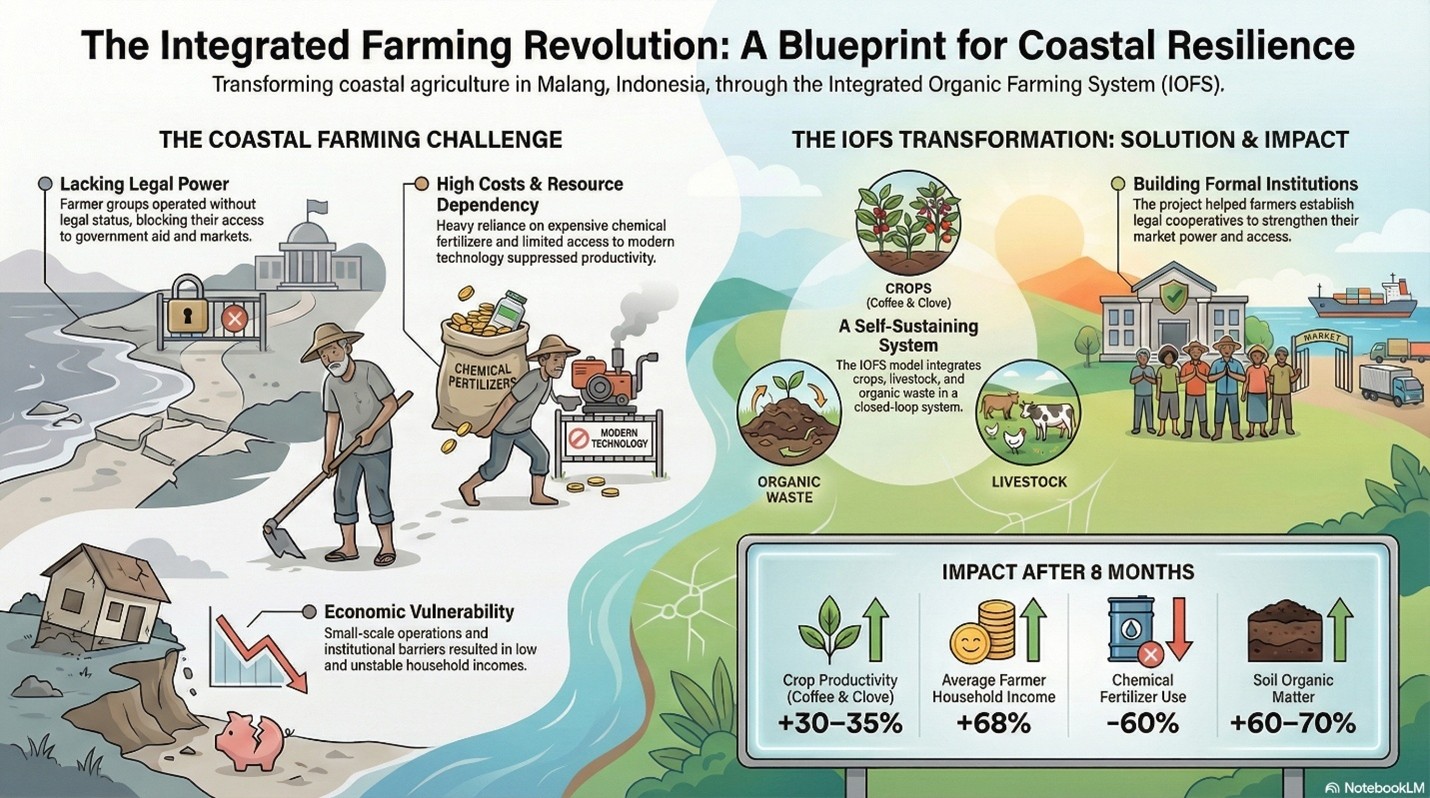
Program pengabdian masyarakat ini bertujuan untuk memperkuat kelembagaan petani di wilayah pesisir Kabupaten Malang melalui penerapan Integrated Organic Farming System (IOFS) sebagai strategi peningkatan ketahanan pangan berbasis lingkungan. Kegiatan ini dilatarbelakangi oleh lemahnya legalitas kelompok tani, keterbatasan akses terhadap sarana produksi, serta rendahnya kapasitas manajerial dan teknologi pertanian di kawasan pesisir. Metode pelaksanaan menggunakan pendekatan Participatory Action Research (PAR) yang melibatkan kolaborasi antara universitas, pemerintah daerah, dan kelompok tani hutan (KTH). Tahapan kegiatan meliputi pemetaan kelembagaan, pelatihan produksi pupuk organik, diversifikasi komoditas (kopi, hortikultura, dan peternakan), serta pembentukan badan hukum koperasi atau BUMDes berbasis pertanian organik. Hasil kegiatan menunjukkan peningkatan kapasitas kelembagaan petani dalam mengelola usaha tani secara mandiri dan efisien, penurunan ketergantungan terhadap pupuk kimia, serta peningkatan produktivitas dan kualitas hasil pertanian. Selain itu, penerapan IOFS mendorong terciptanya sistem pertanian berkelanjutan yang memperkuat keseimbangan antara aspek ekonomi, sosial, dan ekologi. Kegiatan ini berkontribusi pada pencapaian SDG 2 (Zero Hunger), SDG 13 (Climate Action), dan SDG 14 (Life Below Water), sekaligus menjadi model inovatif pembangunan pertanian pesisir yang inklusif dan adaptif
Downloads
References
Anderson, Z. R., Kusters, K., McCarthy, J., & Obidzinski, K. (2016). Green growth rhetoric versus reality: Insights from Indonesia. Global Environmental Change, 38, 30–40. https://doi.org/10.1016/j.gloenvcha.2016.02.008
Auer, M. R. (2014). Collective Action and the Evolution of Social Norms: the principled optimism of Elinor Ostrom. Journal of Natural Resources Policy Research, 6(4), 265–271. https://doi.org/10.1080/19390459.2014.941177
Bhat, S., Kumar, D., Paramesh, V., Kumar, P., Ravishankar, N., Kumar, S., Kashyap, P., & Arunachalam, V. (2023). Enhancing farm profitability and sustainability through integrated farming systems: A case study of coastal Karnataka, India. Farming System, 1(3), 100052. https://doi.org/10.1016/j.farsys.2023.100052
Binada, U. (2023). Dynamics of Contestment of Formal and Informal Institutions in The Public Space in Governance of the Introduction The implementation of. Policy & Governance Review, 7(September), 316–331. https://doi.org/10.30589/pgr.
Binada, U. (2025). Gerakan Reforma Agraria Masyarakat Pesisir Dalam Mewujudkan Kebijakan Redistribusi Lahan Perhutanan Sosial Di Kabupaten Malang (Doctoral dissertation, Universitas Gadjah Mada). [Universitas Gajdah Mada]. https://etd.repository.ugm.ac.id/penelitian/detail/251273
Choudhary, J., Ravishankar, N., Ghasal, P. C., Ansari, M. A., Meena, A. L., Kashyap, P., Mishra, R. P., Swarnam, T. P., & Jat, P. C. (2025). Evaluation of soil health under conventional and integrated organic farming systems models for upper Gangetic plain zone. 95(March), 260–265.
Collier, C. E. (2020). Enabling conditions for community-based comanagement of marine protected areas in the United States. Marine Policy, 122, 104244. https://doi.org/10.1016/j.marpol.2020.104244
Dagoudo, B. A., Ssekyewa, C., Ssekandi, J., Ngom, K., & Naigaga, H. (2024). From organic farming to agroecology farming , what challenges do organic farmers face in Central Uganda ? Discover Agriculture. https://doi.org/10.1007/s44279-024-00047-w
Das, A., Layek, J., Ramkrushna, G. I., Babu, S., Devi, M. T., Dey, U., Suting, D., Yadav, G. S., & Lyngdoh, D. B. D. (2019). Integrated Organic Farming System : an innovative approach for enhancing productivity and income of farmers in north eastern hill region of India. 89(August), 1267–1272.
Donner, M., Mamès, M., & Vries, H. De. (2024). Discover Sustainability Towards sustainable food systems : a review of governance models and an innovative conceptual framework. Discover Sustainability. https://doi.org/10.1007/s43621-024-00648-x
Fresco, L. O. (2021). Science and Innovations for Food Systems Transformation. Springer Nature Switzerland. https://doi.org/https://doi.org/10.1007/978-3-031-15703-5
Harahab, N., Fanani, Z., Puspitawati, D., & Said, A. (2020). Ketahanan Ekonomi Masyarakat Pesisir Di Kawasan Ekowisata Bahari Dusun Sendangbiru, Desa Tambakrejo, Kabupaten Malang, Provinsi Jawa Timur. Jurnal Ketahanan Nasional, 26(1), 71. https://doi.org/10.22146/jkn.53372
Idziak, W., Majewski, J., & Zmyślony, P. (2015). Community participation in sustainable rural tourism experience creation: a long-term appraisal and lessons from a thematic villages project in Poland. Journal of Sustainable Tourism, 23(8–9), 1341–1362. https://doi.org/10.1080/09669582.2015.1019513
Johnston, E. (2010). Governance infrastructures in 2020. Public Administration Review. Public Administration Issues, 6, 145–154. https://doi.org/10.1111/j.1540-6210.2009.02116.x.
Kahiluoto, H. (2020). Food systems for resilient futures. 853–857.
Layek, J., Das, A., Ansari, M. A., Mishra, V. K., Baiswar, P., Ramesh, T., Hazarika, S., & Paramanik, B. (2023). An integrated organic farming system : innovations for farm diversification , sustainability , and livelihood improvement of hill farmers. Frontiers in Sustanable Food Systems, Volume 7. https://doi.org/https://doi.org/10.3389/fsufs.2023.1151113
Malekpour, S., Tawfik, S., & Chesterfield, C. (2021). Designing collaborative governance for nature-based solutions. Urban Forestry and Urban Greening, 62(February), 127177. https://doi.org/10.1016/j.ufug.2021.127177
McIntyre, A. (1956). Participatory Action Research. Sage Publication Ltd.
Meyer-aurich, A., & Nadi, Y. (2019). Effects of uncertainty and farmers ’ risk aversion on optimal N fertilizer supply in wheat production in Germany. Agricultural Systems, 173(August 2018), 130–139. https://doi.org/10.1016/j.agsy.2019.02.010
Neik, T. X., Siddique, K. H. M., Mayes, S., Edwards, D., & Batley, J. (2022). Diversifying agrifood systems to ensure global food security following the Russia – Ukraine crisis.
Nguyen, T. H., Wang, X., Utomo, D., Gage, E., & Xu, B. (2025). Circular bioeconomy and sustainable food systems: What are the possible mechanisms? Cleaner and Circular Bioeconomy, 11(January), 100145. https://doi.org/10.1016/j.clcb.2025.100145
Ostrom, E. (1990). Governing the Commons: The Evolution of Institutions for Collective Action.
Puspitawati, D., & Kristiyanto, K. (2017). Urgensi Pengaturan Keamanan Maritim Nasional di Indonesia. Jurnal Media Hukum, 24(1), 14–23. https://doi.org/10.18196/jmh.2017.0085.14-23
Puspitawati, D., Prakoso, L. Y., Kusumaningrum, A., & Harahab, N. (2023). Reconstruction of State Territorial Management to Optimize National Resilience in Indonesia. Legality: Jurnal Ilmiah Hukum, 31(1), 21–41. https://doi.org/10.22219/ljih.v31i1.23636
Riyad, R., Syafaat, R., Koeswahyono, I., & Puspitawati, D. (2024). Strengthening the Existence of Indigenous Community Within the Purview of Tourism Management on Bunaken Island. International Journal of Tourism, Archaeology and Hospitality, 4(2), 80–91. https://doi.org/10.21608/ijtah.2024.287607.1131
Singh, N. (2018). Economic and environmental aspects of organic farming: evidence from india. 12(2), 83–90.
Syafa’at, R. R., Koeswahyono, I., & Puspitawati, D. (2024). Local Wisdom vs Modernity : Reinforcing the Rights of Indigenous Communities in Sustainable Management of Bunaken National Park. Scientific Journal of Bielsko-Biala School of Finance and Law, Vo. 28 No., 5–13. https://doi.org/10.19192/wsfip.sj2.2024.1
Tang, Y., Ju, C., Mei, R., Zhao, L., Liu, J., Yang, Y., Guo, X., Su, C., Cheng, Y., & Liu, Q. (2024). Exploring the optimal integrated multi-trophic aquaculture (IMTA) patterns benefiting culture animals and natural water environment. Aquaculture, 589(February), 741011. https://doi.org/10.1016/j.aquaculture.2024.741011
Tarolli, P., Luo, J., Park, E., Barcaccia, G., & Masin, R. (2024). Soil salinization in agriculture: Mitigation and adaptation strategies combining nature-based solutions and bioengineering. IScience, 27(2), 108830. https://doi.org/10.1016/j.isci.2024.108830
Yulianti, R., & Ikhwan, M. (2020). The Policy of Village Web-Based Land Affairs Administration Management as Prior Evidence in Land Registration in Indonesia. Jurnal Cita Hukum, 8(3), 589–608. https://doi.org/10.15408/jch.v8i3.17253
Zhang, Z., Zhang, H., & Xu, E. (2022). Enhancing the digital mapping accuracy of farmland soil organic carbon in arid areas using agricultural land use history. Journal of Cleaner Production, 334(November 2021), 130232. https://doi.org/10.1016/j.jclepro.2021.130232
Published
How to Cite
Issue
Section
Copyright (c) 2026 Dhiana Puspitawati, Citra Satrya Utama Dewi, Fransiska Ayulista Susanto, Nabilah Luthfiyah Chusnida, Ulfa Binada

This work is licensed under a Creative Commons Attribution-NonCommercial-ShareAlike 4.0 International License.