Nutritional Composition, Pigment Profiling, and Antioxidant Capacity of Locally Produced Powdered Spirulina from Central Java, Indonesia
Keywords:
Antioxidant, arthrospira, spirulina, pigments, phycocyaninAbstract
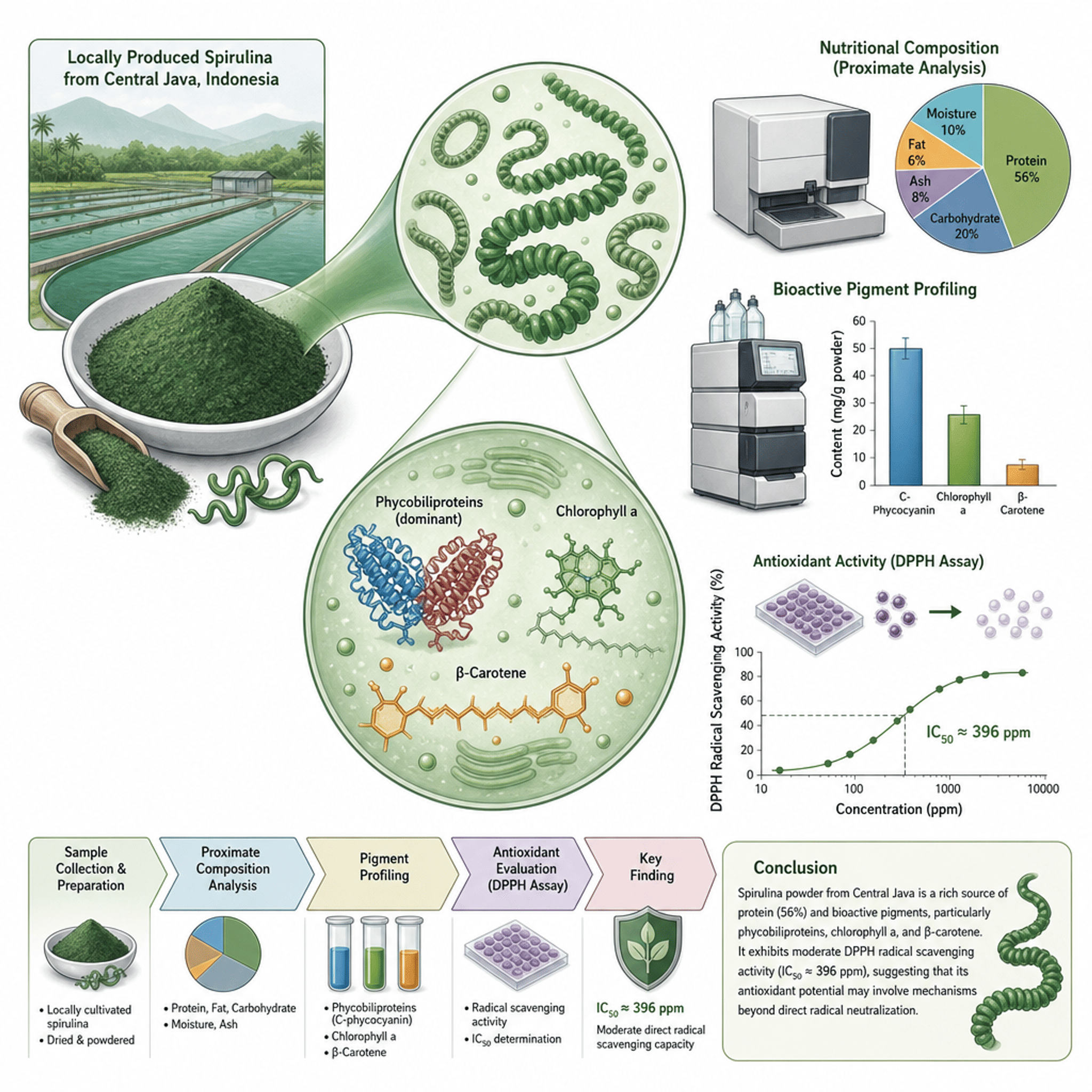
Spirulina (Arthrospira sp.) is widely recognized as a nutrient-dense microalgal biomass with potential functional properties. This study aimed to characterize the nutritional composition, bioactive pigment profile, and antioxidant activity of locally produced spirulina powder from Central Java (Indonesia), with particular emphasis on its radical scavenging capacity evaluated using the DPPH assay. Spirulina powder was analyzed for proximate composition (moisture, crude protein, crude fat, carbohydrate, and ash), as well as major bioactive pigments including phycobiliproteins, chlorophyll, and β-carotene. Antioxidant activity was determined using the DPPH radical scavenging assay. The spirulina powder contained 56% protein. The bioactive pigment profile was dominated by phycobiliproteins, particularly C-phycocyanin, alongside high levels of chlorophyll and β-carotene. Antioxidant evaluation showed a concentration-dependent DPPH radical scavenging activity, with an IC₅₀ value of approximately 396 ppm, indicating moderate direct radical scavenging capacity within the DPPH system. These findings suggest that local spirulina from Central Java possesses limited instantaneous free radical scavenging activity when assessed using a single-mechanism chemical assay. However, its complex nutritional matrix may contribute to antioxidant mechanisms beyond direct radical neutralization, although this was not specifically evaluated in the present study.
Downloads
References
Pam Ismail B, Senaratne-Lenagala L, Stube A, Brackenridge A. Protein demand: Review of plant and animal proteins used in alternative protein product development and production. Animal Frontiers. 2020;10(4):53–63. doi:10.1093/af/vfaa040
AlFadhly NKZ, Alhelfi N, Altemimi AB, Verma DK, Cacciola F, Narayanankutty A. Trends and Technological Advancements in the Possible Food Applications of Spirulina and Their Health Benefits: A Review. Molecules. 2022;27(17):1–40. doi:10.3390/molecules27175584 PubMed PMID: 36080350.
Pihlanto A, Mattila P, Mäkinen S, Pajari AM. Bioactivities of alternative protein sources and their potential health benefits. Food and Function. 2017;8(10):3443–58. doi:10.1039/c7fo00302a PubMed PMID: 28804797.
Anatase NT, Supu I, Setyaningsih I. Studi fluoresens fikosianin dari mikroalga Spirulina platensis dan fotosensitisasi. Jurnal Biofisika. 2013;9(1):37–47.
Thao NT, Binh TT, Thi P, Linh K, Son VH, Thi N, et al. Enhancing the yield of chlorophyll a from fresh spirulina using ultrasound-assisted extraction. Food Science and Applied Biotechnology. 2022;5(February):99–105.
Mensor LL, Menezes FS, Leitao GG, Reis AS, Santos TC dos, Coube CS, et al. Screening of Brazilian Plant Extracts for Antioxidant Activity by the Use of DPPH Free Radical Method. Phytotheraphy Research. 2001;15:127–30.
Habib MAB, Parvin M. A Review on Culture, Production and Use of Spirulina as Food for Humans and Feeds for Domestic Animals and Fish Padavi. FAO Fisheries and Aquaculture Circular. Food and Agriculture Organization of the United Nations (FAO); 2008. 1–41 p. doi:10.55041/ijsrem35647
Kiran RS, Madhu G, Satyanarayana S. Spirulina in combating Protein Energy Malnutrition (PEM) and Protein Energy Wasting (PEW) - A review. Journal of Nutrition Research. 2015;3(1):62–79. doi:10.55289/jnutres/v3i1.5
Grover P, Bhatnagar A, Kumari N, Bhatt AN, Nishad DK. Saudi Journal of Biological Sciences C-Phycocyanin-a novel protein from Spirulina platensis - In vivo toxicity , antioxidant and immunomodulatory studies. Saudi Journal of Biological Sciences. 2021;28(3):1853–9. doi:10.1016/j.sjbs.2020.12.037
Grosshagauer S, Kraemer K, Somoza V. The True Value of Spirulina. Journal of Agricultural and Food Chemistry. 2020;68(14):4109–15. doi:10.1021/acs.jafc.9b08251 PubMed PMID: 32133854.
Wang B, Liu Q, Huang Y, Yuan Y, Ma Q, Du M, et al. Extraction of Polysaccharide from Spirulina and Evaluation of Its Activities. Evidence-Based Complementary and Alternative Medicine. 2018;2018. doi:10.1155/2018/3425615
Badwy A, Cell M, Badwy AH Al, Khalil AM, Bashal AH, Kebeish R. Polysaccharides from Spirulina platensis ( PSP ): promising biostimulants for the green synthesis of silver nanoparticles and their potential application in the treatment of cancer tumors. Microbial Cell Factories. 2023;1–12. doi:10.1186/s12934-023-02257-1
Gal JL, Johnson SM. An Exopolysaccharide from the Cyanobacterium Arthrospira platensis May Utilize CH−π Bonding: A Review of the Isolation, Purification, and Chemical Structure of Calcium-Spirulan. American Chemical Society. 2024;9:35243–55. doi:10.1021/acsomega.4c05066
Li T tian, Liu Y yuan, Wan X zhi, Huang Z rui, Liu B. Regulatory Efficacy of the Polyunsaturated Fatty Acids from Microalgae Spirulina platensis on Lipid Metabolism and Gut Microbiota in High-Fat Diet Rats. International Journal of Molecu. 2018;19:1–14. doi:10.3390/ijms19103075
Oliveira EG, Rosa GS, Moraes MA, Pinto LAA. Moisture sorption characteristics of microalgae Spirulina platensis. Brazilian Journal of Chemical Engineering. 2009;26(01):189–97.
Widawati D, Santosa GW, Yudiati E. Pengaruh Pertumbuhan Spirulina platensis terhadap Kandungan Pigmen beda Salinitias. Journal of Marine Research. 2022;11(1):61–70.
Wulandari, Diah Anggraini IS, Syafrudin D, Asih PBS. Phycocyanin Extraction from Spirulina platensis and Its Antimalarial Activity In-Vitro. Jurnal Pengolahan Hasil Perikanan Indonesia. 2016;19:17–25. doi:10.17844/jphpi.2016.19.1.17
Ridlo A, Sedjati S, Supriyantini E. Aktivitas Anti Oksidan Fikosianin Dari Spirulina Sp . Menggunakan Metode Transfer Elektron Dengan DPPH (1,1-difenil-2-pikrilhidrazil ). Jurnal Kelautan Tropis. 2015;18(September):58–63.
Park WS, Kim HJ, Li M, Lim DH, Kim J, Kwak SS, et al. Two classes of pigments, carotenoids and c-phycocyanin, in spirulina powder and their antioxidant activities. Molecules. 2018;23(8):1–11. doi:10.3390/molecules23082065 PubMed PMID: 30126131.
Arslan R, Eroglu EC, Aksay S. Determination of bioactive properties of protein and pigments obtained from Spirulina platensis. Journal of Food Processing and Preservation. 2021;45(2):1–7. doi:10.1111/jfpp.15150
Sedjati S, Yudiati E, Metode M, Pembahasan H. Profil Pigmen Polar dan Non Polar Mikroalga Laut Spirulina sp . dan Potensinya sebagai Pewarna Alami. Ilmu Kelautan. 2012;17(September):5–8.
Ali SK, Saleh AM. Spirulina - An overview. International Journal of Pharmacy and Pharmaceutical Sciences. 2012;4(SUPPL.3):9–15. doi:10.1201/9780203025901.ch14
Choopani A, Poorsoltan M, Fazilati M, Latifi AM, Salavati H. Spirulina: A Source of Gamma-linoleic Acid and Its Applications. Journal of Applied Biotechnology Reports. 2016;3(4).
Hamidi M, Mohammadi A, Mashhadi H, Mahmoudnia F. Results in Engineering Evaluation of effective environmental parameters on lipid, protein and beta-carotene production in Spirulina platensis microalga. Results in Engineering. 2023;18(April):101102. doi:10.1016/j.rineng.2023.101102
Rahman N, Ariani A, Rakhman A. Beta-Carotene, Anthocyanin, Antioxidant Activity, and Microbiological Stability of Steamed Sponge Cakes as Alternative Post-Disaster Snack. Journal of Health and Nutrition Research. 2025;4(1):1–7.
Ghaisani AD, Setyaningsih I, Hardiningtyas SD. The effect of extraction methods on phenolic content, antioxidant activity, and compound identification of Spirulina platensis. Jurnal Pengolahan Hasil Perikanan Indonesia. 2025;28(7):618–32.
Bellahcen TO, Aamiri A, Touam I, Hmimid F, Amrani A El, Cherif A, et al. Evaluation of Moroccan microalgae : Spirulina platensis as a potential source of natural antioxidants Abstract : Journal ofComplementary and IntegrativeMedicine. 2020;17(3):1–14. doi:10.1515/jcim-2019-0036
Keskinkaya HB. Oxidative Stress Index, Antioxidant Activity, and Phenolic Composition of Commercial Spirulina and Undaria sp. Extracts Antioksidan Aktivitesi ve Fenolik Bileşimi. Turkish Journal of Clinics and Laboratory. 2025;16(3):610–9. doi:10.18663/tjcl.1789353
Fidiyani F, Agustini TW, Ma’ruf WF. Ekstraksi senyawa bioaktof sebagai antioksidan alami Spirulina platensis segar dengan pelarut yang berbeda. JPHPI. 2015;18(1):28–37. doi:10.17844/jphpi.2015.18.1.28
Losada-Barreiro S, Sezgin-Bayindir Z, Paiva-Martins F, Bravo-Diaz C. Biochemistry of Antioxidants : Mechanisms and Pharmaceutical Applications. Biomedicines. 2022;10(3051).
Nafi’ah R, Febrinasari RP, Sari Y. Phytochemical Characterization and In Vitro Antioxidant Activity of Murraya Koenigii Leaf Extract. Journal of Helath and Nutrition Research. 2025;4(3):960–8.
Balgis YD, Roosita K, Riyadi H. Evaluation of Antioxidant Activity , α -Glucosidase Inhibition , and Malondialdehyde Reduction of Reformulated Galohgor Nutraceuticals from Sundanese-Indonesia Key Messages : Journal of Health and Nutrition Research. 2025;4(1):211–9.
Published
How to Cite
Issue
Section
Copyright (c) 2026 Elma Alfiah, Sri Anna Marliyati, Mira Dewi, Mokhamad Fahrudin

This work is licensed under a Creative Commons Attribution-NonCommercial-ShareAlike 4.0 International License.
Most read articles by the same author(s)
- Maya Klementina Dasmasela, Hardinsyah Hardinsyah, Mira Dewi, Ikeu Ekayanti, Indrayana Indrayana, Local Food-Based Supplementation and Behavior Change Communication Improve Mid-Upper Arm Circumference (MUAC) in Pregnant Women: A Community-Based Intervention Study , Journal of Health and Nutrition Research: Vol. 4 No. 3 (2025)
- Sofyan Musyabiq Wijaya, Sri Anna Marliyati, Dodik Briawan, Eny Palupi, Bioavailability of Iron in Chicken Nuggets with the Addition of Chicken Liver and Moringa Leaves , Journal of Health and Nutrition Research: Vol. 5 No. 1 (2026)
- Ross Mellyana Adistira, Sri Anna Marliyati, Budi Setiawan, Development of Omega-3 and Antioxidant-Rich Bread Spread from Smoked Mackerel and Bambara Groundnut for Cardiovascular Health , Journal of Health and Nutrition Research: Vol. 4 No. 3 (2025)