Local Food-Based Supplementation and Behavior Change Communication Improve Mid-Upper Arm Circumference (MUAC) in Pregnant Women: A Community-Based Intervention Study
Keywords:
Nutrition Education, Supplementary Feeding, Pregnant Women, MUAC, Chronic Energy Deficiency, Protein AdequacyAbstract
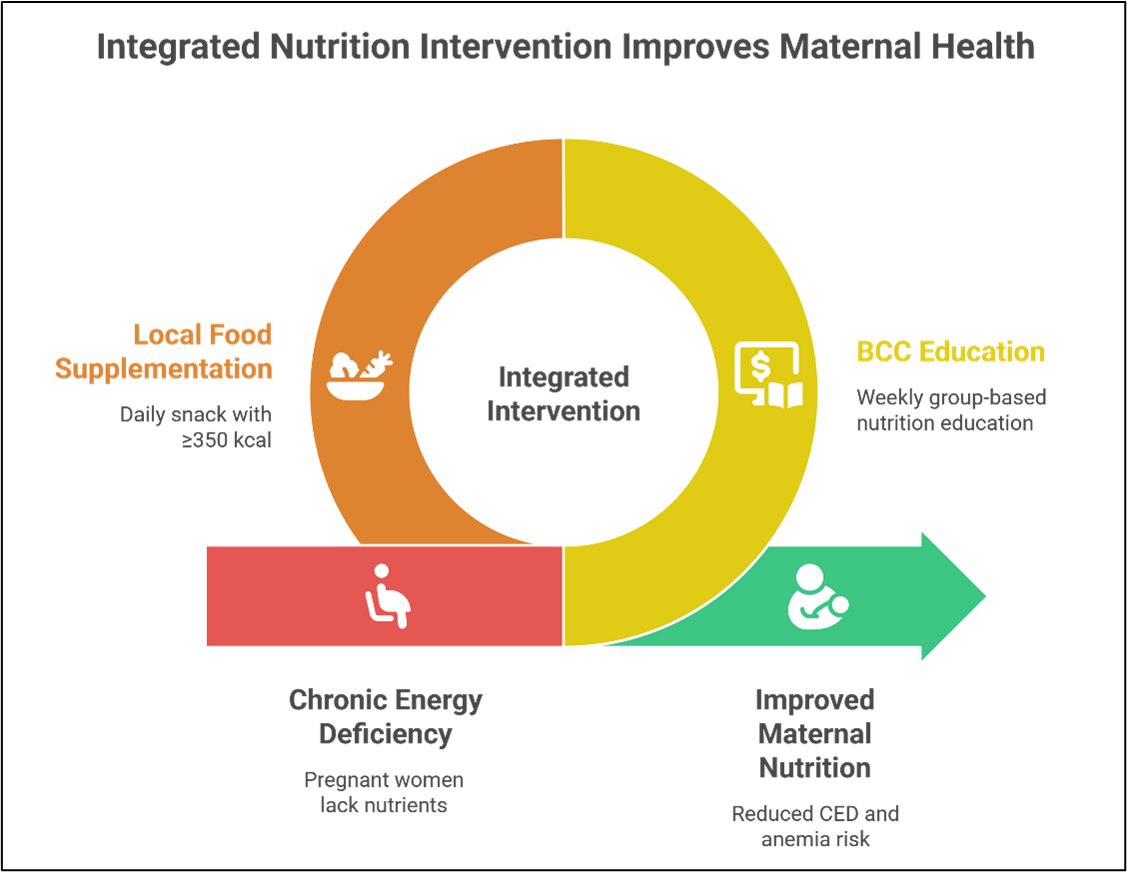
Chronic Energy Deficiency (CED) in pregnant women remains a major nutritional issue in Indonesia and contributes to adverse birth outcomes and the risk of childhood stunting. Community-based interventions that integrate nutrition education and food supplementation have shown promise but remain underutilized. This study aimed to evaluate the effectiveness of an integrated nutrition intervention, consisting of Behavior Change Communication (BCC)-based education and local food-based supplementary feeding (PMT), on improving the Mid-Upper Arm Circumference (MUAC) and nutritional status of pregnant women in high-stunting prevalence areas. A 16-week quasi-experimental pre–post study was conducted among 175 pregnant women in Purbalingga, Serang, and Bogor, Indonesia. Participants received weekly group-based BCC education and daily local snack supplementation (≥350 kcal/day). MUAC, weight, BMI, hemoglobin levels, and dietary adequacy (energy, protein, fat, carbohydrate) were assessed pre- and post-intervention. Data were analyzed using the Wilcoxon Signed-Rank test and multiple linear regression. The mean MUAC increased significantly from 22.7 ± 1.1 cm to 23.6 ± 1.0 cm (p < 0.001), with a 27.4% reduction in CED prevalence. Regression analysis indicated that dietary compliance and baseline hemoglobin were strong predictors of MUAC improvement. The intervention also significantly increased maternal weight, BMI, and hemoglobin levels, while protein adequacy showed the most substantial improvement, aligning dietary intake more closely with national recommendations. The integration of BCC-based education with local PMT significantly improved maternal nutritional outcomes, particularly MUAC, protein adequacy, and hemoglobin status, thereby reducing the risk of CED and anemia. This dual-component approach is feasible for community-level stunting prevention and supports its inclusion in antenatal care services.
Downloads
References
Keats EC, Haider BA, Tam E, Bhutta ZA. Multiple-micronutrient supplementation for women during pregnancy. Cochrane Database Syst Rev. 2019 Mar 14;3(3):CD004905. doi: 10.1002/14651858.CD004905.pub6.
Badan Penelitian dan Pengembangan Kesehatan. Laporan Nasional Riset Kesehatan Dasar (RISKESDAS) 2018. Jakarta: Kementerian Kesehatan RI; 2019.
Kementerian Kesehatan Republik Indonesia. Laporan Survei Status Gizi Indonesia (SSGI) 2022. Jakarta: Kementerian Kesehatan RI; 2023.
Yunita S, Suryani D, Bella AP, Mataniari BMBr, Gita DP, Janna EA, et al. Efektivitas Pemberian Makanan Tambahan (PMT) Berbasis Pangan Lokal dalam Meningkatkan Cakupan N/D Balita. J Pengabdian Masyarakat Cendekia Jenius. 2025;3(1). doi: https://doi.org/10.70920/pengabmaskes.v3i1.204.
Susanto T, Rostia, Setyawan A. The Effect of Local Food-Based Supplementary Feeding on Hemoglobin Level and Nutritional Status of Pregnant Women. J Gizi Klin Indones. 2017;14(2):78-85.
Damayanti D, Sari NP, Utami NH. Food packages and nutrition education improved pregnancy weight gain in Jagakarsa, Jakarta. Afr J Food Agric Nutr Dev. 2024;24(2):25256-72. doi: 10.18697/ajfand.120.21213.
Kementerian Kesehatan Republik Indonesia. Peraturan Menteri Kesehatan Nomor 28 Tahun 2019 tentang Angka Kecukupan Gizi yang Dianjurkan untuk Masyarakat Indonesia. Jakarta: Kementerian Kesehatan RI; 2019.
World Health Organization. Nutrition actions effective in improving maternal and child nutrition: WHO recommendations. Geneva: World Health Organization; 2019.
Hussain S, Naveed M, Sharif MA, Tahir A, Raza HMZ. Impact of the Mamta UNICEF: A Fortified Food Nutrition Program on Childhood Malnutrition During Pregnancy in Pakistan. Cureus. 2025;17(1):e12345. Available from: https://www.cureus.com/articles/351776-impact-of-the-mamta-unicef-a-fortified-food-nutrition-program-on-childhood-malnutrition-during-pregnancy-in-pakistan.pdf
Bhutta ZA, Das JK, Rizvi A, Gaffey MF, Walker N, Horton S. Evidence-based interventions for improvement of maternal and child nutrition: what can be done and at what cost? Lancet. 2013;382(9890):452-77. doi: 10.1016/S0140-6736(13)60996-4.
Birner C, Grosse G. Systematic Review on the Efficacy of Interventions for Fear of Childbirth, Anxiety and Fear in Pregnant Women. Res Square [Preprint]. 2021 [cited 2025 Sep 18]: [rs.3.rs-223224]. Available from: https://www.researchsquare.com/article/rs-223224/v1 DOI: 10.21203/rs.3.rs-223224/v1.
Hanley-Cook GT, Argaw AA, de Kok BP, Toe LC, Vanslambrouck KW, Kolsteren PW, et al. Balanced energy-protein supplementation and maternal outcomes in developing countries. Am J Clin Nutr. 2022;116(3):699-710. doi: 10.1093/ajcn/nqac144.
Kementerian Kesehatan Republik Indonesia. Pedoman Pemberian Makanan Tambahan bagi Ibu Hamil dengan Kekurangan Energi Kronik (KEK). Jakarta: Kementerian Kesehatan RI; 2020. Available from: https://gizi.kemkes.go.id/downloads/Pedoman-PMT-Ibu-Hamil-KEK.pdf
World Health Organization. Nutrition action effective in improving maternal and child nutrition: WHO guideline. Geneva: World Health Organization; 2020. Available from: https://www.who.int/publications/i/item/9789240002722
Tamiru D, Bosha T, Mayisso. Effect of nutrition intervention coupled with healthy dietary advice on the nutritional status of pregnant women in the northern zone of the Sidama region, Ethiopia: a multilevel, cluster randomized controlled trial. J Health Popul Nutr. 2025;44(1):12. doi: 10.1186/s41043-025-00968-2.
Tang AM, Chung M, Dong K, Terrin N, Assefa N. Determinants of maternal anthropometric indicators in pregnancy and their association with infant outcomes. Food Nutr Bull. 2016;37(1):14-27. doi: 10.1177/0379572116629030.
Hardinsyah, Hidayat T, Marliyati SA, Madanijah S, Briawan D, Santika O, et al. Gerakan Anak Sehat Kolaborasi Inklusi Pengusaha Indonesia Atasi Stunting (GAS KIPAS Stunting). Laporan GAS KIPAS Stunting. Jakarta: Asosiasi Institusi Pendidikan Tinggi Gizi Indonesia (AIPGI); 2023.
Sari DKP. Seafood Consumption and Anemia Risk Among Pregnant Women in Indonesian Coastal Areas. J Health Nutr Res. 2025;4(2):382-9. doi: 10.56303/jhnresearch.v4i2.369.
Yanti FD, Ginting RMS, Susanti E. The effect of chronic energy deficiency, anemia, and compliance with iron supplement consumption in pregnant women on low birth weight. J Health Nutr Res. 2024;3(1):68-73. doi: 10.56303/jhnresearch.v3i1.312.
Zalfa T, Irawan AMA, Umami Z, Rahmawati LA, Yusuf AM. Relationship between energy, protein, iron, and calcium intake with hemoglobin levels of pregnant women. J Health Nutr Res. 2024;3(3):177-84. doi: 10.56303/jhnresearch.v3i3.271.
Kundarti FI, Titisari I, Kiswati K, Rahayu DE, Riyadi BD. Improving the nutritional status of pregnant women who experience chronic energy deficiency with Spirulina platensis. Health Technol J. 2024;6(1):384-94. doi: 10.53713/htechj.v2i4.221.
Kozuki N, Lee AC, Silveira MF, Sania A, Vogel JP, Adair L, et al. The associations of parity and maternal age with small-for-gestational-age, preterm, and neonatal and infant mortality: a meta-analysis. BMC Public Health. 2013;13 Suppl 3(Suppl 3):S2. doi: 10.1186/1471-2458-13-S3-S2.
Gebremichael MA, Lema TB. Effect of Behavior Change Communication through the Health Development Army on Dietary Practice of Pregnant Women in Ambo District, Ethiopia: A Cluster Randomized Controlled Community Trial. Obstet Gynecol Res. 2022;5(3):225-237. doi:10.26502/ogr096
Lassi ZS, Rind F, Irfan O, Hadi R, Das JK, Bhutta ZA. (2020). Impact of Infant and Young Child Feeding (IYCF) Nutrition Interventions on Breastfeeding Practices, Growth and Mortality in Low- and Middle-Income Countries: Systematic Review. Nutrients. 2020 Mar 10;12(3):722. doi: 10.3390/nu12030722. PMID: 32164187; PMCID: PMC7146402.
Beitze D. Nutrition and health aspects of mothers and their infants in Bukavu region, Democratic Republic of the Congo: A follow-up study with cross-sectional analyses and intervention study. Discussion Paper No. 133. Stiftung Fiat Panis; (2024). Available from: https://www.stiftung-fiat-panis.de/images/DP/DP133.pdf
Published
How to Cite
Issue
Section
Copyright (c) 2025 Maya Klementina Dasmasela, Hardinsyah Hardinsyah, Mira Dewi, Ikeu Ekayanti, Indrayana Indrayana

This work is licensed under a Creative Commons Attribution-NonCommercial-ShareAlike 4.0 International License.
Most read articles by the same author(s)
- Arfah Husna, Hardinsyah Hardinsyah, Cesilia Meti Dwiriani, Lilik Kustiyah, The Association of Breakfast Consumption with Blood Glucose Levels and Short-Term Memory in Primary School Children: A Cross-Sectional Study , Journal of Health and Nutrition Research: Vol. 5 No. 1 (2026)
- Besti Verawati, Hadi Riyadi, Ali Khomsan, Ikeu Ekayanti, Lifestyle Behaviors and Risk of Metabolic Syndrome: A Case-Control Study among Fishermen and Oil Palm Farmers , Journal of Health and Nutrition Research: Vol. 4 No. 3 (2025)
- Salwa Inayah Huda MA Parewasi, Hardinsyah Hardinsyah, Ikeu Ekayanti, Effect of nutritious snacks provision on breakfast adequacy and nutritional status of elementary school students , Journal of Health and Nutrition Research: Vol. 5 No. 1 (2026)
- Hafika Yunisari Pradina, Katrin Roosita, Ahmad Sulaeman, Hardinsyah Hardinsyah, Stefanus Indrayana, Association of Contribution and Adequacy Levels of Energy and Nutrients from Supplementary Foods with Perceived Breast Milk Sufficiency among Lactating Mothers in a Stunting Prevention Program , Journal of Health and Nutrition Research: Vol. 5 No. 1 (2026)
- Elma Alfiah, Sri Anna Marliyati, Mira Dewi, Mokhamad Fahrudin, Nutritional Composition, Pigment Profiling, and Antioxidant Capacity of Locally Produced Powdered Spirulina from Central Java, Indonesia , Journal of Health and Nutrition Research: Vol. 5 No. 2 (2026)