Nutritional, Sensory, and Glycemic Characterization of Functional Noodles Substituted with Beneng Taro, Red Beans, and Moringa Leaves
Keywords:
Beneng Taro Flour, Dried Noodles, Functional Food, Moringa Leaf Flour, Red Bean FlourAbstract
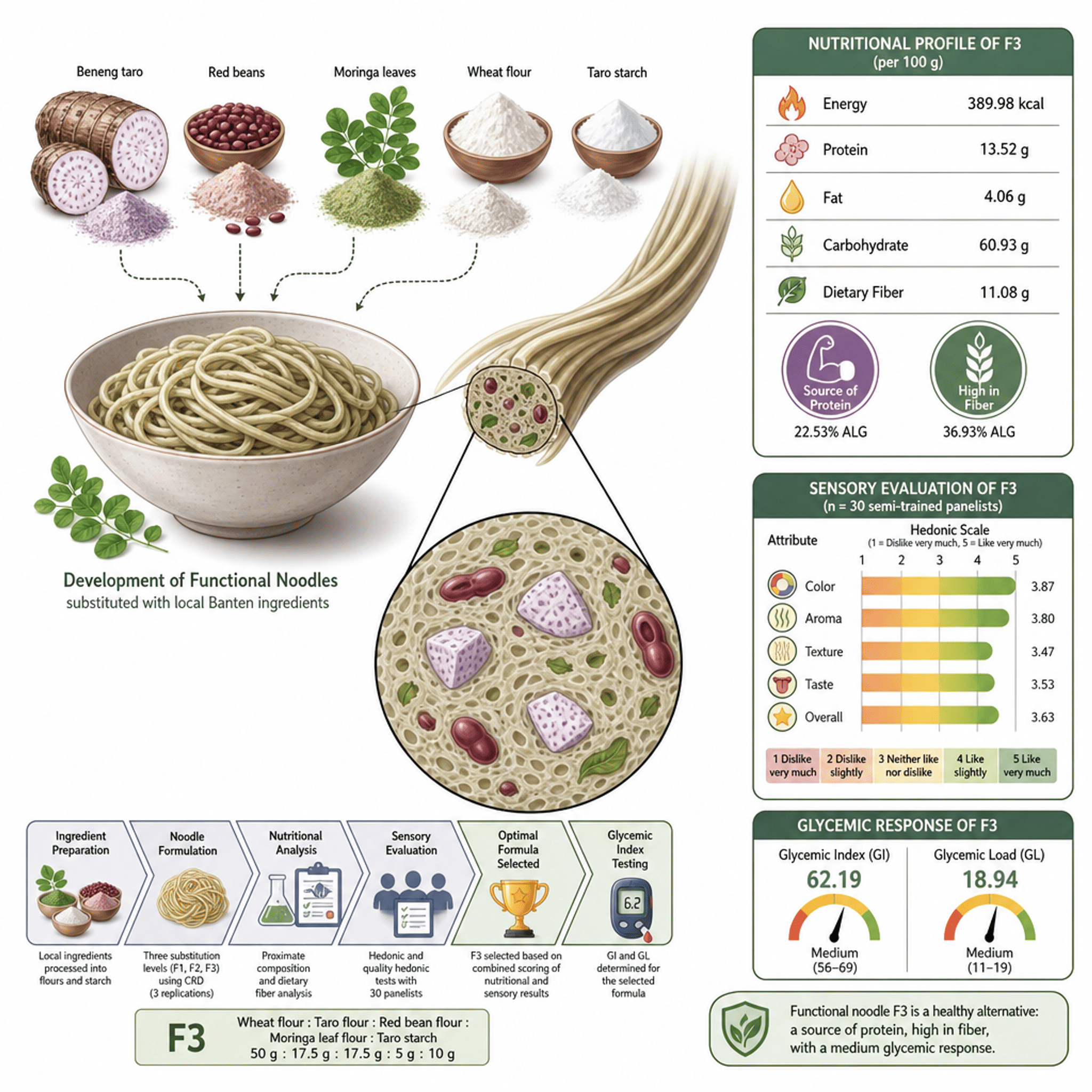
The increasing trend of consuming ultra-processed foods, such as instant noodles, necessitates the development of healthier and more functional food alternatives. This study aimed to develop functional dry noodles by partially substituting wheat flour with local Banten ingredients: Beneng taro, red beans, and Moringa leaves. The experiment utilized a completely randomized design (CRD) with three substitution treatment levels (F1, F2, F3) replicated three times. The nutritional quality of each formula was determined through proximate analysis and dietary fiber content. Sensory quality was assessed using hedonic and quality hedonic tests involving 30 semi-trained panelists. The selected formula was determined through a combined scoring of nutritional and sensory analysis results, followed by Glycemic Index (GI) testing. Based on the scoring, Formula F3 with a ratio of wheat flour : taro flour : red bean flour : moringa leaf flour : taro starch, namely F3 (50 g:17.5 g:17.5 g:5 g:10 g) was selected as the optimal formula, containing per 100g: 389.98 kcal energy, 13.52 g protein, 4.06 g fat, 60.93 g carbohydrate, and 11.08 g dietary fiber. Sensory evaluation showed that panelists liked the color and aroma parameters of F3, and slightly liked the texture, taste, and overall attributes. F3 meets the nutrition label claims as a "source of protein" (22.53% ALG - Acuan Label Gizi/Nutrition Label Reference) and "high in fiber" (36.93% ALG). Furthermore, F3 yielded a Glycemic Index of 62.19 (medium category) with a Glycemic Load of 18.94 (medium category). Thus, this functional dry noodle product has the potential to be a healthy food alternative, serving as a source of protein and high in fiber, while exhibiting a controlled glycemic response.
Downloads
References
Vitale M, Costabile G, Testa R, D’Abbronzo G, Nettore IC, Macchia PE, et al. Ultra-Processed Foods and Human Health: A Systematic Review and Meta-Analysis of Prospective Cohort Studies. Advances in Nutrition. 2024 Jan;15(1):100121. doi:10.1016/j.advnut.2023.09.009
Sitoayu L, Harna H, Sa’pang M, Ronitawati P, Puspita Sari D. Development of Sensory Quality and Shelf Life of Dried Noodles Using Catfish Flour and Mocaf: An Alternative Supplementary Feeding Prototype. J Health Nutr Res. 2026 Apr 1;5(1):362–72. doi:10.56303/jhnresearch.v5i1.1085
Hidayah F. Negara dengan Konsumsi Mi Instan Terbanyak. GoodStats [Internet]. 2023. Available from: https://data.goodstats.id/statistic/negara-dengan-konsumsi-mie-instan-terbanyak-yHFXf
Kusumasari S, Eris FR, Mulyati S, Pamela V. Karakterisasi sifat fisikokimia tepung talas beneng sebagai pangan khas Kabupaten Pandeglang. Jur Agroekotek. 2019;11(2):227–34.
Kusnandar F, Danniswara H, Sutriyono AE. Pengaruh Komposisi Kimia dan Sifat Reologi Tepung Terigu terhadap Mutu Roti Manis. Jurnal Mutu Pangan: Indonesian Journal of Food Quality. 2022.
Widiawati D, Giovani S, Liana SP. Formulasi dan karakterisasi mi kering substitusi tepung kacang merah tinggi serat. SST. 2022 Jun 2;7(2):80. doi:10.36722/sst.v7i2.1114
Simbolon M, Rimbawan R, Roosita K, Artika IM. Metabolite Profiling Differences of Single and Physical Mixture of Moringa Leaves (Moringa oleifera) and Red Galangal (Alpinia purpurata (Vieill) K. Schum). J Health Nutr Res. 2026 Apr 1;5(1):124–35. doi:10.56303/jhnresearch.v5i1.962
Hussin H, Gregory PJ. Enhancing the Nutritional Profile of Noodles With Bambara Groundnut (Vigna subterranea) and Moringa (Moringa oleifera): A Food System Approach.
Badan Standarisasi Nasional. SNI 8217:2015 Mi Kering. Jakarta: BSN; 2015.
Fadillah MF, Trisnawati D, Marlinda, Rostianti T, Mulyanah A. Implementasi Moriga Olifera Lamk Untuk Menentukan Sifat Kimia dan Organik Pada Pasta Makaroni Dari Tepung Talas Beneng. Jurnal Pertanian dan Industri Pangan. 2021;1(1).
Yuniarsih E, Adawiyah DR, Syamsir E. Karakter tepung komposit talas beneng dan daun kelor pada kukis. jmpi. 2019 Apr 30;6(1):46–53. doi:10.29244/jmpi.2019.6.46
Nurtiana W, Meindrawan B. Pelatihan pembuatan muffin talas beneng di Yayasan Ummatan Wasathon, Kecamatan Kasemen, Kota Serang sebagai pemanfaatan pangan lokal. Jurnal Sebatik. 2023;27(01).
Pitaloka IM, Ma’rifah B, Muhlishoh A. Analisis kandungan gizi dan organoleptik mie kering substitusi tepung kacang hijau dan tepung daun kelor untuk remaja gizi kurang. Journal Of Nutrition College. 2024;13(2):105–14.
Karim K, Suriyanti S, Ramlawati R. Edukasi standardisasi mutu produk bagi pelaku UMKM pada masa new normal covid 19 di Desa Paddinging, Kabupaten Takalar. Jurnal Abdi Insani. 2021;8(3):287–94.
Safitri OI, Komang Suwita I, Razak M. Substitusi tepung kacang merah (Phaseoulus vulgaris L.) dan tepung daun kelor (Moringa Oleifera L.) pada biskuit untuk penderita hiperkolesterolemia terhadap kadar zat gizi dan mutu organoleptik. Nutriture Journal. 2024;03(02):74–84.
Ajima A, Isnaini R, Suhartini W. Karakteristik fisikokimia mi kering dengan berbagai rasi ikan barakuda (Sphyraena jello) dan tepung terigu. Jurnal Teknologi Hasil Pertanian. 2024;17(2):133–46.
Elisa N. Pemanfaatan daun binahong dalam pembuatan mie untuk meningkatkan kandungan gizi [Skripsi]. [Makassar]: Universitas Negeri Makassar; 2022.
Ardianto ET, Subaktilah Y, Elisanti AD. Formulasi biskuit buah naga dan daun kelor untuk mencegah anemia. Jurnal Kesehatan. 2020;8(1):10–1.
Rosalina L, Suyanto A, Yusuf M. Kadar protein, elastisitas, dan mutu hedonik mie basah dengan substitusi tepung ganyong. Jurnal Pangan dan Gizi. 2018;8(1):1–10.
Wulandari P, Putri NA. Pengaruh Substitusi Tepung Terigu Dengan Tepung Talas Beneng dan Mocaf Terhadap Karakteristik Fisikokimia Mi Kering. Jurnal Teknologi Pangan. 2020;16(1):50–6.
Badan Pengawas Obat dan Makanan. Peraturan Kepala Badan Pengawas Obat dan Makanan Republik Indonesia Nomor 1 Tahun 2022 Tentang Pengawasan Klaim Pada Label dan Iklan Pangan Olahan. Jakarta: Jakarta: BPOM RI; 2022.
Marbun TSG, Susyani S, Podojoyo P. Pengaruh Pemberian Food Bar Tinggi Serat Terhadap Kadar Glukosa Darah Pasien Diabetes Melitus Tipe 2. Journal of Nutrition College. 2023;12(2):105–12.
Probosari E. Pengaruh protein diet terhadap indeks glikemik. JNH (Journal of Nutrition and Health). 2019;7(1):33–9.
Situmorang PM. Karakteristik kimia, fisik dan fungsional tepung talas beneng (Xanthosoma undipes K. koch) modifikasi menggunakan metode autoclaving-cooling) [Skripsi]. [Serang]: Universitas Sultan Ageng Tirtayasa; 2024.
Published
How to Cite
Issue
Section
Copyright (c) 2026 Rakhmi Setyani Sartika, Annisa Nuradhiani, Rahmawati Rahmawati, Sifa Nurani, Fachruddin Perdana, Ratu Diah Koerniawati

This work is licensed under a Creative Commons Attribution-NonCommercial-ShareAlike 4.0 International License.
Most read articles by the same author(s)
- Rahmah Nur Hidayah, Annisa Nuradhiani, Bohari Bohari, The Relationship Between Dietary Patterns and the Incidence of Overweight among Adolescents , Journal of Health and Nutrition Research: Vol. 3 No. 2 (2024)
- Ade Sulistiyani, Rakhmi Setyani Sartika, The Effect of Powder Form and Sample Weight on the Acceptability of Yellow Melinjo (Gnetum gnemon L.) Peel Tea , Journal of Health and Nutrition Research: Vol. 3 No. 2 (2024)