Relationship Between Behavioral and Emotional Problems Using the Strengths and Difficulties Questionnaire (SDQ) and Academic and Sports Achievement Index Among Students at State Sports-Talented High School in Aceh
Keywords:
Academic Achievement, Adolescents, Behavioral Problems, Emotional Problems, Strengths, Difficulties QuestionnaireAbstract
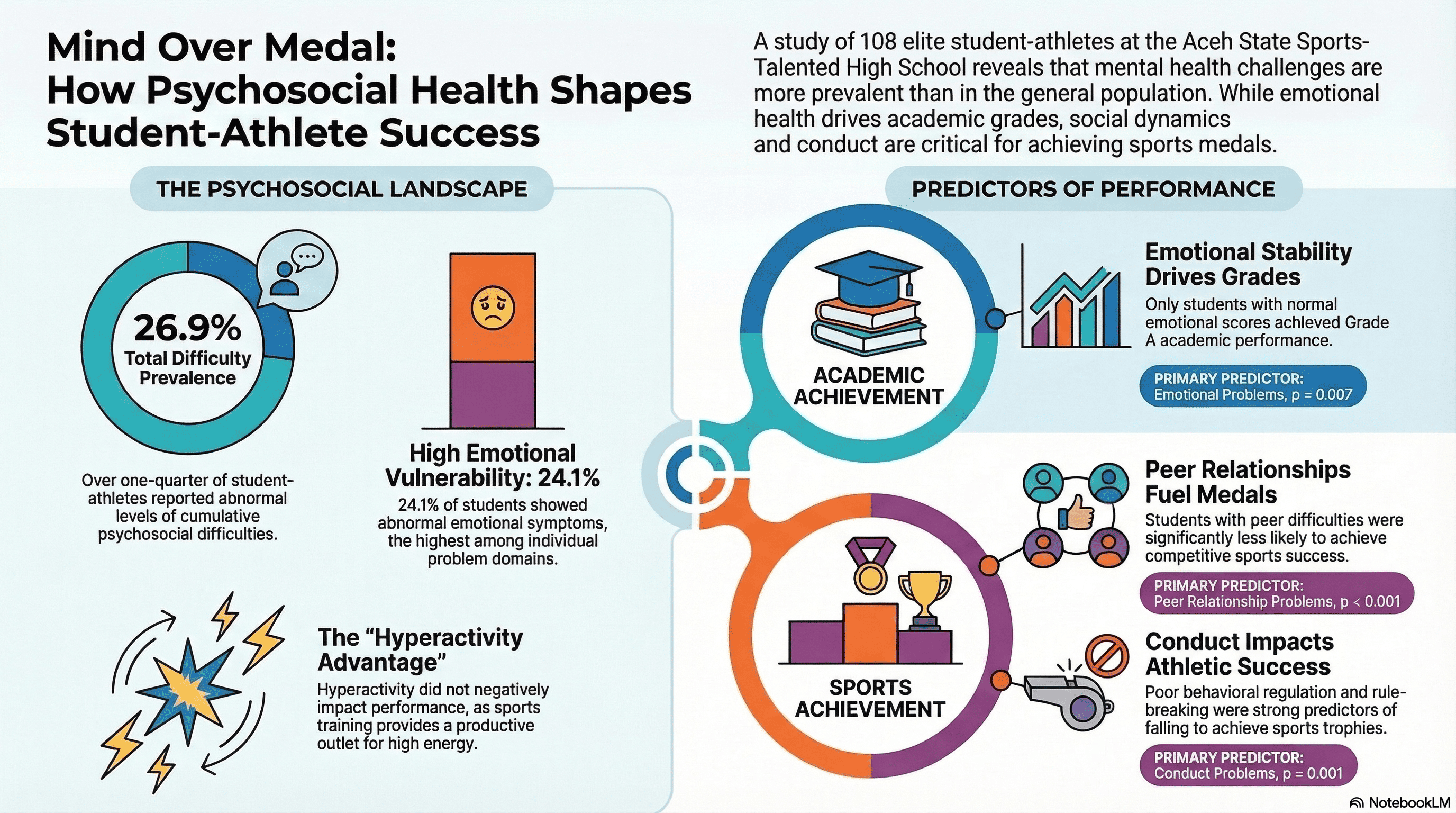
Adolescence represents a vulnerable developmental period characterized by rapid behavioral and emotional changes that significantly influence academic achievement and sports performance. The Strengths and Difficulties Questionnaire (SDQ) is a standardized screening instrument widely utilized to assess emotional symptoms, conduct problems, hyperactivity, peer relationship difficulties, and prosocial behavior in adolescents. This study aimed to investigate the relationship between behavioral and emotional problems measured by SDQ and academic and sports achievement indices among students at State Sports-Talented High School in Aceh. An observational analytical study with cross-sectional design was conducted involving 108 students aged 15-18 years. Data collection utilized SDQ self-report questionnaire, academic records, and sports achievement documentation. Statistical analysis employed Mann-Whitney test for academic achievement and Fisher's exact test for sports achievement with 95% confidence level. Total difficulties score demonstrated significant associations with academic achievement (p=0.035) and sports achievement (p=0.010). Emotional problems subscale showed significant correlations with both academic (p=0.007) and sports achievement (p=0.038). Conduct problems and peer relationship difficulties exhibited highly significant associations with sports achievement (p=0.001 and p<0.001 respectively). The findings indicated that 26.9% of participants reported abnormal total difficulties scores, suggesting a need for intervention. Behavioral and emotional problems significantly correlate with academic achievement and sports performance among talented sports students. These findings emphasize the importance of routine mental health screening using SDQ in sports-specialized schools to enable early identification and timely intervention
Downloads
References
Hinton R. PMNCH [Internet]. [cited 2026 Mar 21]. Adolescent mental health: Time for action - PMNCH Knowledge Summary #36. Available from: https://pmnch.who.int/resources/publications/m/item/pmnch-knowledge-summary-36-adolescent-mental-health-time-for-action
WHO. The adolescent health indicators recommended by the Global Action for Measurement of Adolescent health [Internet]. 2024 [cited 2026 Mar 21]. Available from: https://www.who.int/publications/i/item/9789240092198
WHO. Helping Adolescents Thrive Toolkit [Internet]. 2021 [cited 2026 Mar 21]. Available from: https://www.who.int/publications/i/item/9789240025554
Tian J, Yan N, Hu X, Tian S, Wang Y, Mackay LE, et al. Global burden of mental disorders among adolescents and young adults, 1990–2021: a systematic analysis of the Global Burden of Diseases Study 2021. Gen Psychiatr. 2025 Dec 23;38(6):e102278. doi:10.1136/gpsych-2025-102278 PubMed PMID: 41451038; PubMed Central PMCID: PMC12730781.
Kemenkes RI. Riset Kesehatan Dasar (Riskesdas). Jakarta: Badan Penelitian dan Pengembangan Kesehatan Kementerian Kesehatan RI; 2018.
DTO Kemenkes RI. Reflecting Mental Health Situation in Indonesia with SATUSEHAT. Medium [Internet]. 2024 Oct 10 [cited 2026 Mar 21]. Available from: https://medium.com/@dtokemkes/reflecting-mental-health-situation-in-indonesia-with-satusehat-e76bd1e0c8ce
WHO. Global health workforce, finances remain low for mental health [Internet]. 2015 [cited 2026 Mar 21]. Available from: https://www.who.int/news/item/14-07-2015-global-health-workforce-finances-remain-low-for-mental-health
Nakigudde J, Bauta B, Wolf S, Huang KY. Screening Child Social-emotional and Behavioral Functioning in Low-Income African Country Contexts. Jacobs J Psychiatry Behav Sci. 2016 Dec;2(2):016. PubMed PMID: 30148211; PubMed Central PMCID: PMC6107071.
Richter J, Sagatun Å, Heyerdahl S, Oppedal B, Røysamb E. The Strengths and Difficulties Questionnaire (SDQ) – Self-Report. An analysis of its structure in a multiethnic urban adolescent sample. Journal of Child Psychology and Psychiatry. 2011;52(9):1002–11. doi:10.1111/j.1469-7610.2011.02372.x
Sastroasmoro S. Dasar-dasar metodologi penelitian klinis, edisi 5 [Internet]. Jakarta: Sagung Seto; 2014 [cited 2026 Mar 21]. Available from: //elibrary.poltektedc.ac.id/index.php?p=show_detail&id=3867
Durlak JA, Weissberg RP, Dymnicki AB, Taylor RD, Schellinger KB. The impact of enhancing students’ social and emotional learning: a meta-analysis of school-based universal interventions. Child Dev. 2011;82(1):405–32. doi:10.1111/j.1467-8624.2010.01564.x PubMed PMID: 21291449.
Fradana YA, Sandayanti V, Harkina P. Pengaruh Emotional Intelligence dan Prestasi Akademik Terhadap Kecenderungan Conduct Disorder Pada Remaja. Jurnal Psikologi Malahayati. 2024 Sep 14;6(2). doi:10.33024/jpm.v6i2.10135
Mammadov S. Big Five personality traits and academic performance: A meta-analysis. J Pers. 2022 Apr;90(2):222–55. doi:10.1111/jopy.12663 PubMed PMID: 34265097.
Pashchenko O, Medvedovska T, Terkhanova O, Baidak A, Danyliuk Y. The impact of emotional intelligence on academic achievement. PrOsvita. 2024 Oct 20;(2):57–70. doi:10.36074/PrOsvita.issue2.004
Afriani G, Zaman N. Developing Emotional Intelligence as a Key to Academic Success among High School Students. Global Education Journal. 2025 Oct 30;3(3):621–31. doi:10.59525/gej.1197
Li H. Impact of collaborative learning on student engagement in college English programs: mediating effect of peer support and moderating role of group size. Front Psychol. 2025 Apr 9;16:1525192. doi:10.3389/fpsyg.2025.1525192 PubMed PMID: 40271361; PubMed Central PMCID: PMC12015942.
Abdullah MZ, Jamal A, Rashid MAA, Lipa M, Yao G. Exploring the Causes of Psychological Distress among University Students. IJRISS. 2025;IX(I):2424–37. doi:10.47772/IJRISS.2025.9010194
Martinot D, Sicard A, Gul B, Yakimova S, Taillandier-Schmitt A, Maintenant C. Peers and teachers as the best source of social support for school engagement for both advantaged and priority education area students. Front Psychol. 2022 Sep 23;13:958286. doi:10.3389/fpsyg.2022.958286 PubMed PMID: 36211851; PubMed Central PMCID: PMC9537635.
Trigueros R, Sanchez-Sanchez E, Mercader I, Aguilar-Parra JM, López-Liria R, Morales-Gázquez MJ, et al. Relationship between Emotional Intelligence, Social Skills and Peer Harassment. A Study with High School Students. Int J Environ Res Public Health. 2020 Jun;17(12):4208. doi:10.3390/ijerph17124208 PubMed PMID: 32545626; PubMed Central PMCID: PMC7345273.
Keilow M, Sievertsen HH, Niclasen J, Obel C. The Strengths and Difficulties Questionnaire and standardized academic tests: Reliability across respondent type and age. PLoS One. 2019 Jul 25;14(7):e0220193. doi:10.1371/journal.pone.0220193 PubMed PMID: 31344079; PubMed Central PMCID: PMC6657876.
Pan F, Sui W. Research on coach-athlete relationship and team performance based on 3Cs theory: the chain mediating role of emotional intelligence and athletic engagement. Front Psychol. 2025 Jun 18;16:1587900. doi:10.3389/fpsyg.2025.1587900 PubMed PMID: 40606863; PubMed Central PMCID: PMC12213683.
Sánchez-Álvarez N, Berrios Martos MP, Extremera N. A Meta-Analysis of the Relationship Between Emotional Intelligence and Academic Performance in Secondary Education: A Multi-Stream Comparison. Front Psychol. 2020 Jul 21;11. doi:10.3389/fpsyg.2020.01517
Español-Martín G, Pagerols M, Prat R, Rivas C, Ramos-Quiroga JA, Casas M, et al. The impact of attention-deficit/hyperactivity disorder and specific learning disorders on academic performance in Spanish children from a low-middle- and a high-income population. Front Psychiatry. 2023 Apr 12;14:1136994. doi:10.3389/fpsyt.2023.1136994 PubMed PMID: 37124266; PubMed Central PMCID: PMC10130398.
Musullulu H. Evaluating attention deficit and hyperactivity disorder (ADHD): a review of current methods and issues. Front Psychol. 2025 Feb 24;16. doi:10.3389/fpsyg.2025.1466088
Li L, Zhang L. The Relationship between Physical Activity and Academic Achievement in Multimodal Environment Using Computational Analysis. Comput Intell Neurosci. 2022;2022:9418004. doi:10.1155/2022/9418004 PubMed PMID: 36082350; PubMed Central PMCID: PMC9448553.
Published
How to Cite
Issue
Section
Copyright (c) 2026 Mestika Kuine, Herlina Dimiati, T.M. Thaib, Rusdi Andid, Sulaiman Yusuf, Eka Yunita Amna

This work is licensed under a Creative Commons Attribution-NonCommercial-ShareAlike 4.0 International License.