The Association Between Chronotype and Physical Activity with Type of Obesity on Healthcare Students in Samarinda
Keywords:
Chronotype, Physical Activity, Obesity, Healthcare, Students, Type II ObesityAbstract
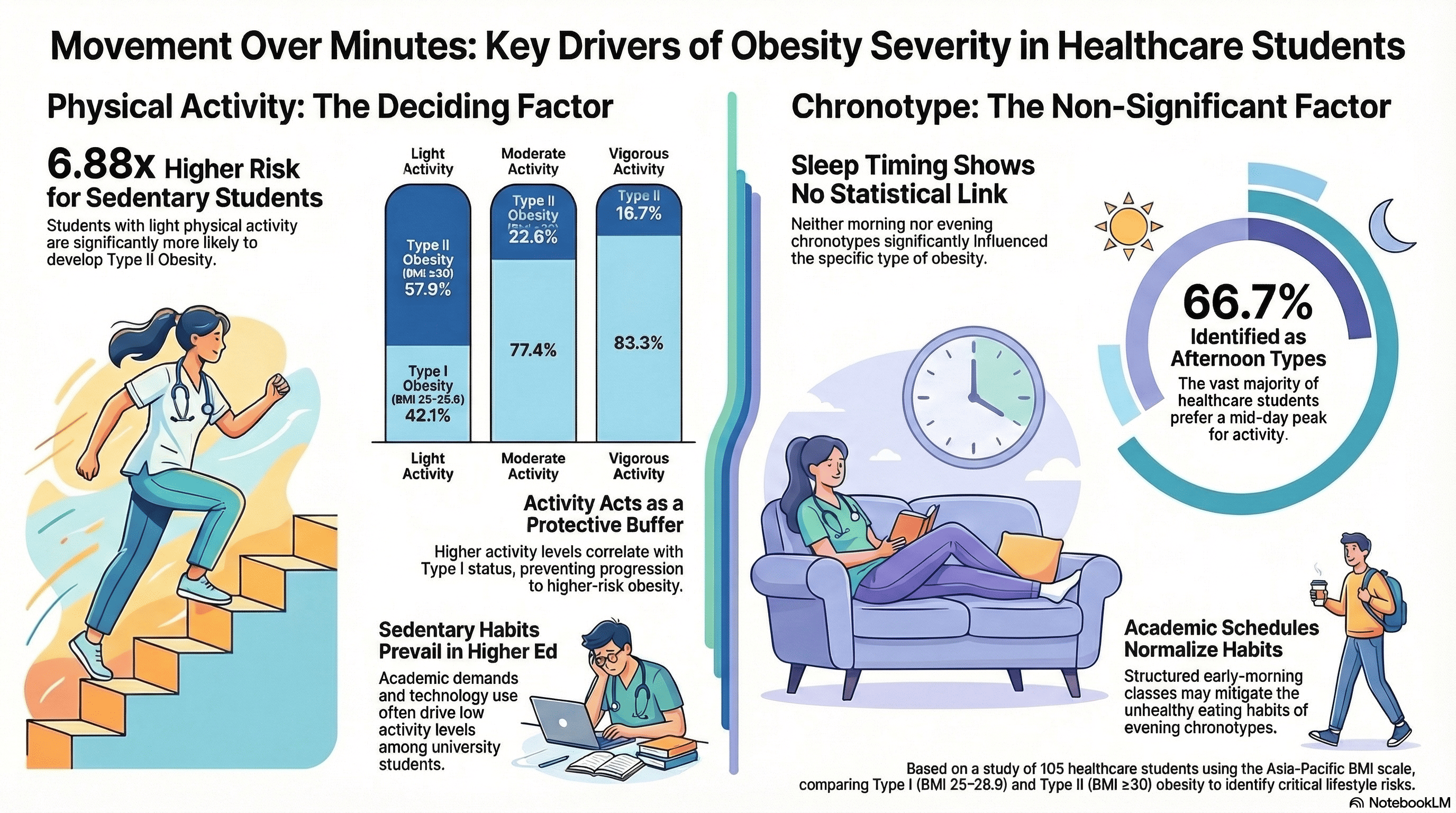
Obesity is a major global health problem, including in Indonesia, and is linked to increased risks of degenerative diseases and reduced quality of life. Based on the Asia-Pacific BMI classification from World Health Organization, Type I Obesity is defined as a BMI of 25–29.9 kg/m², while Type II Obesity (≥30 kg/m²) poses higher risks of degenerative diseases. In Indonesia, adult obesity prevalence has risen from 14.8% in 2013 to 23.4% in 2023, with East Kalimantan (29%) and Samarinda (25.9%) exceeding national averages. University students are a vulnerable group due to lifestyle transitions involving irregular sleep, dietary changes, and low physical activity. Among them, health sciences students hold a critical role in obesity prevention, yet their credibility may be challenged if they themselves engage in unhealthy behaviors. This study aims to determine the correlation between chronotype and physical activity with the type of obesity on healthcare students in Samarinda city. The research method used is quantitative with a cross-sectional study design. The study population consisted of 7,728 students from six universities with healthcare faculties in Samarinda City, from which a sample of 105 respondents was selected using a purposive sampling technique. Data collection was conducted using MEQ-SA and IPAQ-SF questionnaires. Data were analyzed using the logistic regression test. This study found a statistically significant relationship between physical activity and obesity type among healthcare students in Samarinda (p < 0.05). In contrast, no significant associations were observed between chronotype and obesity type (p > 0.05) on healthcare students in Samarinda.
Downloads
References
WHO. Obesity: Preventing and managing the global epidemic. Report of a WHO consultation. Geneva; 2000.
Ella Y, Noor I, Sugiarto E, Fatimah AS. The Description of Obesity Among Housewifes in The World. Jurnal Gizi Kesehatan. 2022;14(1):34–42.
Lecube A. Impacto De La Obesidad Y La Diabetes en La Salud y en La Enfermedad Cardiovascular. Aten Primaria. 2024;56(12):103045.
Kemenkes RI. Riset Kesehatan Dasar (Riskesdas) 2013. Jakarta: adan Penelitian dan Pengembangan Kesehatan, Kementerian Kesehatan RI; 2013.
Koerniawati RD, Siregar MH. Hubungan Status Gizi dengan Nilai Sumatif Mahasiswa Program Studi Gizi Universitas Sultan Ageng Tirtayasa. Ghidza: Jurnal Gizi dan Kesehatan. 2023 Jun 26;7(1):99–105.
Gormley N, Melby V. Nursing students’ attitudes towards obese people, knowledge of obesity risk, and self-disclosure of own health behaviours: An exploratory survey. Nurse Educ Today [Internet]. 2020;84(June 2019):104232. Available from: https://doi.org/10.1016/j.nedt.2019.104232
Rahadian FA, Wahyuningsih U, Simanungkalit SF. Factors Associated with the Incidence of Obesity among College Students at Fakultas Ilmu Kesehatan Universitas Pembangunan Nasional “Veteran” Jakarta. Amerta Nutrition. 2024;8(3SP):24–34.
Horne JA, Ostberg O. A Self-assesment Questionnaire to Determine Morningness-Eveningness in Human Circadian Rhythms. Int J Chronobiol. 1976;4(2):97–110.
Verde L, Barrea L, Docimo A, Savastano S, Colao A, Muscogiuri G. Chronotype as a predictor of weight loss and body composition improvements in women with overweight or obesity undergoing a very low-calorie ketogenic diet (VLCKD). Clinical Nutrition. 2023 Jul 1;42(7):1106–14.
Sadeghzadeh H, Haghgoo M, Rabiei S. Association of Individuals’ Chronotypes With Obesity and Body Composition in Tehrani Adults in 2020. Chronobiology in Medicine. 2022;4(1):35–41.
Bloom MJ, Jost SR, Stuart A, Donald I, Mankin NV, Mast ZW, et al. The influence of chronotype on the body mass index of U . S . college students. 2022;15(Special 2):314–7.
Avrialdo M, Elon Y. Hubungan Aktivitas Fisik Mahasiswa Overweight dan Obesitas Menurut Indeks Massa Tubuh. Nutrix Journal. 2023;7(1):50–8.
Farradika Y, Umniyatun Y, Nurmansyah MI, Jannah M. Perilaku Aktivitas Fisik dan Determinannya pada Mahasiswa Fakultas Ilmu-Ilmu Kesehatan Universitas Muhammadiyah Prof. Dr. Hamka. ARKESMAS. 2019;4(1):134–42.
Kristiana T, Hermawan D, Febriani U, Farich A. Hubungan Antara Pola Tidur Dan Kebiasaan Makan Junk Food Dengan Kejadian Obesitas Pada Mahasiswa Universitas Malahayati Tahun 2019. Human Care Journal. 2020;5(3):750.
Alfarisi R, Detty AU, Firdaus AA. Hubungan Pola Aktivitas dan Kebiasaan Olahraga dengan Kejadian Obesitas. Jurnal Ilmu Kedokteran dan Kesehatan. 2022;9(2):738–45.
Kemenkes RI. Survei Kesehatan Indonesia (SKI) 2023 dalam Angka. Jakarta: Badan Kebijakan Pembangunan Kesehatan.; 2023.
Davies JC, Choo-Kang C, Soepnel L, Geffen H, Africa C, Mtintsilana A, et al. Objectively measured moderate-to-vigorous physical activity does not attenuate prospective weight gain among african-origin adults spanning the epidemiological transition. Sci Rep. 2025;15(1):1–11.
World Obesity Federation. World Obesity Atlas 2024 [Internet]. London (UK): World Obesity Federation; 2024 [cited 2025 Oct 20]. Available from: https://knowledge-action-portal.com/en/content/world-obesity-atlas-2024.
WHO. Obesity and overweight [Internet]. Geneva (CH): World Health Organization; 2024 [cited 2025 Oct 20]. Available from: https://www.who.int/news-room/fact-sheets/detail/obesity-and-overweight.
Saraswati SK, Rahmaningrum FD, Pahsya MNZ, Paramitha N, Wulansari A, Ristantya AR, et al. Literature Review : Faktor Risiko Penyebab Obesitas. MEDIA KESEHATAN MASYARAKAT INDONESIA. 2021 Feb 1;20(1):70–4.
Reutrakul S, Knutson KL. Chronotype and meal timing: Clinical and metabolic implications. Clin Sci (Lond). 2021;135(10):1313-34.
Al-Mohaimeed A, Sharaf F, Rahman S, Al-Mutairi A, Al-Mulhim A. Relationship between chronotype, social jetlag, and dietary patterns among university students in Saudi Arabia. Chronobiol Int. 2020;37(9-10):1326-38.
Mota MC, Silva CM, Balieiro LCT, Gonçalves BF, Fahmy WM, Crispim CA. Association between chronotype, food intake, and nutritional status in adolescents. Chronobiol Int. 2019;36(4):506-15.
Xiao Q, Garaulet M, Scheer FAJL. Meal timing and obesity: Epidemiologic and experimental evidence. Physiol Behav. 2019;199:188-96.
Published
How to Cite
Issue
Section
Copyright (c) 2026 Risda Septiana, Anik Lestari, Sapja Anantanyu

This work is licensed under a Creative Commons Attribution-NonCommercial-ShareAlike 4.0 International License.