Analysis of Human Resources, Infrastructure, Budget, and Procedures on the Implementation Process of the PHBS Program in South Kalimantan
Keywords:
Healthy, Input, Living Behavior, Process, Regulations ExistAbstract
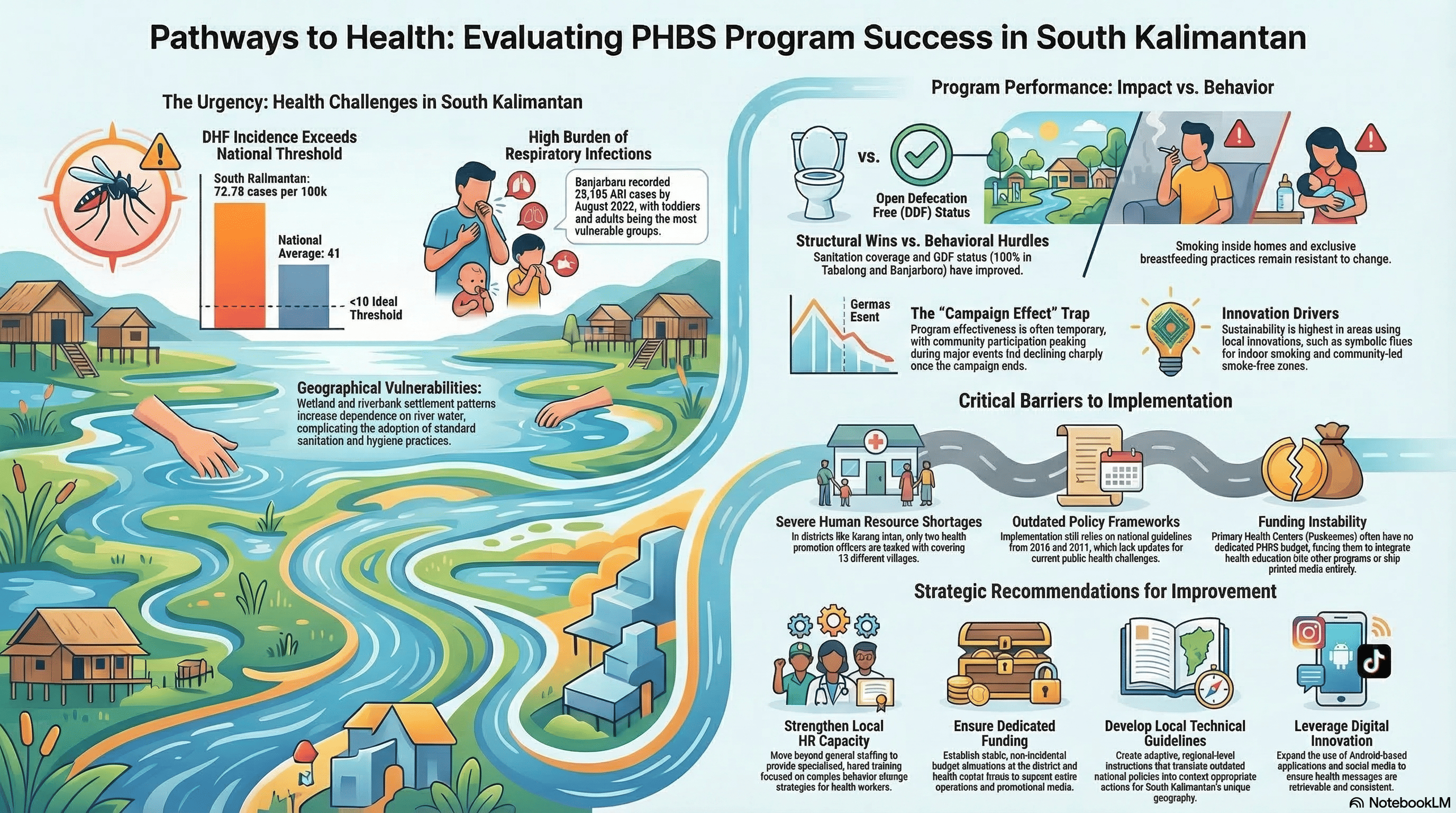
The Clean and Healthy Living Behavior Program (PHBS) is a strategic initiative of the Indonesian government aimed at improving the population’s health status through promotive and preventive approaches. In South Kalimantan, its implementation still faces tangible challenges, such as the high incidence of acute respiratory infections (ARI) and dengue hemorrhagic fever (DHF), as well as the low coverage of household PHBS practices. This study aims to evaluate the supporting and inhibiting factors affecting the implementation of PHBS in the region. The study employed a qualitative descriptive method with a purposive sampling technique. Eight informants were involved, consisting of officials from the Provincial Health Office, PHBS coordinators at the district/city level, health center staff from areas with the highest and lowest coverage, and community representatives. Data were collected through in-depth interviews, observation, and documentation, and then analyzed thematically. The results show that PHBS implementation is influenced by the interaction of supporting and inhibiting factors. Supporting factors include the availability of regulations, the commitment of health workers, and community participation. This condition results in the program’s implementation not yet being optimal, despite the existence of a policy framework. Therefore, improvements are needed in human resource capacity based on local needs, more stable funding mechanisms, and updated technical guidelines to ensure that PHBS implementation becomes more adaptive and effective in supporting community health development
Downloads
References
Juraidin, dkk. Perilaku Hidup Bersih dan Sehat (PHBS) Pada Masyarakat di Kelurahan Kolo Untuk Mendukung Kota Bima Bersih, Indah, Sehat dan Asri (BISA). Journal of Innovative and Creativity. 2025; 5(3): 28418-422.
Rahmat NN, dkk. Analisis Faktor Jenis Kelamin dan Perilaku Hidup Bersih Sehat (PHBS) Terhadap Kejadian Ispa pada Kalangan Santri. Journal of Nursing and Midwifery Sciences. 2025; 4(1): 67-78.
Pratimi AR, Nugraheni N. Pengenalan Kebiasaan Cuci Tangan Dengan Sabun Sebagai Inisiatif Kesehatan di Sekolah Dasar. Jurnal Penelitian Ilmu-Ilmu Sosial. 2024; 1(10): 25-33.
Laporan Provinsi Kalimantan Selatan Tahun 2025. Dinas Kesehatan Provinsi Kalimantan Selatan; 2025.
Statistik Kesehatan Provinsi Kalimantan Selatan 2024. Banjarmasin: BPS Provinsi Kalimantan Selatan; 2024.
Arislan. Evaluasi Program Perilaku Hidup Bersih dan Sehat (PHBS) rumah tangga di Wilayah Kerja Puskesmas Pematang Kandis Tahun 2017. Jurnal Kesehatan dan Sains Terapan STIKes Merangin. 2018; 4(1): 59-75.
Listiawaty R. 2020. Analisis pelaksanaan program perilaku hidup bersih dan sehat pada tatanan rumah tangga di Wilayah Kerja Puskesmas X. Journal of Health Science and Physiotherapy; 2(2): 134-142.
Luthfia Y. 2021. Evaluasi pelaksanaan program pembinaan Perilaku Hidup Bersih dan Sehat (PHBS) tatanan sekolah pada siswa sekolah dasar Kabupaten lampung Timur Tahun 2020. Jurnal Ilmu Kesehatan Masyarakat Indonesia; 2(1):
Noviana N. Studi komparatif upaya peningkatan hidup bersih dan sehat di Kalimantan Selatan dan Pemalang. BALITBANGDA KALSEL. 2014.
Ainy A, Pertiwi RD. Booklet evaluasi program kesehatan. Fakultas Kesehatan Masyarakat Universitas Sriwijaya. Palembang. 2021.
Arifin S, Rahman F, Pujianti N, Laily N, Wulandari A, dkk. Ilmu dan Seni Administrasi Kebijakan Kesehatan. Yogyakarta: CV Mine. 2020.
Notoatmodjo, S. (2018). Promosi Kesehatan dan Perilaku Kesehatan. Jakarta: Rineka Cipta
Rofiq A. Partisipasi masyarakat dalam keberhasilan pengembangan program posyandu lansia di Puskesmas Jagir Surabaya. Jurnal Kebijakan dan Manajemen Publik. 2018; 6(2): 1-14.
Adiputra MS dkk. Metodelogi Penelitian Kesehatan. Denpasar: Yayasan Kita Menulis. 2021.
Sutrisno, Sinanto RA. 2022. Efektivitas penggunaan lembar bolak balik sebagai media promosi kesehatan: tinjauan sistematis. Jurnal Kesehatan Terpadu (Integrated Health Journal); 13(1): 1-11.
Suyasa IM, Sedana IN. 2020. Mempertahankan eksistensi media cetak di tengah gempuran media online. Jurnal Komunikasi Budaya; 1(1): 56-64.
Salma TA, Purnomo I, Irawan T. 2024. Analisis pelaksanaan program PHBS rumah tangga di Puskesmas Paduraksa Kabupaten Pemalang. Jurnal Kesmas Prima Indonesia; 8(1): 113-117.
Menteri Kesehatan Republik Indonesia. 2011. Peraturan Menteri Kesehatan Republik Indonesia Nomor 2269/MENKES/PER/XI/2011 Tentang Pedoman Pembinaan Perilaku Hidup Bersih dan Sehat (PHBS). Jakarta: Menteri Kesehatan.
Utomo R, dkk. 2023. Menuju monitoring dan evaluasi partisipatif program pembinaan UMKM berbasis kewilayahan yang terpadu. Syntax Literature: Jurnal Ilmiah Indonesia; 8(6): 4442-4452.
Jamko MN, Djanah SN, Handayani L. 2024. Analisis strategi promosi kesehatan terhadap implementasi Perilaku Hidup Bersih dan Sehat (PHBS) di Desa Dullah Laut Kota Tuai Provinsi Maluku. Journal of Multidisciplinary Research and Development; 6(6): 2363-2385.
Sipahutar SW, dkk. 2025. Peningkatan kesadaran dan partisipasi masyarakat melalui program rutin sabtu bersih di Kelurahan Tanjung Sari. Jurnal Pemberdayaan Masyarakat: Jurnal Aksi Sosial; 2(2): 49-63.
Published
How to Cite
Issue
Section
Copyright (c) 2026 Nur Laily, Andini Octaviana Putri, Anggun Wulandari, Fauzie Rahman, Lia Anggraini, Nidaul Jannah, Lisa Salsa Billa, Siti Maimunah, Sri Wulandari, Nuralpisah Nuralpisah, Fitrya Hayati Alkamaliah

This work is licensed under a Creative Commons Attribution-NonCommercial-ShareAlike 4.0 International License.
Most read articles by the same author(s)
- Fauzie Rahman, Anggun Wulandari, Nur Laily, Muhammad Ali Faisal, Rizqi Rifani, Intan Yustikasari, Andini Octaviana Putri, Lia Anggraini, Muhamad Azmiyannoor, Muhammad Zainal Khadafi, Ahmad Navijay, The Relationship Between Immunization, Health Insurance, Family Support, and Health Workers with Stunting Incidence , Journal of Health and Nutrition Research: Vol. 5 No. 1 (2026)
- Anggun Wulandari, Neka Erlyani , Fauzie Rahman, Nur Laily, Andini Octaviana Putri, Lia Anggraini, Siti Maimunah, Sri Wulandari, Nuralpisah Nuralpisah, Fitrya Hayati Alkamaliah, Evaluation of Integrated Primary Care (ILP) Implementation: A Qualitative Assessment of Input and Process Dimensions in Banjarbaru City Health Centers , Journal of Health and Nutrition Research: Vol. 5 No. 2 (2026)