Association of Contribution and Adequacy Levels of Energy and Nutrients from Supplementary Foods with Perceived Breast Milk Sufficiency among Lactating Mothers in a Stunting Prevention Program
Keywords:
Lactating Mothers, Supplementary Foods, Perceived Breast Milk Sufficiency, GAS KIPAS Stunting ProgramAbstract
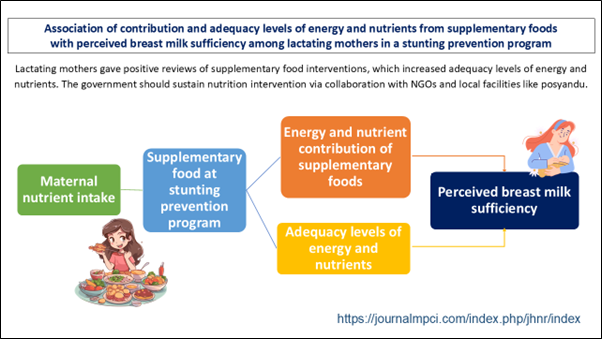
Maternal nutrition intake, as well as nutritional status, influence breast milk production and nutrient content. To reduce stunting, the GAS KIPAS Stunting Program (Gerakan Anak Sehat – Kolaborasi Inklusif Pengusaha Indonesia Atasi Stunting) provided high-nutrient supplementary foods for lactating mothers. This program was implemented in several priority locations. This study analyzed the associations between contribution and the adequacy levels of energy and nutrients from supplementary foods with perceived breast milk sufficiency. Secondary data were obtained from the 2023 GAS KIPAS Stunting Program. This study used a one-group pretest–posttest pre-experimental design without a control group. Nutritional intake of supplementary foods was obtained using the Comstock method. Statistical analyses included the Wilcoxon signed-rank test and Spearman's rank correlation. The results showed no significant association between the energy and nutrient contribution of supplementary foods and perceived breast milk sufficiency. However, calcium adequacy level showed a significant positive correlation (r=0.38; p=0.039). During lactation, mothers require increased micronutrient intake to support maternal health and infant development. Conclusion: Providing supplementary foods for lactating mothers does not directly affect mothers’ perceptions. These findings suggest that a larger sample size, measurement of milk production volume, and a 24-hour food recall may be needed to optimize intervention outcomes in supporting exclusive breastfeeding as a stunting prevention
Downloads
References
Setyorini F, Nasution Z, Fitriani AD. Multifaktor penyebab gizi kurang pada balita. J Kesehat Amanah. 2025;9(1):247–54.
[SSGI] Survei Status Gizi Indonesia. Survei status gizi Indonesia (SSGI) 2024 dalam angka. Jakarta: Kemenkes RI; 2024.
[Bappenas] Badan Perencanaan Pembangunan Nasional. Rencana Pembangunan Jangka Menengah Nasional 2020-2024. 2024.
[BPS] Badan Pusat Statistik. Laporan Pelaksanaan Integrasi Susenas Maret 2019 dan SSGBI Tahun 2019. Jakarta; 2019.
[SSGI] Survei Status Gizi Indonesia. Buku Saku Hasil Survei Status Gizi Indonesia (SSGI) 2022. Jakarta: Kemenkes RI; 2022.
Melinda, Anjarwati. Hubungan pemberian asi eksklusif dengan kenaikan berat badan bayi usia 0-6 bulan. In: Prosiding Seminar Nasional Penelitian dan Pengabdian Kepada Masyarakat LPPM Universitas ‘Aisyiyah Yogyakarta. 2024. p. 1485–92.
Perdana SM, Reskiaddin LO, Ningsih VR. Edukasi gizi keberhasilan menyusui pada masa 1000 hari pertama kehidupan. J Salam Sehat Masy. 2023;4(2):29–36.
Jannah SR. Kebutuhan nutrisi ibu menyusui: studi literatur review. SINERGi J Ris Ilm. 2024;1(7):511–21.
Prabasiwi A, Fikawati S, Syafiq A. ASI eksklusif dan persepsi ketidakcukupan ASI. Kesmas Natl Public Heal J. 2015;9(3):282.
Huang Y, Liu Y, Yu X-Y, Zeng T-Y. The rates and factors of perceived insufficient milk supply: A systematic review. Matern Child Nutr. 2021;
Novianto ED, Suprapto SI, Sujatmi MM br L. Implementasi program pemberian makanan tambahan dalam mendukung upaya pencegahan stunting. Kolaborasi J Pengabdi Masy. 2025;05(06):1036–42.
Sanz Ortiz J, Moreno Noguiera JA G de L y MA. Protein energy malnutrition (PEM) in cancer patients. 2008. 579–582 p.
[TKS] Tim Kipas Stunting. Buku Panduan Pengumpulan Data Kipas Stunting Tahun 2023. Bogor; 2023.
[Dinkes Kab. Bogor] Dinas Kesehatan Kabupaten Bogor. Profil Kesehatan Kabupaten Bogor 2019. Cibinong; 2020.
Kusumawati D, Rimbawan, Ekayanti I. Pengaruh program makan siang terhadap asupan makanan, status anemia dan perilaku gizi santri perempuan. Media Kesehat Masy Indones. 2019;15(1):7–17.
Redowati TE. Faktor-faktor yang berhubungan dengan kejadian ketuban pecah dini pada ibu bersalin di RSUD Jendral Ahmad Yani Kota Metro tahun 2016. J Kesehat “Akbid Wira Buana.” 2018;3(2).
Prameswari IGAAD, Paramurthi IAP, Astrawan IP. Hubungan antara indeks massa tubuh (IMT) dengan kualitas hidup dan Vo2 maks pada lanjut usia di Banjar Kemulan Desa Jagapati Kecamatan Abiansemal Badung. PREPOTIF J Kesehat Masy. 2022;6(3).
Handriani, Demmalewa JQ, Dhesa DB, M. HI, Ananda SH. Analisis tingkat kepuasan karyawan pada penyelenggaraan makanan jasa catering di kantin PT. Arga Morini Indah. J Gizi Ilm. 2023;10(3).
Meriana NPL, Ariati NN, Gumala NMY. Hubungan cita rasa makanan dengan daya terima makanan lunak pasien di Rumah Sakit Umum Shanti Graha Kabupaten Buleleng. J Ilmu Gizi J Nutr Sci. 2025;14(1):1–11.
Comstock EM, Symington LE. Distributions of serving sizes and plate waste in school lunches. Implications for measurement. J Am Diet Assoc [Internet]. 1982;81(4):413–22. Available from: https://pubmed.ncbi.nlm.nih.gov/7119320/
Budiraharti P, Harini R, Sudrajat S. Determinan tingkat konsumsi gizi makro rumah tangga di provinsi riau: kajian demografi dan spasial. Maj Geogr Indones. 2022;36(2):111.
Chahyanto BA, Roosita K. Kaitan asupan vitamin A dengan produksi air susu ibu (ASI) pada ibu nifas. J Gizi dan Pangan. 2014;8(2):83.
Kent JC, Ashton E, Meria C, Rea A, Murray K, Tracy D. Causes of perception of insufficient milk supply in Western Australian mothers. 2021;(September 2020):1–11.
Madiyanti DA, Tiara, Agustin A. Hubungan asupan makanan dengan kecukupan ASI pada ibu menyusui di wilayah kerja Upt Puskesmas Rejosari. J Ilm Kesehat. 2022;11(2):68–77.
Szyller H, Antosz K, Batko J, Mytych A, Wrzesniewska M, Braksator J, et al. Bioactive components of human milk and their impact on child’s health and development, literature review. Nutrients. 2024;16(1487).
Basrowi RW, Darus F, Sundjaya T, Arumndari R. Gizi ibu : fondasi menyusui dan masa depan anak. Amerta Nutr. 2025;9(4):735–46.
Saragih HS, Hutabarat J. Hubungan inisiasi menyusu dini (IMD) dengan produksi ASI pada ibu menyusui di Pustu Penen Wilayah Puskesmas Biru-Biru Kecamatan Biru- Biru tahun 2017. J Ilm Pannmed (Pharmacyst, Anal Nurse, Nutr Midwivery, Environ Dent Hyg. 2017;15(1):146–52.
Published
How to Cite
Issue
Section
Copyright (c) 2026 Hafika Yunisari Pradina, Katrin Roosita, Ahmad Sulaeman, Hardinsyah Hardinsyah, Stefanus Indrayana

This work is licensed under a Creative Commons Attribution-NonCommercial-ShareAlike 4.0 International License.
Most read articles by the same author(s)
- Arfah Husna, Hardinsyah Hardinsyah, Cesilia Meti Dwiriani, Lilik Kustiyah, The Association of Breakfast Consumption with Blood Glucose Levels and Short-Term Memory in Primary School Children: A Cross-Sectional Study , Journal of Health and Nutrition Research: Vol. 5 No. 1 (2026)
- Maya Klementina Dasmasela, Hardinsyah Hardinsyah, Mira Dewi, Ikeu Ekayanti, Indrayana Indrayana, Local Food-Based Supplementation and Behavior Change Communication Improve Mid-Upper Arm Circumference (MUAC) in Pregnant Women: A Community-Based Intervention Study , Journal of Health and Nutrition Research: Vol. 4 No. 3 (2025)
- Rina Oktasari, Hadi Riyadi, Ali Khomsan, Katrin Roosita, Yulin Lestari, Parity, Interpregnancy Interval, and Socioeconomic Status in Relation to Low Birth Weight: A Prospective Cohort in Yogyakarta , Journal of Health and Nutrition Research: Vol. 5 No. 1 (2026)
- Salwa Inayah Huda MA Parewasi, Hardinsyah Hardinsyah, Ikeu Ekayanti, Effect of nutritious snacks provision on breakfast adequacy and nutritional status of elementary school students , Journal of Health and Nutrition Research: Vol. 5 No. 1 (2026)
- Fathimah Fathimah, Katrin Roosita, Budi Setiawan, Zuraidah Nasution, Mohamad Rafi, Global Knowledge Structure and Research Fronts of Kaempferol in Antidiabetic Studies: A Bibliometric and Science Mapping Analysis , Journal of Health and Nutrition Research: Vol. 5 No. 2 (2026)