Environmental Assessment of Cadmium in Paddy Soils and Rice Grains Adjacent to Limboto Lake: Bioaccumulation and Non-Carcinogenic Health Risks
Keywords:
Bioaccumulation, Cadmium, Non-Carcinogenic Health Risks, Paddy Soil, Rice GrainsAbstract
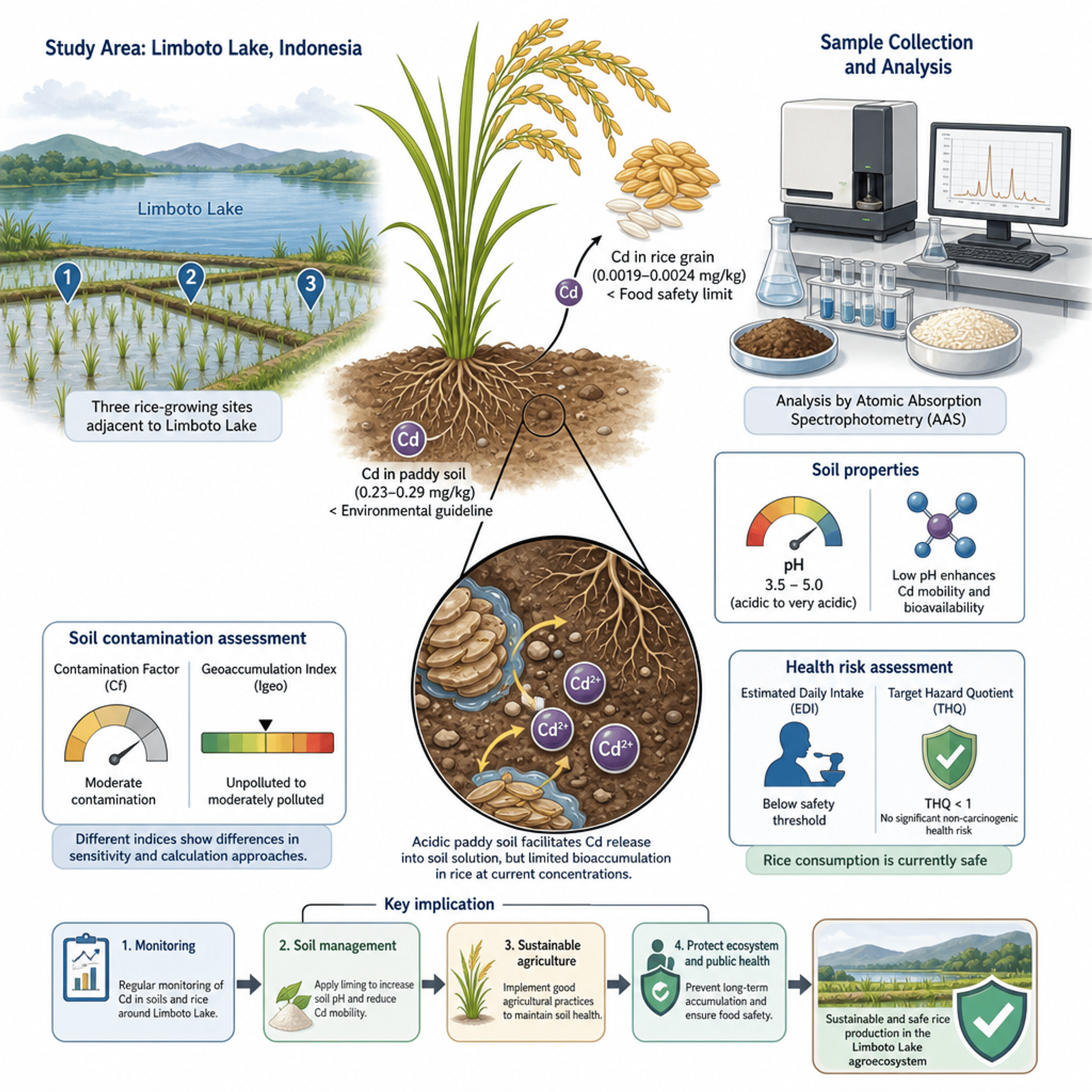
Cadmium (Cd) in agroecosystems poses risks to environmental quality, food safety, and public health because of its persistence and toxicity. This study assessed Cd concentrations in paddy soils and rice grains around Limboto Lake, Indonesia, evaluated soil contamination status, determined Cd transfer from soil to rice, and estimated potential health risks associated with rice consumption. A descriptive quantitative study was conducted at three rice-growing sites adjacent to the lake. Composite soil and rice grain samples were analyzed using Atomic Absorption Spectrophotometry (AAS). Soil contamination was evaluated using the Contamination Factor (Cf) and Geoaccumulation Index (Igeo), Cd transfer using the Bioaccumulation Factor (BAF), and health risks using the Estimated Daily Intake (EDI) and Target Hazard Quotient (THQ). Soil pH ranged from 3.5 to 5.0, indicating acidic to very acidic conditions that may enhance Cd mobility and bioavailability. Cd concentrations ranged from 0.23–0.29 mg/kg in soils and 0.0019–0.0024 mg/kg in rice grains, both below environmental and food safety standards. Cf indicated moderate contamination, whereas Igeo classified the soils as unpolluted to moderately polluted, reflecting differences in the sensitivity and calculation approaches of the two indices. BAF values <1 indicated that although pH increases mobility, the current concentrations do not lead to significant bioaccumulation. EDI and THQ were below the safety threshold, indicating no significant non-carcinogenic health risk from current rice consumption. Although rice remains safe for consumption, persistent Cd occurrence in soils and rice suggests a potential long-term environmental concern if accumulation continues. Therefore, regular monitoring and soil management, including liming to increase soil pH, are recommended to reduce Cd mobility and maintain food safety in the Limboto Lake agroecosystem.
Downloads
References
Wamaulana F, Hasyimuddin, Fakhruddin A. Analisis Logam Berat Kadmium (Cd) pada Sampel Pangan Segar Asal Tumbuhan (PSAT) di BBKP Makassar. Filogeni J Mhs Biol. 2022 Aug 30;2(2):53–8.
Nungula EZ, Raza MA, Nasar J, Maitra S, Seleiman MF, Ranjan S, et al. Cadmium in Soil and Plants: A Review. Springer Water. Springer Nature; 2024.
Rahman A, Haeruddin, Ghofar A. Konsentrasi Karbon Organik dan Logam Berat (Cu, Fe, Mn, Pb)Sedimen di Sungai Garang dan Banjir Kanal Barat, Semarang. J Fish Mar Res [Internet]. 2022; Available from: http://jfmr.ub.ac.id
Girikallo GG, Joseph WBS, Madussa SS. Analisis Risiko Kesehatan Lingkungan Paparan Logam Berat Cadmium (Cd) pada Masyarakat Sekitar Sungai yang Mengonsumsi Ikan Nilem (Ostoechillus Vittatus) dari. J KESMAS. 2022;11(2):90–6.
Pratiwiningsih RE, Ramadhan MF, Sari WY. Uji Kandungan Logam Berat Kadmium (Cd) pada Beras di Daerah Maos dengan Metode Spektrometri Serapan Atom (SSA). Serulingmas Heal J. 2022;2(1):39–48.
Li C, Wang H, Yang Y, Liu H, Fang X, Zhang Y, et al. Inhibition of microbially mediated total organic carbon decomposition in different types of cadmium contaminated soils with wheat straw addition. Sci Rep. 2024 Dec 1;14(1).
Rahim TR, Hasim, Juliana. Aquatic Quality Parameter at Lake Limboto. JPs J Ris dan Pengemb Ilmu Pengetah. 2020;
Noor SY. Konsentrasi Logam Berat Kadmium (Cd) dan Timbal (Pb) pada Air, Sedimen dan Ikan Nila (Oreochromis niloticus Linn.) di Danau Limboto. Pros SemNas Peningkatan Mutu Pendidik. 2020;1(1):289–93.
Hadiyanto, Hasim, Juliana. Kandungan Logam Berat Merkuri, Timbal dan Cadmium pada Air, Ikan, dan Sedimen di Danau Limboto. J Sumberd Akuatik Indopasifik [Internet]. 2022;6(1). Available from: https://doi.org/10.46252/jsai-fpik-unipa.2021.Vol.6.No.1.195
Satya A, Sulawesty F, Yustiawati, Widiyanto T. Cadmium distribution in water, microalgae biomass, and sediment of River Bonan Dolok, Samosir-North Sumatra, Indonesia. In: IOP Conference Series: Earth and Environmental Science. Institute of Physics Publishing; 2020.
Junila Aulia A, Ridwan I, Tambung A. Bioremediasi Tanah Tercemar Logam Berat Kadmium (Cd) dari Tempat Pembuangan Akhir Sampah Tamangapa di Kota Makassar Menggunakan Saccharomyces cerevisiae untuk Budidaya Tanaman Kedelai (Glycine max L.). J Lanskap dan Lingkung [Internet]. 2023;1(2):2–16. Available from: https://journal.unhas.ac.id/index.php/julia
Zou C, Shi Z, Yang Y, Zhang J, Hou Y, Zhang N. The Characteristics, Enrichment, and Migration Mechanism of Cadmium in Phosphate Rock and Phosphogypsum of the Qingping Phosphate Deposit, Southwest China. Minerals. 2023 Jan 1;13(1).
Zhang Q, Dou W, Wang Z, Xu X, Jiang T. Safety Risk Assessment and Classification of Cadmium in Grain Processing Products. Foods. 2025 Jun 1;14(11).
Iresha FM, Rahmawati S, Wacano D, Kasam K, Sari RK, Yoneda M. Heavy Metals Exposure and Risk Assessment of Cooked Rice from the Field Near the old Dumpsite in Indonesia. Int J GEOMATE. 2021;20(80):36–44.
Badan Standarisasi Nasional. Standar Nasional Indonesia Nomor 19-0428.1998 tentang Petunjuk Pengambilan Contoh Padatan. Indonesia; 1998.
Kementerian Pertanian Republik Indonesia. Petunjuk Teknis Analisis Kimia Tanah, Tanaman, Air dan Pupuk. Indonesia; 2023.
Badan Standarisasi Nasional. Standar Nasional Indonesia Nomor 06-6992.4 tentang Sedimen – Bagian 4: Cara Uji Kadmium (Cd) Secara Destruksi Asam dengan Spektrofotometer Serapan Atom (SSA). Indonesia; 2004.
Badan Standarisasi Nasional. Standar Nasional Indonesia Nomor 6989-84:2019 tentang Air dan Air Limbah – Bagian 84: Cara Uji Kadar Logam Terlarut dan Logam Total Secara Spektrofotometri Serapan Atom (SSA) – Nyala. Indonesia; 2019.
Canadian Council of Ministers of the Environment. Sediment Quality Guideliness. Indonesia; 1997.
Badan Standarisasi Nasional. Standar Nasional Indonesia Nomor 6128:2020 tentang Beras. Indonesia; 2020.
Ballabio C, Jones A, Panagos P. Cadmium in topsoils of the European Union – An analysis based on LUCAS topsoil database. Sci Total Environ [Internet]. 2024 Feb;912:168710. Available from: https://linkinghub.elsevier.com/retrieve/pii/S0048969723073382
Hakanson L. An ecological risk index for aquatic pollution control.a sedimentological approach. Water Res [Internet]. 1980 Jan;14(8):975–1001. Available from: https://linkinghub.elsevier.com/retrieve/pii/0043135480901438
Muller G. Index of Geoaccumulation in Sediments of the Rhine River. GeoJournal. 1996;2(3):108–18.
Gao J, Ye X, Wang X, Jiang Y, Li D, Ma Y, et al. Derivation and validation of thresholds of cadmium, chromium, lead, mercury and arsenic for safe rice production in paddy soil. Ecotoxicol Environ Saf [Internet]. 2021 Sep;220:112404. Available from: https://linkinghub.elsevier.com/retrieve/pii/S0147651321005169
UNICEF. Fortifikasi Beras di Indonesia. 2023.
Dirjen PP dan PL. Pedoman Analisis Risiko Kesehatan Lingkungan (ARKL). 2012.
EPA U. Cadmium; CASRN 7440-43-9. 1989.
Adamczyk-Szabela D, Wolf WM. The Impact of Soil pH on Heavy Metals Uptake and Photosynthesis Efficiency in Melissa officinalis, Taraxacum officinalis, Ocimum basilicum. Molecules. 2022;27(15).
Wei B, Peng Y, Jeyakumar P, Lin L, Zhang D, Yang M, et al. Soil pH restricts the ability of biochar to passivate cadmium: A meta-analysis. Environ Res [Internet]. 2023;219(November 2022):115110. Available from: https://doi.org/10.1016/j.envres.2022.115110
Gao T, Wu Q, Xia Y, Liu Y, Zhu JM, Qi M, et al. Flooding-drainage alternations impact mobilization and isotope fractionation of cadmium in soil-rice systems. J Hazard Mater [Internet]. 2022;436(January):129048. Available from: https://doi.org/10.1016/j.jhazmat.2022.129048
Liang H, Tan Y, Yin J, Peng Y, Wei M, Chen H, et al. Phosphate Fertilizers’ Dual Role in Cadmium-Polluted Acidic Agricultural Soils: Dosage Dependency and Passivation Potential. Agronomy. 2024;14(10):1–13.
Hussain B, Ashraf MN, Shafeeq-ur-Rahman, Abbas A, Li J, Farooq M. Cadmium stress in paddy fields: Effects of soil conditions and remediation strategies. Sci Total Environ [Internet]. 2021 Feb;754:142188. Available from: https://linkinghub.elsevier.com/retrieve/pii/S004896972035717X
Zou M, Zhou S, Zhou Y, Jia Z, Guo T, Wang J. Cadmium pollution of soil-rice ecosystems in rice cultivation dominated regions in China: A review. Environ Pollut [Internet]. 2021 Jul;280:116965. Available from: https://linkinghub.elsevier.com/retrieve/pii/S0269749121005479
Wiggenhauser M, Aucour AM, Bureau S, Campillo S, Telouk P, Romani M, et al. Cadmium transfer in contaminated soil-rice systems: Insights from solid-state speciation analysis and stable isotope fractionation. Environ Pollut [Internet]. 2021 Jan;269:115934. Available from: https://linkinghub.elsevier.com/retrieve/pii/S0269749120366239
Published
How to Cite
Issue
Section
Copyright (c) 2026 Tri Septian Maksum, Agung Nurwahid Mancu

This work is licensed under a Creative Commons Attribution-NonCommercial-ShareAlike 4.0 International License.