Changes in Menstrual Pain Following Dysmenorrhea Exercise among Early-Adolescent Female Students at Two Elementary Schools: A One Group Pretest–Posttest Study
Keywords:
Dysmenorrhea, Dysmenorrhea Exercise, Menarche, Menstrual PainAbstract
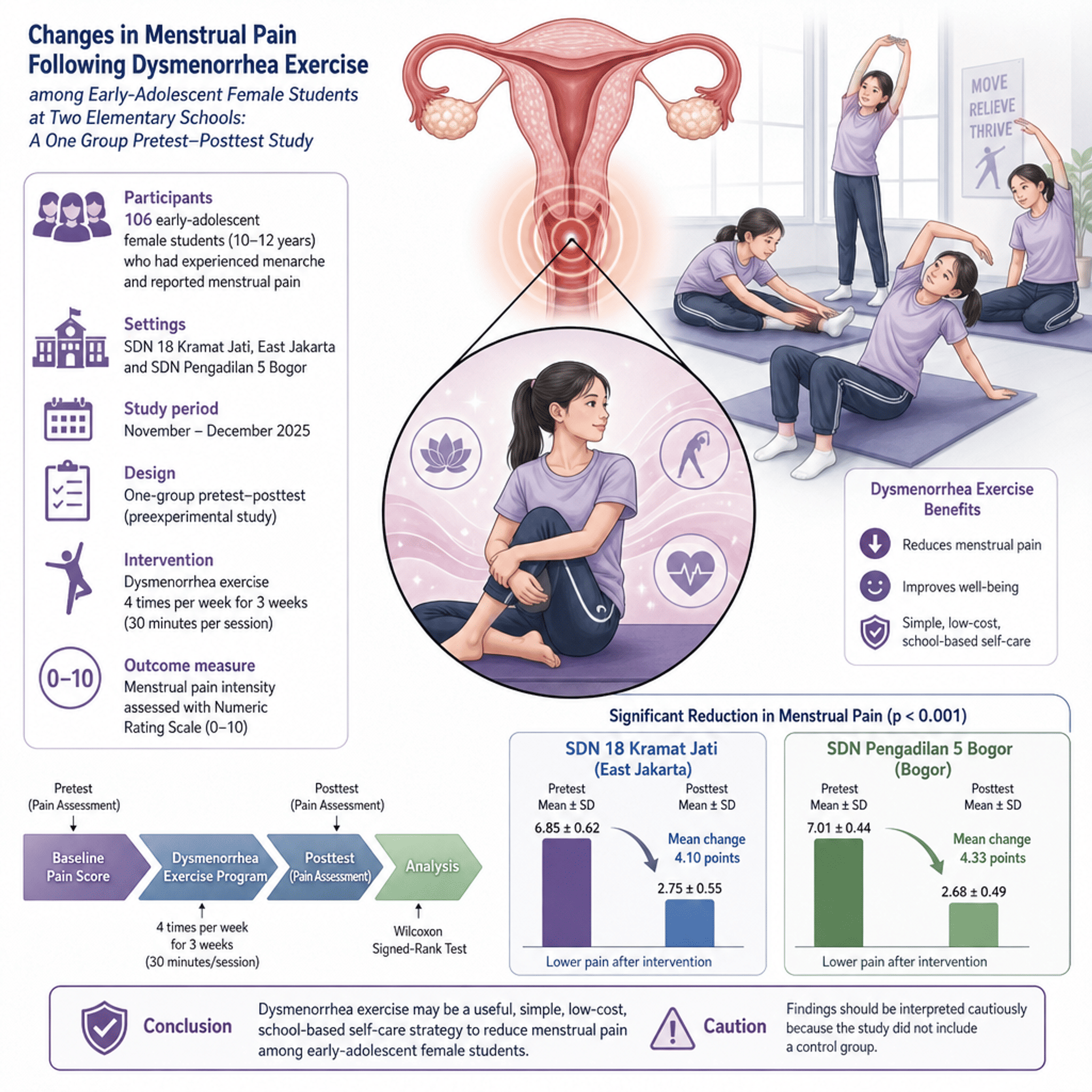
Dysmenorrhea is a menstrual complaint among adolescent girls and may interfere with activities, school attendance, concentration, and academic performance. Dysmenorrhea exercise is a nonpharmacological approach that may support menstrual pain management. This study assessed changes in menstrual pain following a dysmenorrhea exercise program among early-adolescent female students at SDN 18 Kramat Jati, East Jakarta, and SDN Pengadilan 5 Bogor. A quantitative preexperimental study with a one-group pretest–posttest design was conducted from November to December 2025. Participants were selected using purposive sampling. A total of 106 female students aged 10 to 12 years who had experienced menarche and reported menstrual pain participated. The intervention consisted of dysmenorrhea exercise four times per week for three weeks, with each session lasting 30 minutes. Menstrual pain intensity was assessed before and after the intervention using the Numeric Rating Scale. Differences in preintervention and postintervention scores were analyzed using the Wilcoxon signed-rank test. At SDN 18 Kramat Jati, the mean pain score decreased from 6.85 ± 0.62 to 2.75 ± 0.55, corresponding to a mean change of 4.10 points. At SDN Pengadilan 5 Bogor, the mean score decreased from 7.01 ± 0.44 to 2.68 ± 0.49, corresponding to a mean change of 4.33 points. Postintervention scores were significantly lower than preintervention scores in the overall sample (p < 0.001). Lower pain scores were observed at both study sites. Dysmenorrhea exercise may be a useful, simple, low-cost, school-based self-care strategy, although the findings should be interpreted cautiously because the study did not include a control group.
Downloads
References
Pfeifer JH, Allen NB. Puberty Initiates Cascading Relationships Between Neurodevelopmental, Social, and Internalizing Processes Across Adolescence. Biological Psychiatry. 2021 Jan;89(2):99–108. doi:10.1016/j.biopsych.2020.09.002
Blakemore S, Burnett S, Dahl RE. The role of puberty in the developing adolescent brain. Human Brain Mapping. 2010 Jun;31(6):926–33. doi:10.1002/hbm.21052
Mohanty S, Mehra D, Das SS, Sethi G, Garg R, Gupta A, et al. School-based adolescent health survey in Himachal Pradesh, India: study design and protocol. Front Public Health. 2024 Dec 16;12:1463776. doi:10.3389/fpubh.2024.1463776
World Health Organization, World Bank. Global Monitoring Report on Financial Protection in Health 2021 [Internet]. World Bank; 2021 [cited 2026 Jul 12]. Available from: https://hdl.handle.net/10986/36723 doi:10.1596/36723
Armour M, Parry K, Manohar N, Holmes K, Ferfolja T, Curry C, et al. The Prevalence and Academic Impact of Dysmenorrhea in 21,573 Young Women: A Systematic Review and Meta-Analysis. Journal of Women’s Health. 2019 Aug;28(8):1161–71. doi:10.1089/jwh.2018.7615
Gutman G, Nunez AT, Fisher M. Dysmenorrhea in adolescents. Current Problems in Pediatric and Adolescent Health Care. 2022 May;52(5):101186. doi:10.1016/j.cppeds.2022.101186
Itani R, Soubra L, Karout S, Rahme D, Karout L, Khojah HMJ. Primary Dysmenorrhea: Pathophysiology, Diagnosis, and Treatment Updates. Korean J Fam Med. 2022 Mar 20;43(2):101–8. doi:10.4082/kjfm.21.0103
De Arruda GT, Barbosa-Silva J, Driusso P, Pathmanathan C, Armijo-Olivo S, Avila MA. Worldwide prevalence of dysmenorrhea: a systematic review and meta-analysis across 70 countries. Pain. 2026 Jan;167(1):41–55. doi:10.1097/j.pain.0000000000003768
Kemenkes RI. Indonesian health survey. Jakarta; 2023.
Resty Hermawahyuni, Handayani S, Alnur RD. Risk Factors of Primary Dysmenorrhea in Students of SMK PGRI 1 Jakarta Timur. Jurnal kesehatan komunitas (Journal of community health). 2022 Apr 30;8(1 SE-Articles):97–101. doi:10.25311/keskom.Vol8.Iss1.1079
Tsai IC, Hsu CW, Chang CH, Lei WT, Tseng PT, Chang KV. Comparative Effectiveness of Different Exercises for Reducing Pain Intensity in Primary Dysmenorrhea: A Systematic Review and Network Meta-analysis of Randomized Controlled Trials. Sports Med - Open. 2024 May 30;10(1):63. doi:10.1186/s40798-024-00718-4
Li X, Hao X, Liu J hua, Huang J peng. Efficacy of non-pharmacological interventions for primary dysmenorrhoea: a systematic review and Bayesian network meta-analysis. BMJ EBM. 2024 Jun;29(3):162–70. doi:10.1136/bmjebm-2023-112434
Jian S, Liu H. Psychological comfort, creativity, and learning efficiency in informal learning spaces: A university student dataset. Data in Brief. 2025 Apr;59:111450. doi:10.1016/j.dib.2025.111450
Situmorang H, Sutanto RL, Tjoa K, Rivaldo R. Association between primary dysmenorrhoea on quality of life, mental health and academic performance among medical students in Indonesia: a cross-sectional study. BMJ Open. 2025 Jan;15(1):e093237. doi:10.1136/bmjopen-2024-093237
Núñez-Troconis JT, Carvallo-Ruiz DE, Martínez-Núñez EN, Núñez-Urdaneta RA. Psychosocial stress as a predisposing risk factor of primary dysmenorrhea: a Venezuelan cross-sectional study. RECHOG. 2024 Jul 30;89(4):14348. doi:10.24875/RECHOG.23000137
Wang L, Yan Y, Qiu H, Xu D, Zhu J, Liu J, et al. Prevalence and Risk Factors of Primary Dysmenorrhea in Students: A Meta-Analysis. Value in Health. 2022 Oct;25(10):1678–84. doi:10.1016/j.jval.2022.03.023
Armour M, Smith CA, Steel KA, Macmillan F. The effectiveness of self-care and lifestyle interventions in primary dysmenorrhea: a systematic review and meta-analysis. BMC Complementary and Alternative Medicine. 2019;19(1):22. doi:10.1186/s12906-019-2433-8
Rigal P, Bonnet S, Vieira Á, Carvalhais A, Lopes S. Therapeutic Physical Exercise for Dysmenorrhea: A Scoping Review. Journal of Functional Morphology and Kinesiology. 2025. p. 10. doi:10.3390/jfmk10010010
Jaleel G, Shaphe MA, Khan AR, Malhotra D, Khan H, Parveen S, et al. Effect of Exercises on Central and Endocrine System for Pain Modulation in Primary Dysmenorrhea. JLM. 2022 Jan 31;12(1):15–25. doi:10.15280/jlm.2022.12.1.15
Cai J, Liu M, Jing Y, Yin Z, Kong N, Guo C. Aerobic exercise to alleviate primary dysmenorrhea in adolescents and young women: A systematic review and meta‐analysis of randomized controlled trials. Acta Obstet Gynecol Scand. 2025 May;104(5):815–28. doi:10.1111/aogs.15042
Cai J, Liu M, Jing Y, Yin Z, Kong N, Guo C. Aerobic exercise to alleviate primary dysmenorrhea in adolescents and young women: A systematic review and meta‐analysis of randomized controlled trials. Acta Obstet Gynecol Scand. 2025 May;104(5):815–28. doi:10.1111/aogs.15042
Itriyeva K. The normal menstrual cycle. Current problems in pediatric and adolescent health care. 2022 May;52(5):101183. doi:10.1016/j.cppeds.2022.101183 PubMed PMID: 35527220.
Marques P, Madeira T, Gama A. Menstrual cycle among adolescents: girls’ awareness and influence of age at menarche and overweight. Revista paulista de pediatria : orgao oficial da Sociedade de Pediatria de Sao Paulo. 2022;40:e2020494. doi:10.1590/1984-0462/2022/40/2020494 PubMed PMID: 35019010.
Agarwal AK, Agarwal A. A study of dysmenorrhea during menstruation in adolescent girls. Indian journal of community medicine : official publication of Indian Association of Preventive & Social Medicine. 2010 Jan;35(1):159–64. doi:10.4103/0970-0218.62586 PubMed PMID: 20606943.
Martire FG, Piccione E, Exacoustos C, Zupi E. Endometriosis and Adolescence: The Impact of Dysmenorrhea. Journal of Clinical Medicine. 2023. p. 5624. doi:10.3390/jcm12175624
Motahari-Tabari N, Shirvani MA, Alipour A. Comparison of the Effect of Stretching Exercises and Mefenamic Acid on the Reduction of Pain and Menstruation Characteristics in Primary Dysmenorrhea: A Randomized Clinical Trial. Oman medical journal. 2017 Jan;32(1):47–53. doi:10.5001/omj.2017.09 PubMed PMID: 28042403.
Nyoman NNS, Puspita H R, Yuliana D. The Effect of Dysmenorrhea Exercise on Reducing Dysmenorrhea in Grade X Adolescent Females. Java Nursing Journal. 2025 Jun 17;3(2 SE-Original Research Articles):155–61. doi:10.61716/jnj.v3i2.107
Tsai IC, Hsu CW, Chang CH, Lei WT, Tseng PT, Chang KV. Comparative Effectiveness of Different Exercises for Reducing Pain Intensity in Primary Dysmenorrhea: A Systematic Review and Network Meta-analysis of Randomized Controlled Trials. Sports medicine - open. 2024 May;10(1):63. doi:10.1186/s40798-024-00718-4 PubMed PMID: 38816591.
Ayu IG, Agustini R. The Effect of Dysmenorrhea Exercise on Reducing Menstrual Pain Felt by Adolescent Girls. Vol. 3. 2022;3(3):293–9.
Wijaya A, Anwar R, Estiningtyas Q, Adnani S, Susiarno H. How physical exercises ameliorate dysmenorrhea in adolescence. Vol. 12. 2024;12(1):40–9.
Jaleel G, Shaphe MA, Khan AR, Malhotra D, Khan H, Parveen S, et al. Effect of Exercises on Central and Endocrine System for Pain Modulation in Primary Dysmenorrhea. Journal of lifestyle medicine. 2022 Jan;12(1):15–25. doi:10.15280/jlm.2022.12.1.15 PubMed PMID: 35300040.
Dawood MY. Primary Dysmenorrhea: Advances in Pathogenesis and Management. Obstetrics & Gynecology. 2006;108(2).
Zheng Q, Huang G, Cao W, Zhao Y. Comparative effectiveness of exercise interventions for primary dysmenorrhea: a systematic review and network meta-analysis. BMC Women’s Health. 2024 Nov 16;24(1):610. doi:10.1186/s12905-024-03453-w
Belo TCA, Santos GX, Da Silva BEG, Rocha BLG, Abdala DW, Freire LAM, et al. IL-10/β-Endorphin-Mediated Neuroimmune Modulation on Microglia during Antinociception. Brain Sciences. 2023 May 12;13(5):789. doi:10.3390/brainsci13050789
Higginbotham JA, Markovic T, Massaly N, Morón JA. Endogenous opioid systems alterations in pain and opioid use disorder. Front Syst Neurosci. 2022 Oct 19;16:1014768. doi:10.3389/fnsys.2022.1014768
Seales P, Seales S, Ho G. Exercise for Dysmenorrhea. Am Fam Physician. Vol. 03. 2021 May 1;03(9):525–6. PubMed PMID: PMID: 33929165.
Published
How to Cite
Issue
Section
Copyright (c) 2026 Bunga Romadhona Haque, Yenny Retno Kinasih, Synthia Anggarini

This work is licensed under a Creative Commons Attribution-NonCommercial-ShareAlike 4.0 International License.