Association Between Age and CD68 Expression in Patients with Adenomyosis
Keywords:
Adenomyosis, CD68, Immunohistochemistry, Immunosenescence, MacrophagesAbstract
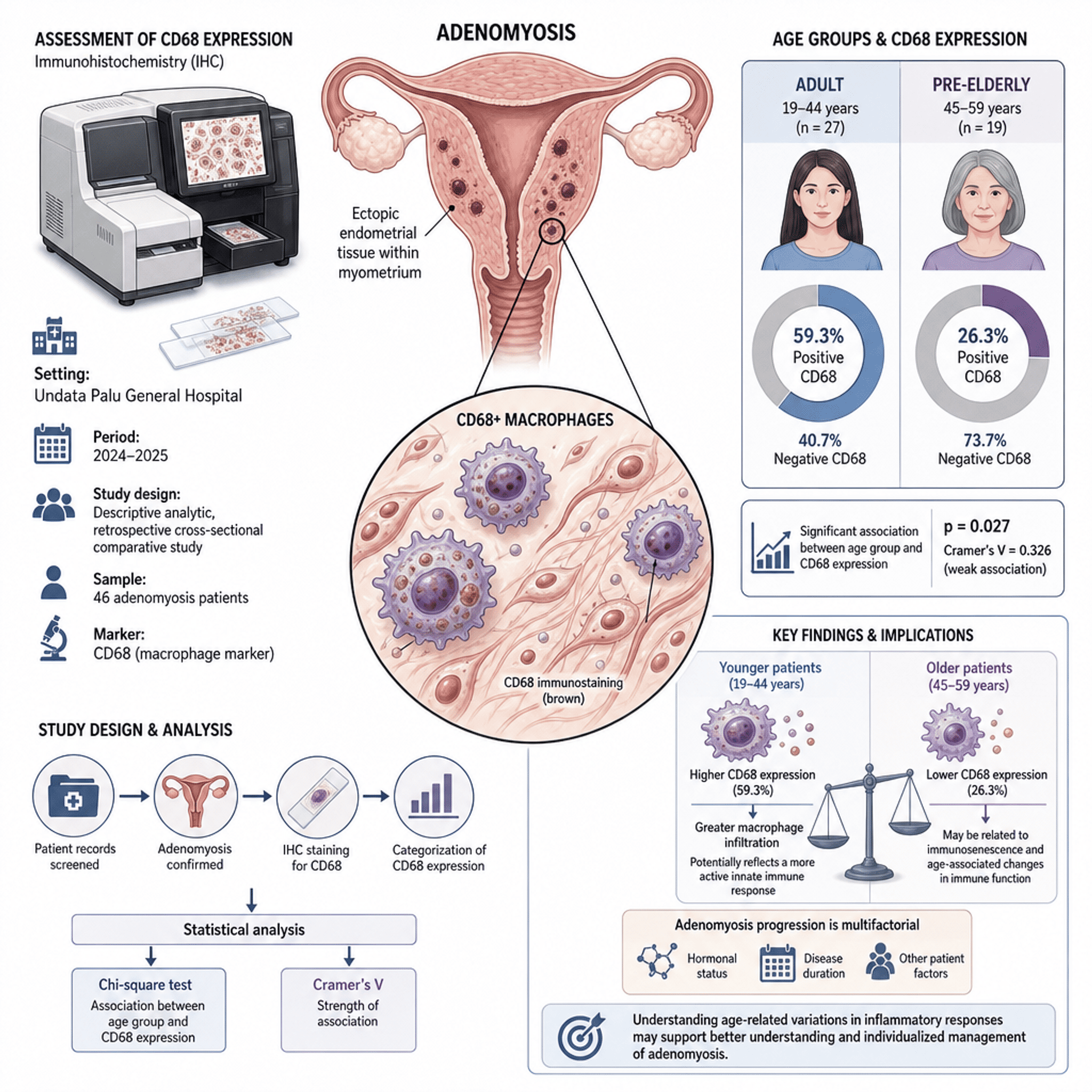
This study explores the relationship between CD68 expression, a macrophage marker involved in inflammation, and clinical outcomes in patients with adenomyosis across different age groups. A descriptive analytic retrospective cross-sectional comparative study was conducted at Undata Palu General Hospital from 2024 to 2025. CD68 expression was assessed using immunohistochemical (IHC) staining of uterine tissue samples obtained from 46 patients with adenomyosis, who were categorized into adult (19–44 years) and pre-elderly (45–59 years) age groups. The association between age groups and CD68 expression categories was analyzed using the Chi-square test, while the strength of the association was evaluated using Cramer’s V coefficient. Positive CD68 expression was observed in 58.7% of patients. Statistical analysis demonstrated a significant association between age and CD68 expression (p = 0.027), although the strength of the association was weak (Cramer’s V = 0.326). The adult group showed a higher proportion of positive CD68 expression (59.3%) compared with the pre-elderly group (where 73.7% showed negative expression). These findings suggest that age is associated with macrophage infiltration in adenomyosis, with younger patients exhibiting greater CD68 expression, potentially reflecting a more active innate immune response. In contrast, lower CD68 expression in older patients may be related to age-associated changes in immune function, including immunosenescence. Given the weak strength of the association, adenomyosis progression should be considered a multifactorial process influenced by age, hormonal status, and disease duration. Understanding age-related variations in inflammatory responses may contribute to a better understanding of adenomyosis pathophysiology and support the development of individualized management strategies.
Downloads
References
Moawad G, Fruscalzo A, Youssef Y, Kheil M, Tawil T, Nehme J, et al. Adenomyosis: An Updated Review on Diagnosis and Classification. J Clin Med. 2023 Jul 21;12(14):4828. doi:10.3390/jcm12144828 PubMed PMID: 37510943; PubMed Central PMCID: PMC10381628.
Martire FG, Costantini E, D’Abate C, Schettini G, Sorrenti G, Centini G, et al. Endometriosis and Adenomyosis: From Pathogenesis to Follow-Up. Current Issues in Molecular Biology. 2025 May;47(5):298. doi:10.3390/cimb47050298
Trommelen LM, De Leeuw RA, Van den Bosch T, Huirne JAF. Grading Sonographic Severity of Adenomyosis. Journal of Ultrasound in Medicine. 2025;44(3):495–506. doi:10.1002/jum.16612
Pinzauti S, Lazzeri L, Tosti C, Centini G, Orlandini C, Luisi S, et al. Transvaginal sonographic features of diffuse adenomyosis in 18–30-year-old nulligravid women without endometriosis: association with symptoms. Ultrasound in Obstetrics & Gynecology. 2015;46(6):730–6. doi:10.1002/uog.14834
Park JH, Chae KH, Kim S, Park JY, Song JY, Chung YJ, et al. Prevalence, incidence, and treatment trends of adenomyosis in South Korean women for 15 years: A national population-based study. Int J Gynaecol Obstet. 2024 Oct;167(1):197–205. doi:10.1002/ijgo.15550 PubMed PMID: 38641915.
Harada T, Khine YM, Kaponis A, Nikellis T, Decavalas G, Taniguchi F. The Impact of Adenomyosis on Women’s Fertility. Obstet Gynecol Surv. 2016 Sep;71(9):557–68. doi:10.1097/OGX.0000000000000346 PubMed PMID: 27640610; PubMed Central PMCID: PMC5049976.
Vercellini P, Consonni D, Barbara G, Buggio L, Frattaruolo MP, Somigliana E. Adenomyosis and reproductive performance after surgery for rectovaginal and colorectal endometriosis: a systematic review and meta-analysis. Reprod Biomed Online. 2014 Jun;28(6):704–13. doi:10.1016/j.rbmo.2014.02.006 PubMed PMID: 24745831.
Yeh CC, Su FH, Tzeng CR, Muo CH, Wang WC. Women with adenomyosis are at higher risks of endometrial and thyroid cancers: A population-based historical cohort study. PLoS One. 2018;13(3):e0194011. doi:10.1371/journal.pone.0194011 PubMed PMID: 29522577; PubMed Central PMCID: PMC5844548.
López-Novoa JM, Nieto MA. Inflammation and EMT: an alliance towards organ fibrosis and cancer progression. EMBO Mol Med. 2009 Sep;1(6–7):303–14. doi:10.1002/emmm.200900043 PubMed PMID: 20049734; PubMed Central PMCID: PMC3378143.
Li H, Zhang H, Dai R, Zheng D, Zhao J, Jing H, et al. CD68 as a multi-omic prognostic biomarker in digestive system cancers: correlations with tumor-infiltrating immune cells and immune checkpoints. Front Immunol. 2025 Aug 21;16:1599677. doi:10.3389/fimmu.2025.1599677 PubMed PMID: 40918116; PubMed Central PMCID: PMC12408268.
Li X, Deng S, Leng J. Adenomyosis and Pain. In: Xue M, Leng J, Wong F, editors. Adenomyosis: Facts and treatments [Internet]. Singapore: Springer; 2021 [cited 2026 Mar 30]. p. 37–46. Available from: https://doi.org/10.1007/978-981-33-4095-4_5 doi:10.1007/978-981-33-4095-4_5
Oishi Y, Manabe I. Macrophages in age-related chronic inflammatory diseases. npj Aging Mech Dis. 2016 Jul 28;2(1):16018. doi:10.1038/npjamd.2016.18
Tabatabaei F, Tahernia H, Ghaedi A, Bazrgar A, Khanzadeh S. Diagnostic significance of neutrophil to lymphocyte ratio in endometriosis: a systematic review and meta-analysis. BMC Womens Health. 2023 Nov 7;23:576. doi:10.1186/s12905-023-02692-7 PubMed PMID: 37936116; PubMed Central PMCID: PMC10631181.
Chistiakov DA, Killingsworth MC, Myasoedova VA, Orekhov AN, Bobryshev YV. CD68/macrosialin: not just a histochemical marker. Lab Invest. 2017 Jan;97(1):4–13. doi:10.1038/labinvest.2016.116
Hogg C, Horne AW, Greaves E. Endometriosis-Associated Macrophages: Origin, Phenotype, and Function. Front Endocrinol. 2020 Jan 23;11. doi:10.3389/fendo.2020.00007
Brulport A, Bourdon M, Vaiman D, Drouet C, Pocate-Cheriet K, Bouzid K, et al. An integrated multi-tissue approach for endometriosis candidate biomarkers: a systematic review. Reprod Biol Endocrinol. 2024 Feb 10;22(1):21. doi:10.1186/s12958-023-01181-8
Franceschi C, Bonafè M, Valensin S, Olivieri F, De Luca M, Ottaviani E, et al. Inflamm-aging: An Evolutionary Perspective on Immunosenescence. Annals of the New York Academy of Sciences. 2000;908(1):244–54. doi:10.1111/j.1749-6632.2000.tb06651.x
Burger H. The Menopausal Transition—Endocrinology. J Sex Med. 2008 Oct 1;5(10):2266–73. doi:10.1111/j.1743-6109.2008.00921.x
Khan KN, Masuzaki H, Fujishita A, Kitajima M, Sekine I, Matsuyama T, et al. Estrogen and progesterone receptor expression in macrophages and regulation of hepatocyte growth factor by ovarian steroids in women with endometriosis. Hum Reprod. 2005 Jul 1;20(7):2004–13. doi:10.1093/humrep/deh897
Malik S, Chakraborty D, Agnihotri P, Sarkar A, Joshi L, Saquib M, et al. Mitochondrial proteomics reveals the impact of Estrogen in enhancing energy metabolism of patient-derived fibroblast-like synoviocytes in rheumatoid arthritis. Inflamm Res. 2025 Oct 22;74(1):146. doi:10.1007/s00011-025-02120-6
Skulska K, Kędzierska AE, Krzyżowska M, Chodaczek G. Age-Related Changes in Female Murine Reproductive Mucosa with respect to γδ T Cell Presence. Journal of Immunology Research. 2023;2023(1):3072573. doi:10.1155/2023/3072573
Bourdon M, Santulli P, Jeljeli M, Vannuccini S, Marcellin L, Doridot L, et al. Immunological changes associated with adenomyosis: a systematic review. Hum Reprod Update. 2021 Jan 4;27(1):108–29. doi:10.1093/humupd/dmaa038
Ramírez-Pavez TN, Martínez-Esparza M, Ruiz-Alcaraz AJ, Marín-Sánchez P, Machado-Linde F, García-Peñarrubia P. The Role of Peritoneal Macrophages in Endometriosis. International Journal of Molecular Sciences. 2021 Jan;22(19):10792. doi:10.3390/ijms221910792
Vannuccini S, Petraglia F. Recent advances in understanding and managing adenomyosis. F1000Res. 2019;8:F1000 Faculty Rev-283. doi:10.12688/f1000research.17242.1 PubMed PMID: 30918629; PubMed Central PMCID: PMC6419978.
Oh H, Eliassen AH, Wang M, Smith-Warner SA, Beck AH, Schnitt SJ, et al. Expression of estrogen receptor, progesterone receptor, and Ki67 in normal breast tissue in relation to subsequent risk of breast cancer. NPJ Breast Cancer. 2016 Oct 26;2:16032. doi:10.1038/npjbcancer.2016.32 PubMed PMID: 28111631; PubMed Central PMCID: PMC5243126.
Muscatell KA, Brosso SN, Humphreys KL. Socioeconomic status and inflammation: a meta-analysis. Mol Psychiatry. 2020 Sep;25(9):2189–99. doi:10.1038/s41380-018-0259-2 PubMed PMID: 31628416; PubMed Central PMCID: PMC6814496.
Maurel M, Castagné R, Berger E, Bochud M, Chadeau-Hyam M, Fraga S, et al. Patterning of educational attainment across inflammatory markers: Findings from a multi-cohort study. Brain Behav Immun. 2020 Nov;90:303–10. doi:10.1016/j.bbi.2020.09.002 PubMed PMID: 32919037; PubMed Central PMCID: PMC8140486.
Published
How to Cite
Issue
Section
Copyright (c) 2026 Gina Andyka Hutasoit, I Kadek Rupawan, Budi Dharmono Tulaka, Nilawati Nilawati, Aristo Aristo, Mawar Rahmi, Janita A. Pamusok, Kathryn Sarah, Emi Sunarya, Siska Putri Wulandari Raharja

This work is licensed under a Creative Commons Attribution-NonCommercial-ShareAlike 4.0 International License.
Most read articles by the same author(s)
- Imtihanah Amri, Rahma Rahma, Gina Andyka Hutasoit, Ayu Sekarani Damana Putri, Haerani Harun, Riyadh Rasyid, Comparison of Neutrophile-to-Lymphocyte Ratio Between Dengue Haemorrhagic Fever and Dengue Shock Syndrome in Pediatric Patients at Anutapura Hospital , Journal of Health and Nutrition Research: Vol. 4 No. 1 (2025)
- Amalia Amalia, Upik A. Miskad, Zaldi Zaldi, Gina Andyka Hutasoit, Muhammad Aslam, Comparative Diagnostic Performance of Monoclonal Antibody Immunohistochemistry and Modified Giemsa Staining for Helicobacter pylori Detection in Chronic Gastritis , Journal of Health and Nutrition Research: Vol. 5 No. 2 (2026)