Postpartum Blues and Its Determinants: Continuity of Care, Spousal Support, and A Sleep Quality Among Postnatal Women in an Urban Indonesia Setting
Keywords:
Continuity of Care, Maternal Mental Health, Sleep Quality, Spousal Support, Postpartum BluesAbstract
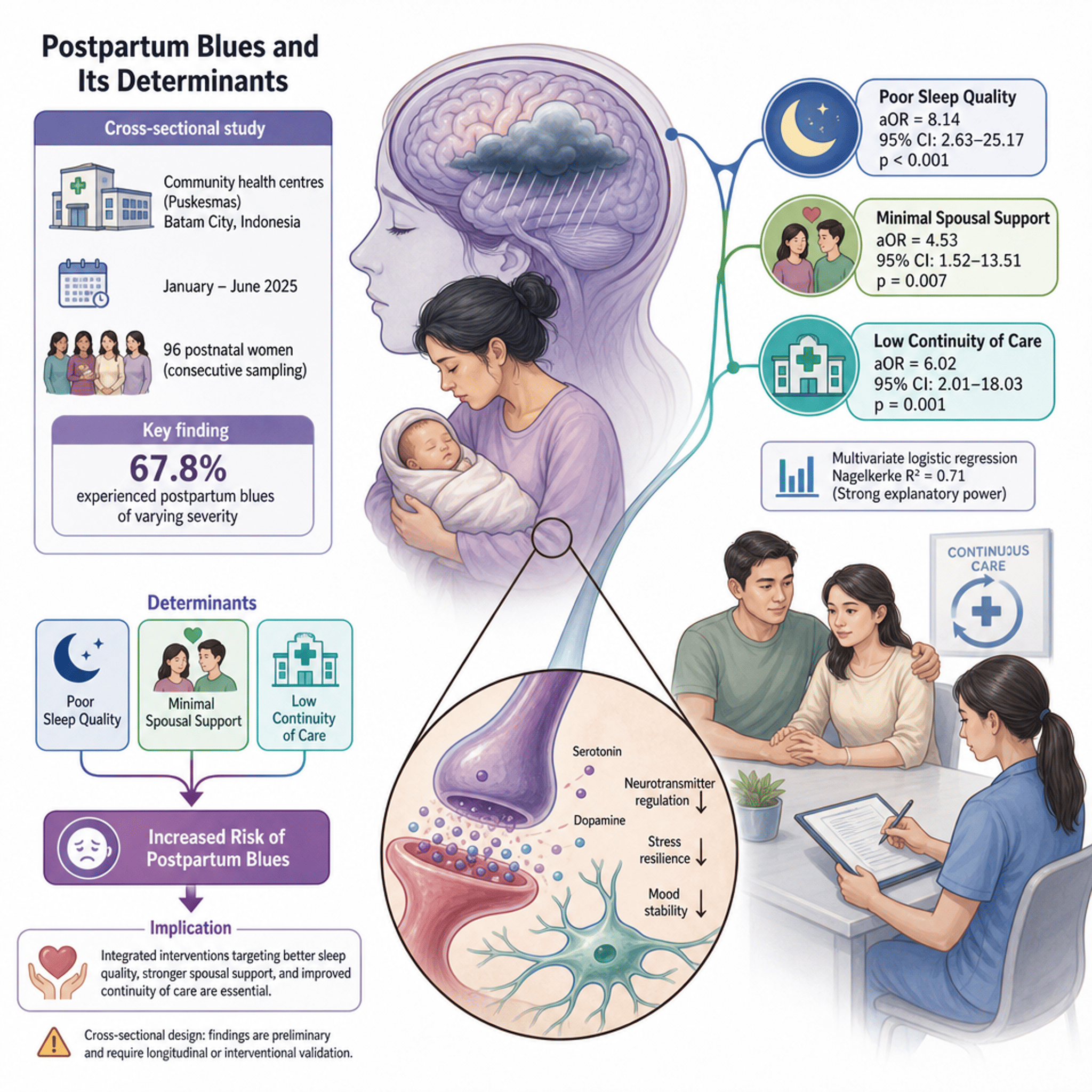
Postpartum blues is a prevalent yet underrecognized mental health condition among postnatal women, particularly in rapidly urbanizing settings. Comprehensive identification of its determinants is essential for designing targeted interventions. This cross-sectional study aimed to examine the predictive roles of sleep quality, spousal support, and continuity of care on postpartum blues among 96 postnatal women attending community health centres (Puskesmas) in Batam City, Indonesia, enrolled via consecutive sampling between January and June 2025. Data were collected using validated instruments, the Pittsburgh Sleep Quality Index (PSQI), Postpartum Partner Support Scale (PPSS), and Continuity of Care Index (COCI), and postpartum blues was assessed using the Postpartum Blues Questionnaire (PBQ-32). Data analysis included chi-square tests and multivariate logistic regression. A total of 67.8% of respondents experienced postpartum blues of varying severity. Multivariate analysis showed that poor sleep quality (aOR = 8.14; 95% CI: 2.63–25.17; p < 0.001), low continuity of care (aOR = 6.02; 95% CI: 2.01–18.03; p = 0.001), and minimal spousal support (aOR = 4.53; 95% CI: 1.52–13.51; p = 0.007) were significant independent predictors, with sleep quality being the most dominant factor. Parity and delivery method did not show a significant association. The model had strong explanatory power (Nagelkerke R² = 0.71). Postpartum blues are significantly influenced by the interaction of behavioural, interpersonal, and structural factors within healthcare. Integrated interventions targeting improved sleep quality, strengthening spousal support, and improving continuity of care are needed. Given the cross-sectional design, these findings are preliminary and require longitudinal or interventional validation.
Downloads
References
Howard LM, Molyneaux E, Dennis CL, Rochat T, Stein A, Milgrom J. Non-psychotic mental disorders in the perinatal period. The Lancet. 2014;384(9956):1775–88. doi:10.1016/S0140-6736(14)61276-9 PubMed PMID: 25455248.
Stein A, Pearson RM, Goodman SH, Rapa E, Rahman A, McCallum M, et al. Effects of perinatal mental disorders on the fetus and child. The Lancet. 2014 Nov 15;384(9956):1800–19. doi:10.1016/S0140-6736(14)61277-0
Khamidullina Z, Marat A, Muratbekova S, Mustapayeva NM, Chingayeva GN, Shepetov AM, et al. Postpartum Depression Epidemiology, Risk Factors, Diagnosis, and Management: An Appraisal of the Current Knowledge and Future Perspectives. Journal of clinical medicine. 2025 Apr;14(7). doi:10.3390/jcm14072418 PubMed PMID: 40217868.
WHO WHO. Transforming mental health for all. WHO WHO, editor. WHO; 2022. 296 p.
Shorey S, Chee CYI, Ng ED, Chan YH, Tam WWS, Chong YS. Prevalence and incidence of postpartum depression among healthy mothers: A systematic review and meta-analysis. Journal of psychiatric research. 2018 Sep;104:235–48. doi:10.1016/j.jpsychires.2018.08.001 PubMed PMID: 30114665.
Nurbaeti I, Deoisres W, Hengudomsub P. Association between psychosocial factors and postpartum depression in South Jakarta, Indonesia. Sexual & reproductive healthcare : official journal of the Swedish Association of Midwives. 2019 Jun;20:72–6. doi:10.1016/j.srhc.2019.02.004 PubMed PMID: 31084823.
Rahmadhani W, Chamroen P. Prevalence and Determinants of Postpartum Depression Among Adolescent Mothers : A Cross-Sectional Study. Vol. 6. 2022;6(2):533–44.
Palupi KC, Mulyadewi Z, Fadhilah R, Melani V, Siahaan MF. The Effect of a Fruit-Based Antioxidant Intervention on Depressive and Anxiety Symptoms in Postpartum Mothers : A Quasi-Experimental Study Key Messages : Vol. 4. 2025;4(3):1322–33.
Sari N, Sari N, Dewi FNM, Muhani N. Maternal Factors Influencing Postpartum Depression in Indonesia Maternal Factors Influencing Postpartum Depression in. Vol. 18. 2023;18(3):203–8. doi:10.21109/kesmas.v18i3.7209
Zarroug M, Altaf MF, Shaikh S, Tidjani A, Bashir O, Ayash MI, et al. The Prevalence and Risk Factors of Postpartum Depression Among Saudi Arabian Women—A Systematic Review and Meta-Analysis. Healthcare. 2025;13(16). doi:10.3390/healthcare13162040
Fisher J, Cabral de Mello M, Patel V, Rahman A, Tran T, Holton S, et al. Prevalence and determinants of common perinatal mental disorders in women in low- and lower-middle-income countries: a systematic review. Bulletin of the World Health Organization. 2012 Feb;90(2):139G-149G. doi:10.2471/BLT.11.091850 PubMed PMID: 22423165.
Okun ML, Mancuso RA, Hobel CJ, Schetter CD, Coussons-Read M. Poor sleep quality increases symptoms of depression and anxiety in postpartum women. Journal of behavioral medicine. 2018 Oct;41(5):703–10. doi:10.1007/s10865-018-9950-7 PubMed PMID: 30030650.
Bei B, Coo S, Trinder J. Sleep and Mood During Pregnancy and the Postpartum Period. Sleep medicine clinics. 2015 Mar;10(1):25–33. doi:10.1016/j.jsmc.2014.11.011 PubMed PMID: 26055670.
Bangsgaard RB, Høgh S, Borgsted C, Cvetanovska E, Pinborg A, Hegaard H, et al. Sleep quality in late pregnancy is associated with maternal mental health in the early postpartum period. European Journal of Obstetrics & Gynecology and Reproductive Biology. 2025;311:113980. doi:https://doi.org/10.1016/j.ejogrb.2025.113980
Bm XL, Student G, Wang S, Wang G, Student G. Prevalence and Risk Factors of Postpartum Depression in Women : A Systematic Review and Meta- analysis. 2022;(July 2021):2665–77. doi:10.1111/jocn.16121
Horwitz A, Bar-Shachar Y, Ran-Peled D, Meiri G, Tikotzky L. Sleep and symptoms of depression and anxiety in mothers and fathers of infants: A longitudinal perspective. Sleep Health. 2026;12(2):273–82. doi:https://doi.org/10.1016/j.sleh.2025.11.009
Penu AS, Mediawati AS, Agustina HR. Impact of the I-PASS Communication Method on Nurse Handover Quality in Hospital Settings : A Scoping Review Key Messages : Journal of Health and Nutrition Research. 2026;5(1):450–63. doi:https://doi.org/10.56303/jhnresearch.v5i1.1073
Sandall J, Soltani H, Gates S, Shennan A, Devane D. Midwife-led continuity models versus other models of care for childbearing women. The Cochrane database of systematic reviews. 2016 Apr;4(4):CD004667. doi:10.1002/14651858.CD004667.pub5 PubMed PMID: 27121907.
Homer CSE, Leap N, Edwards N, Sandall J. Midwifery continuity of carer in an area of high socio-economic disadvantage in London: A retrospective analysis of Albany Midwifery Practice outcomes using routine data (1997–2009). Midwifery. 2017;48:1–10. doi:https://doi.org/10.1016/j.midw.2017.02.009
Mortensen B, Lieng M, Diep LM, Lukasse M, Atieh K, Fosse E. Improving Maternal and Neonatal Health by a Midwife-led Continuity Model of Care - An Observational Study in One Governmental Hospital in Palestine. EClinicalMedicine. 2019 Apr;10:84–91. doi:10.1016/j.eclinm.2019.04.003 PubMed PMID: 31193799.
Erdfelder E. Statistical power analyses using G * Power 3 . 1 : Tests for correlation and regression analyses. Vol. 41. 2009;41(4):1149–60. doi:10.3758/BRM.41.4.1149
Sari IN, Sansuwito T. Development and psychometric validation of the Indonesian versions of the Postpartum Blues and Maternal Self-Efficacy Scales Ika Novita Sari. F1000research. 2026;1–19.
Sari IN, Sansuwito T. Development And Psychometric Validation Of The Indonesian Versions Of The Postpartum Blues And Maternal Self-Efficacy Scales. Zenoda. 2025. doi:https://doi.org/10.5281/zenodo.16298002
Bloom BS, Hastings T, Madaus GF; Handbook on Formative and Summative Evaluation of Student Learning. New York; 1971.
Haggerty JL, Reid RJ, Freeman GK, Starfield BH, Adair CE, McKendry R. Continuity of care: a multidisciplinary review. BMJ. 2003;327(7425):1219–21. doi:10.1136/bmj.327.7425.1219
Freeman G, Shepperd S, Robinson I, Ehrich K, Richards S. Continuity of care: Report of a scoping exercise. 2001.
Buysse DJ, Reynolds CF 3rd, Monk TH, Berman SR, Kupfer DJ. The Pittsburgh Sleep Quality Index: a new instrument for psychiatric practice and research. Psychiatry research. 1989 May;28(2):193–213. doi:10.1016/0165-1781(89)90047-4 PubMed PMID: 2748771.
David W. Hosmer Jr., Stanley Lemeshow RXS. Applied Logistic Regression. Wiley Online Library; 2013. doi:10.1002/9781118548387
Patel V, Saxena S, Lund C, Thornicroft G, Baingana F, Bolton P, et al. The Lancet Commission on global mental health and sustainable development. The Lancet. 2018 Oct 27;392(10157):1553–98. doi:10.1016/S0140-6736(18)31612-X
Norhayati MN, Nik Hazlina NH, Asrenee AR, Wan Emilin WMA. Magnitude and risk factors for postpartum symptoms: A literature review. Journal of Affective Disorders. 2015;175:34–52. doi:https://doi.org/10.1016/j.jad.2014.12.041
Dennis CL, Ross L. Relationships Among Infant Sleep Patterns, Maternal Fatigue, and Development of Depressive Symptomatology. Birth. 2005 Sep 1;32(3):187–93. doi:https://doi.org/10.1111/j.0730-7659.2005.00368.x
Dørheim SK, Bondevik GT, Eberhard-Gran M, Bjorvatn B. Sleep and Depression in Postpartum Women: A Population-Based Study. Sleep. 2009 Jul 1;32(7):847–55. doi:10.1093/sleep/32.7.847
Giallo R, Rose N, Vittorino R. Fatigue, wellbeing and parenting in mothers of infants and toddlers with sleep problems. Journal of Reproductive and Infant Psychology. 2011 Jul 1;29(3):236–49. doi:10.1080/02646838.2011.593030
Published
How to Cite
Issue
Section
Copyright (c) 2026 Ika Novita Sari, Tukimin Bin Sansuwito

This work is licensed under a Creative Commons Attribution-NonCommercial-ShareAlike 4.0 International License.