Determinants of Perceived Vulnerability to Illness among Coastal Communities in Mangrove Ecosystems
Keywords:
community participation, knowledge of mangrove ecosystems, mangrove ecosystem, perceived environmental health, perceived vulnerability to illnessAbstract
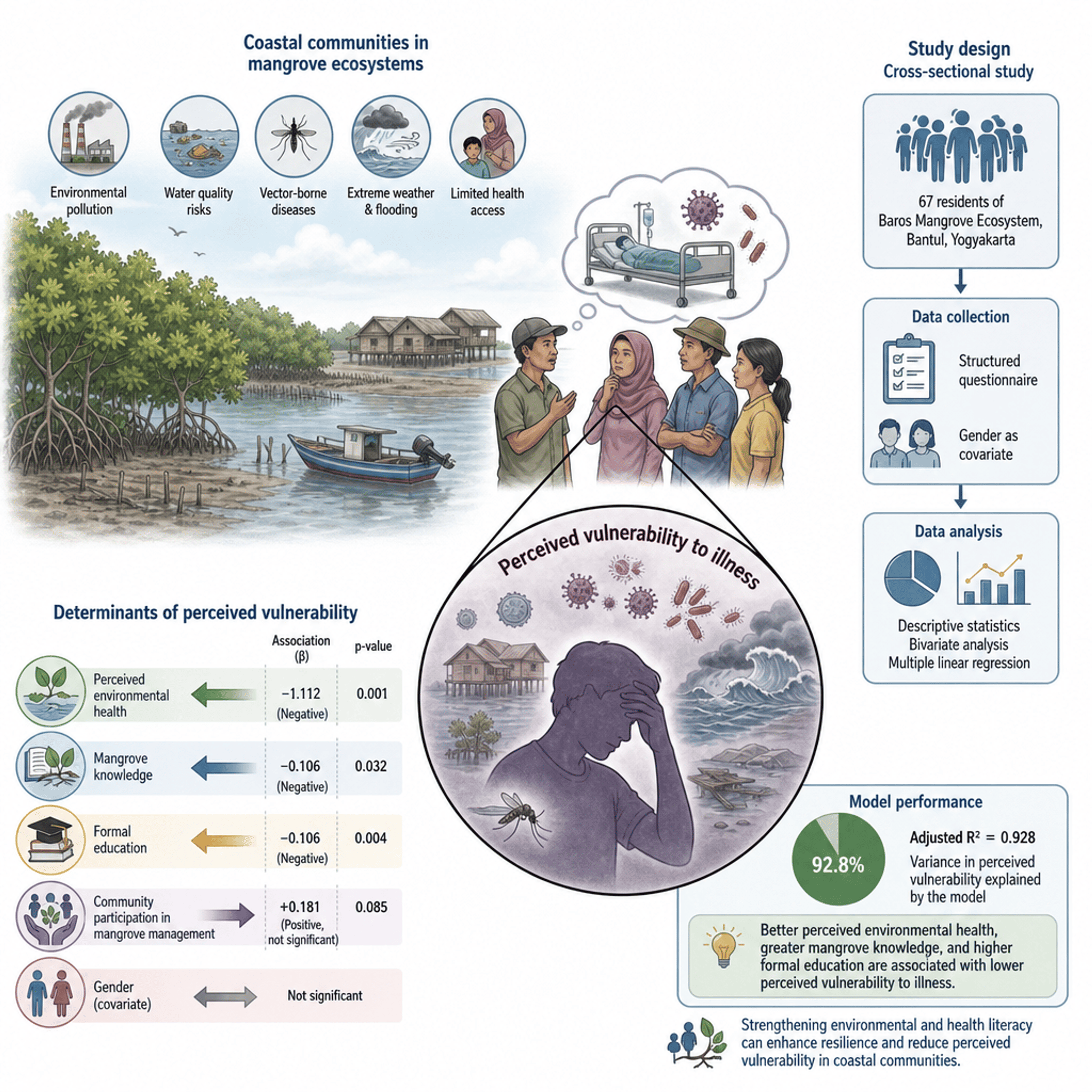
Coastal communities living in mangrove ecosystems are exposed to various environmental and health risks that may influence their perceived vulnerability to illness. Understanding the determinants of perceived vulnerability is important for improving community health resilience. Objective: This study aimed to identify the determinants of perceived vulnerability to illness among communities living in mangrove ecosystems. An observational cross-sectional study was conducted involving 67 residents of the Baros Mangrove Ecosystem, Bantul, Yogyakarta, who were recruited consecutively. Data were collected using a structured questionnaire measuring perceived environmental health, mangrove knowledge, community participation in mangrove management, and formal education, with gender treated as a covariate. Descriptive statistics, bivariate analysis, and multiple linear regression were used to analyze the data. Perceived vulnerability to illness was significantly and negatively associated with perceived environmental health (β = −1.112, p = 0.001), mangrove knowledge (β = −0.106, p = 0.032), and formal education (β = −0.106, p = 0.004). Community participation showed a positive but non-significant association (β = 0.181, p = 0.085), while gender was not significantly associated with perceived vulnerability. The model explained 92.8% of the variance in perceived vulnerability to illness (adjusted R² = 0.928). Perceived environmental health, mangrove-related knowledge, and formal education were significantly associated with perceived vulnerability to illness among coastal communities in mangrove ecosystems. These findings highlight the potential importance of health and environmental literacy in shaping risk perceptions within coastal populations. Further studies with longitudinal designs are needed to clarify the causal relationships between these factors.
Downloads
References
Zakaria M, Karim R, Islam D, Ahmad MS, Ahammad M, Cheng F, et al. Perceptions of coastal dwellers about the effects of extreme temperature and saline water on human health: evidence from Bangladesh. Front Public Heal [Internet]. 2025;13(August):1–10. Available from: https://doi.org/10.21203/rs.3.rs-4334355/v1
Fleming LE, Maycock B, White MP, Depledge MH. Fostering human health through ocean sustainability in the 21st century. People Nat [Internet]. 2019;1(3):276–83. Available from: https://doi.org/10.1002/pan3.10038
Sakati SN, Herawati, Kanan M, Balebu DW. Health Risks of Rainwater Consumption: A Study of Microbiological and Heavy Metal Exposure in Island Areas. J Heal Nutr Res [Internet]. 2025;4(1):29–37. Available from: https://doi.org/10.56303/jhnresearch.v4i1.340
Suhartawan B, Daawia. Coastal Water Quality Index (CWQI) Assessment of Youtefa Bay, Jayapura: Status and Management Implications. J Heal Nutr Res [Internet]. 2025;4(1):287–300. Available from: https://doi.org/10.56303/jhnresearch.v4i1.380
Cushing LJ, Ju Y, Kulp S, Depsky N, Karasaki S, Jaeger J, et al. Toxic Tides and Environmental Injustice: Social Vulnerability to Sea Level Rise and Flooding of Hazardous Sites in Coastal California. Environ Sci Technol [Internet]. 2023;57(19):7370–7381. Available from: https://doi.org/10.1021/acs.est.2c07481
Saifah A, Ardiputra MA, Miswan, Safirah NA, Arifuddin A, Guli M, et al. Ambient Air Pollution Exposure and Social Health Outcomes in Communities Near the Kawatuna Landfill, Palu, Indonesia. J Heal Nutr Res [Internet]. 2025;4(2):869–81. Available from: https://doi.org/10.56303/jhnresearch.v4i2.540
Ratnasari WO, Ningsih SR, Juliana N. Risk Factors for Acute Respiratory Infections in Coastal Areas: A Literature Review and Bibliometric Analysis. J Heal Sci Pharm [Internet]. 2025;2(2):283–95. Available from: https://doi.org/10.36685/jhsp.v2i2.1290
Bio RK, Dupras J, Gagné L. Study of the local population’s perceptions of the ecosystem services provided by mangroves in Benin. Ethnobot Res Appl [Internet]. 2025;30(16):1–15. Available from: http://dx.doi.org/10.32859/era.30.16.1-15
Moore AC, Hierro L, Mir N, Stewart T. Mangrove cultural services and values: Current status and knowledge gaps. People Nat [Internet]. 2022;4(5):1083–97. Available from: https://doi.org/10.1002/pan3.10375
Soalihin, Asmawi, Riyanto D, Ariyani I, Nur NH, Sudiyasa IK. The Role of Local Communities in Responding to Health Crises and Disaster Mitigation: A Systematic Literature Review. J Heal Nutr Res [Internet]. 2025;4(1):235–48. Available from: https://doi.org/10.56303/jhnresearch.v4i1.363
Aerts C, Revilla M, Duval L, Paaijmans K, Chandrabose J, Cox H, et al. Understanding the role of disease knowledge and risk perception in shaping preventive behavior for selected vector-borne diseases in Guyana. PLoS Negl Trop Dis [Internet]. 2020;14(4):1–19. Available from: https://doi.org/10.1371/journal.pntd.0008149
Bulengela GS, Mbwete RI. Engaging with Coastal Ecosystems: Communities’ Perception of Mangroves in Kigamboni, Tanzania. J Res Acad Writ [Internet]. 2025;2(2):1–15. Available from: https://doi.org/10.58721/jraw.v2i2.1104
Maguire PA, Looi JC. Grasping the nettle of danger: a commentary on how people perceive their health risks, impacting on their health behaviours. Australas Psychiatry [Internet]. 2022;30(5):1–7. Available from: https://doi.org/10.1177/10398562221104001
Chen Y, Zhang Z, Shi P, Song X, Wang P, Wei X. Public perception and responses to environmental pollution and health risks: evaluation and implication from a national survey in China. J Risk Res [Internet]. 2017;20(3):1–6. Available from: https://doi.org/10.1080/13669877.2015.1057199
Siegrist M, Árvai J. Risk Perception: Reflections on 40 Years of Research. Risk Anal an Int J. 2020;40(S1):2191–206.
Majid U, Wasim A, Bakshi S, Truong J. Knowledge, (mis-)conceptions, risk perception, and behavior change during pandemics: A scoping review of 149 studies. Public Underst Sci [Internet]. 2020;29(8):1–9. Available from: https://doi.org/10.1177/0963662520963365
Cadena S, Ochoa-gómez J. Mangroves: “Superhero” Ecosystems Santiago. Front Young Minds [Internet]. 2023;10(January):1–7. Available from: https://doi.org/10.3389/frym.2022.812948
Andrian P, Sudrajat J, Suyatno A. The Relationship between Knowledge and Perceptions of Fishing Communities Towards the Existence of Mangrove Forest in Setapuk Besar Urban Village Singkawang City. J Daun [Internet]. 2023;10(2):171–83. Available from: https://doi.org/10.33084/daun.v10i2.5222
Lee B, Davies PA, Schober GS, Lee GK. Vulnerability and Community Participation in Individuals with Multiple Sclerosis: Gratitude as Moderator. J Vocat Rehabil [Internet]. 2025;63(2):198–206. Available from: https://doi.org/10.1177/10522263251357438
Matos-castro JC, Ramos-lucca A, Rosa-jimenez AA, Beauchamp-lebr AM, Motta-pag JL, Morales-torres LM, et al. A Qualitative Approach to Explore Perceptions, Opinions and Beliefs of Communities who Experienced Health Disparities towards Chronic Health Conditions. Int J Environ Res Public Health [Internet]. 2023;20(April):1–12. Available from: https://doi.org/10.3390/ijerph20085572
Beyerl K, Putz O, Breckwoldt A. The Role of Perceptions for Community-Based Marine Resource Management. Front Mar Sci [Internet]. 2016;3(November):1–17. Available from: https://doi.org/10.3389/fmars.2016.00238
Hutan M, Mada UG. IMPLICATION CULTURAL CHARACTERISTICS OF COMMUNITIES SURROUNDING THE SIRIMAU PROTECTED FOREST IN AMBON CITY , MALUKU PROVINCE Hutan Lindung Gunung Sirimau memiliki peran penting dalam menjaga keberlanjutan lingkungan di sekitar Kota Ambon , Maluku . Kawasa. Implic Cult Charact Communities Surround Sirimau Prot For Ambon City, Maluku Prov [Internet]. 2024;1(8):728–35. Available from: https://doi.org/10.69840/marsegu/1.8.2024.728-735
Sun L, Yang S, Li S, Zhang Y. Does education level affect individuals’ environmentally conscious behavior? Evidence from Mainland China. Soc Behav Personal an Int J [Internet]. 2020;48(9):1–12. Available from: https://doi.org/10.2224/sbp.8488
Lin P-Y, Liang W-M, Chang M-C, Chang J-W, Kuo H-W. Environmental health literacy (EHL) and its association with knowledge, attitudes, risk avoidance, and stakeholder trust among residents near a petrochemical industry. Int J Environ Health Res [Internet]. 2025;207(July):1–11. Available from: https://doi.org/10.1080/09603123.2025.2541022
Sharples JM, Oxman AD, Mahtani KR, Chalmers I, Oliver S, Collins K. Critical thinking in healthcare and education. Br Med J [Internet]. 2017;357(May):1–4. Available from: https://doi.org/10.1136/bmj.j2234
Krumov K, Schneider JF, Liu J, Krumova AK, Widodo E, Kliment S. Cross-cultural Research of the Perceived Risk During the COVID-19 Pandemic. J Risk Anal Cris Response [Internet]. 2023;13(1):1–18. Available from: https://doi.org/10.54560/jracr.v13i1.352
Banerjee D. Risk Preference, Gender, Responsibility: A Cross-Cultural Study from India. J Cross Cult Psychol [Internet]. 2023;54(6):1–13. Available from: https://doi.org/10.1177/00220221231193995
Published
How to Cite
Issue
Section
Copyright (c) 2026 Thalita Aldila Pramitasari, Maria Theresia Sri Budiastuti, Sutarno Sutarno

This work is licensed under a Creative Commons Attribution-NonCommercial-ShareAlike 4.0 International License.