The Impact of Multimedia-Based Education on Dietary Diversity and Protein Intake among School Children: A Quasi-Experimental Analysis
Keywords:
Balanced Nutrition Education, Children’s Nutrition Behavior, Multimedia, Dietary Diversity ScoreAbstract
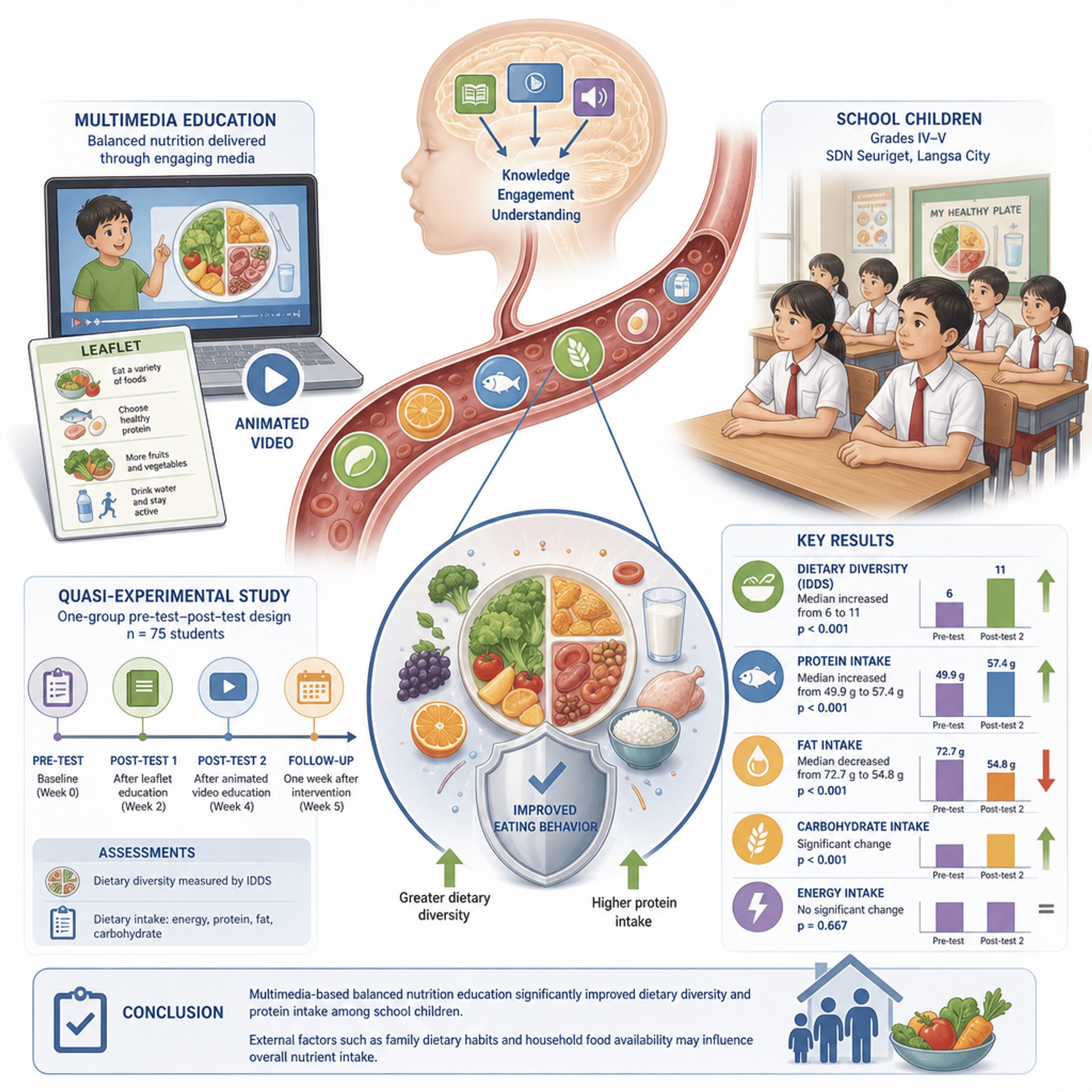
Nutritional problems among school-age children in Indonesia remain a concern due to low consumption of balanced diets. Basic Health Research 2018 reported that only 5.3% of children meet the recommended fruit and vegetable intake. This highlights the need for more effective nutrition education strategies, with multimedia-based approaches offering a more engaging and understandable way to promote healthy eating behaviors. This study aimed to assess the effectiveness of multimedia-based balanced nutrition education in improving the eating behavior of school-age children. A quasi-experimental study with a one-group pre-test–post-test design was conducted among 75 students in grades IV and V at SDN Seuriget, Langsa City, selected using total sampling. The intervention was implemented over five weeks through a gradual educational approach combining leaflets and animated videos on balanced nutrition. Data were collected at four time points: before the intervention (pre-test), after leaflet education (post-test 1), after animated video education (post-test 2), and one week after the intervention (follow-up). Eating behavior was assessed using the IDDS and dietary intake measurements. The results showed significant improvements in several variables. The median IDDS increased from 6 to 11 (p < 0.001). Median protein intake increased from 49.9 g to 57.4 g (p < 0.001). Median fat intake decreased significantly from 72.7 g to 54.8 g (p < 0.001), while carbohydrate intake showed significant changes (p < 0.001). However, energy intake did not show a statistically significant change (p = 0.667). In conclusion, multimedia based nutrition education improved dietary diversity and protein intake. These result suggest that external factors such as family dietary habits and household food availability may affect children’s overall nutrient intake.
Downloads
References
Kementrian Kesehatan RI. Survei Status Gizi Indonesia (SSGI) 2024. Badan Kebijakan Pembangunan Kesehatan, Kementrian Kesehatan RI. 2024. .
Hayati, F. ., Neviyarni, N., & Irdamurni, I. (2021). Karakteristik Perkembangan Siswa Sekolah Dasar : Sebuah Kajian Literatur. Jurnal Pendidikan Tambusai, 5(1), 1809–1815. Retrieved from https://jptam.org/index.php/jptam/article/view/1181.
Badan Penelitian dan Pengembangan Kesehatan. Laporan Nasional Riskesdas 2018. Kementerian Kesehatan Republik Indonesia. 2018. p. hal 156.
Kusumastuty I, Handayani D, Nugroho FA. Pemanfaatan Video Edukasi Dalam Perbaikan Pengetahuan Gizi Pada Remaja. Smart Society Empowerment Journal. 2021;1(3):76. doi:10.20961/ssej.v1i3.56215
Bujuri DA. Analisis Perkembangan Kognitif Anak Usia Dasar dan Implikasinya dalam Kegiatan Belajar Mengajar. LITERASI (Jurnal Ilmu Pendidikan). 2018;9(1):37. doi:10.21927/literasi.2018.9(1).37-50
Azhari MA, Fayasari A. Pengaruh edukasi gizi dengan media ceramah dan video animasi terhadap pengetahuan sikap dan perilaku sarapan serta konsumsi sayur buah. AcTion: Aceh Nutrition Journal. 2020;5(1):55. doi:10.30867/action.v5i1.203
Li SR, Chang YJ. Effectiveness of a nutrition education intervention using simulation videos and encouragement of parental involvement for elementary school students. Journal of Nutritional Science. 2024/09/19 ed. 2024;13:e35. doi:DOI: 10.1017/jns.2024.41
Nova F, Allenidekania A, Agustini N. The effect of multimedia-based nutrition education on parents’ knowledge and body weight change in leukemia children. Enfermería Clínica. 2019;29:229–33. doi:https://doi.org/10.1016/j.enfcli.2019.04.027
Saritessa N, Ibrahim K, Haroen H. Booklet-Based Education in Diabetes Mellitus Patients: A Scoping Review. Journal of Health and Nutrition Research. 2025 Apr 24;4(1 SE-Articles):172–85. doi:10.56303/jhnresearch.v4i1.372
Abraham C, Sheeran P. The Health Belief Model. In: Predicting Health Behaviour: Research and Practice with Social Cognition Models. 2005. p. 28–80.
Luszczynska A, Schwarzer R. Social cognitive theory. In: Predicting and Changing Health Behavior. 2001. p. 225–51.
Nizmah N, Reski S, Wahyuningrum DR, Cahyono J. The Relationship of Balanced Nutrition Knowledge with the Attitudes and Behaviors of Young Women. Journal of Health and Nutrition Research. 2024 Apr 10;3(1 SE-Articles):91–8. doi:10.56303/jhnresearch.v3i1.203
Li SR, Chang YJ. Effectiveness of a nutrition education intervention using simulation videos and encouragement of parental involvement for elementary school students. Journal of Nutritional Science. 2024;13(19):1 of 6. doi:10.1017/jns.2024.41
Nurbaiti N, Safitri SI, Sari Y. The Relationship Between Dietary Diversity And The Risk Of Stunting In Young Children In Indonesia. International Journal of Health & Medical Research. 2024;03(06):368–73. doi:10.58806/ijhmr.2024.v3i06n19
Fayasari FSA. Differences in Knowledge and Behavior Consumption of Vegetable Fruit after Nutrition Education with Video Animation and Leaflet Methods in Elementary Children in Cibinong Bogor. Jurnal Riset Gizi. 2022;10(1).
Vestine V, Muflihatin I, Eko G, Suyoso J, Swari SJ. Hubungan Tingkat Pengetahuan Orang Tua dengan Status Gizi Anak Usia 7–12 Tahun. Jurnal Kesehatan. 2021;9(1):9–14.
Ramadhani J, Yusup A. Peran Keluarga Terhadap Pemenuhan Gizi Anak Usia Sekolah. Jurnal Forum Kesehatan : Media Publikasi Kesehatan Ilmiah. 2022;26–32.
Aryal BK, Mahotra A, Thapa Pachya A, Pahari DP. Effect of an Educational Intervention on Dietary Diversity Practices among Public School Students. Journal of Nepal Health Research Council. 2021 Sep;19(2):239–45. doi:10.33314/jnhrc.v19i2.2255 PubMed PMID: 34601510.
Syawitri WA, Sefrina LR. Pengaruh media, pendidikan gizi, dan lingkungan sebagai penunjang kesadaran dalam pemilihan makanan. Journal of Nutrition College. 2022;11:197–203.
Marwan UK, Alfi NA, Ryska H, Puli T. Efektivitas Edukasi Gizi Berbasis Media Video dalam Meningkatkan Pemahaman Pola Makan Seimbang pada Anak Sekolah Dasar. Jurnal Pengabdian Masyarakat. 2025;1(1).
Ningrum D, Setiadi DK, Sejati AP, Fauziyah RN, Indonesia UP, Sumedang K, et al. The Effect of Animated Video Media-Based Education on Mother ’ s Knowledge. Jurnal Riset Kesehatan Poltekkes Depkes Bandung. 2024;16(1):238–51.
Latif R, Haniarti, Muin H. Pengaruh Media Poster dan Leaflet terhadap Tingkat Pengetahuan dan Sikap Konsumsi Makanan Jajanan Anak Sekolah SMP 1 Patampanua Pinrang. Jurnal Ilmiah Manusia dan Kesehatan. 2018;1(1):272–9.
Mahmudiono T, Nindya TS, Rachmah Q, Segalita C, Wiradnyani LA. Nutrition Education Intervention Increases Fish Consumption among School Children in Indonesia: Results from Behavioral Based Randomized Control Trial. International Journal of Environmental Research and Public Health. 2020. p. 6970. doi:10.3390/ijerph17196970
Mahmood L, Flores-barrantes P, Moreno LA, Manios Y, Gonzalez-gil EM. The Influence of Parental Dietary Behaviors and Practices on Children ’ s Eating Habits. Nutrients. 2021;13:1–13.
Kemenkes. Peraturan Menteri Kesehatan Republik Indonesia Nomor 28 Tahun 2019 tentang Angka Kecukupan Gizi yang Dianjurkan untuk Masyarakat Indonesia. Berita Negara Republik Indonesia. 2019;(956).
Mayer RE. Multimedia Learning. 2009. 1–320 p.
Hansen S, Jensen TS, Schmidt AM, Strøm J, Vistisen P, Høybye MT. The Effectiveness of Video Animations as a Tool to Improve Health Information Recall for Patients: Systematic Review. J Med Internet Res. 2024;26:e58306. doi:10.2196/58306
Raman S, Ooi GS, Ong SC. Assessing the effectiveness of health belief model-based educational interventions on weight control intentions among Malaysians. Scientific reports. 2024 Oct;14(1):25823. doi:10.1038/s41598-024-76114-5 PubMed PMID: 39468191.
Whitton C, Mullan BA, Dhaliwal SS, Norman R, Boushey CJ, Collins CE, et al. The association of cognitive task scores with energy intake measurement error from technology-assisted 24-h recalls. British Journal of Nutrition. 2025/03/03 ed. 2025;133(6):855–64. doi:DOI: 10.1017/S000711452500042X
Published
How to Cite
Issue
Section
Copyright (c) 2026 Fadyassyifa Nurhafidza, Widya Rahmawati, Fuadiyah Nila Kurniasari3

This work is licensed under a Creative Commons Attribution-NonCommercial-ShareAlike 4.0 International License.