Diet Quality, Nutrient Intake, and Estimated Iron and Zinc Bioavailability in Stunted and Normal Toddlers in Bogor Regency, Indonesia: A Comparative Study
Keywords:
Diet Quality, Nutrition Adequacy, Iron and zinc Bioavailability Estimates, Stunted, Sosioeconomic FactorAbstract
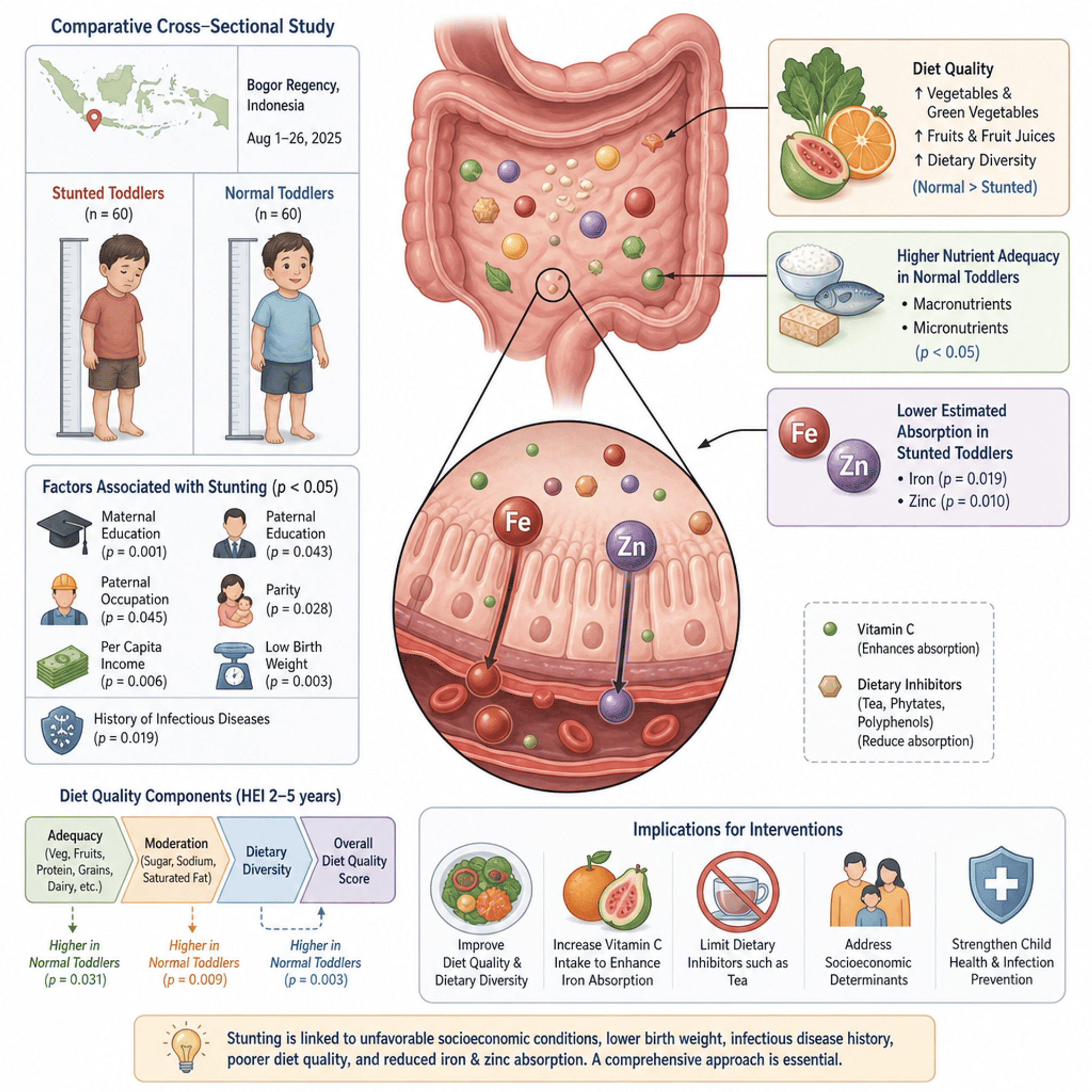
There are still limited studies assessing nutrient intake, especially micronutrients, among stunted children under five. Indonesia also does not yet have official indicators to evaluate diet quality in young children. This study aimed to analyze the differences in diet quality, macro-and micronutrient adequacy, and estimated bioavailability of zinc and iron in stunted and normal toddlers. Using a comparative cross-sectional design, the study was conducted at Purwasari and Kampung Manggis Community Health Centers from August 1 to 26, 2025, involving 60 stunted and 60 normal children. Diet quality was assessed using an Indonesian-adapted Healthy Eating Index (HEI 2–5 years). The results showed significant differences between stunted and normal toddlers in maternal education (p=0.001), paternal education (p=0.043), paternal occupation (p=0.045), parity (p=0.028), per capita income (p=0.006), birth weight (p=0.003), and history of infectious diseases (p=0.019). Diet quality components that differed significantly included vegetables and green vegetables (p=0.031), fruits and fruit juices (p=0.009), and dietary diversity (p=0.003), with normal toddlers demonstrating higher scores. Normal toddlers also had significantly higher adequacy of macronutrients and micronutrients (p<0.05). Estimated iron and zinc absorption were significantly lower among stunted toddlers (iron p=0.019; zinc p=0.010), although overall iron and zinc bioavailability categories did not differ significantly between groups. Stunting among Indonesian toddlers is associated with unfavorable socioeconomic conditions, lower birth weight, history of infectious diseases, needs improvement diet quality, and reduced estimated micronutrient absorption. Interventions should prioritize improving dietary quality, increasing vitamin C intake to enhance iron absorption, and limiting dietary inhibitors such as tea, alongside broader strategies addressing household socioeconomic factors and child health.
Downloads
References
de Onis M, Branca F. Childhood stunting: A global perspective. Matern Child Nutr. 1 Mei 2016;12:12–26.
Leal KK, Schneider BC, França GVA, Gigante DP, Dos Santos I, Assunção MCF. Diet quality of preschool children aged 2 to 5 years living in the urban area of Pelotas, Brazil. Revista Paulista de Pediatria. 1 September 2015;33(3):311–8.
Shinsugi C, Tani Y, Kurotani K, Takimoto H, Ochi M, Fujiwara T. Change in Growth and Diet Quality Among Preschool Children in Tokyo, Japan. Nutrients. 1 Mei 2020;12(5):1290.
Vilela S, Hetherington MM, Oliveira A, Lopes C. Tracking diet variety in childhood and its association with eating behaviours related to appetite: The generation XXI birth cohort. Appetite. April 2018;123:241–8.
Leal KK, Schneider BC, França GVA, Gigante DP, dos Santos I, Assunção MCF. Diet quality of preschool children aged 2 to 5 years living in the urban area of Pelotas, Brazil. Revista Paulista de Pediatria (English Edition). September 2015;33(3):310–7.
INDDEX. International Dietary Data Expansion Project. 2015 [dikutip 1 Maret 2025]. Quality: What is a quality diet and is it the same everywhere? Tersedia pada: https://inddex.nutrition.tufts.edu/data4diets/illustrative-question/quality-what-quality-diet-and-it-same-everywhere
Rolands MR, Toh JY, Sugianto R, Yuan WL, Lee YS, Tan KH, dkk. Development and Evaluation of a Diet Quality Index for Preschool-Aged Children in an Asian population: The Growing Up in Singapore Towards Healthy Outcomes cohort. J Acad Nutr Diet [Internet]. Februari 2023;123(2):299-308.e3. Tersedia pada: https://linkinghub.elsevier.com/retrieve/pii/S2212267222003859
Dalwood P, Marshall S, Burrows TL, McIntosh A, Collins CE. Diet quality indices and their associations with health-related outcomes in children and adolescents: an updated systematic review. Nutr J. 24 Desember 2020;19(1):118.
Nguyen AN, Jen V, Jaddoe VWV, Rivadeneira F, Jansen PW, Ikram MA, dkk. Diet quality in early and mid-childhood in relation to trajectories of growth and body composition. Clinical Nutrition. Maret 2020;39(3):845–52.
Atkins LA, McNaughton SA, Spence AC, Evans LJ, Leech RM, Szymlek-Gay EA. Bioavailability of Australian pre-schooler iron intakes at specific eating occasions is low. Eur J Nutr. 1 Oktober 2024;63(7):2587–98.
Elvandari M, Briawan D, Tanziha I. Suplementasi vitamin A dan asupan zat gizi dengan serum retinol dan morbiditas anak 1-3 tahun. Jurnal Gizi Klinik Indonesia. 4 April 2017;12(4):179–87.
Arini HRB, Hadju V, Thomas P, Ferguson M. Nutrient and Food Intake of Indonesian Children Under 5 Years of Age: A Systematic Review. Vol. 34, Asia-Pacific Journal of Public Health. SAGE Publications Inc.; 2022. hlm. 25–35.
Sutiari NK, Dwipayanti NMU, Astuti PAS, Wulandari KNP, Astuti W. Defisiensi mikronutrien pada anak usia 12-59 bulan di Desa Lebih, Kabupaten Gianyar, Bali. Jurnal Gizi Klinik Indonesia. 30 Oktober 2022;19(2):58.
Goudia BD, Hash CT. Breeding for high grain Fe and Zn levels in cereals. Int J Innov Appl Stud [Internet]. 2015;12(2):342–54. Tersedia pada: http://www.ijias.issr-journals.org/
Krebs NF, Miller L V., Michael Hambidge K. Zinc deficiency in infants and children: A review of its complex and synergistic interactions. Paediatr Int Child Health. 1 November 2014;34(4):279–88.
Gropper SareenS, Smith JackL, Carr TimothyP. Advance Nutrition and Human Metabolism. 7 ed. Boston: Cengage Learning; 2018.
Palmer AC, Bedsaul-Fryer JR, Stephensen CB. Interactions of Nutrition and Infection: The Role of Micronutrient Deficiencies in the Immune Response to Pathogens and Implications for Child Health. Annu Rev Nutr. 29 Agustus 2024;44(1):99–124.
Kemenkes. Hasil Survei Status Gizi Indonesia (SSGI) 2022 [Internet]. Jakarta; 2022 [dikutip 19 Januari 2025]. Tersedia pada: https://layanandata.kemkes.go.id/katalog-data/ssgi/ketersediaan-data/ssgi-2022
Kemenkes. Survey Kesehatan Indonesia [Internet]. Jakarta; 2023 [dikutip 19 September 2024]. Tersedia pada: https://www.kemkes.go.id/id/survei-kesehatan-indonesia-ski-2023
SK Bupati. Penetapan Lokasi Intervensi Stunting di Kabupaten Bogor Tahun 2024. Bogor; 2024.
BPS. Garis Kemiskinan Menurut Kabupaten/Kota (Rupiah/kapita/bulan), 2025 [Internet]. Jawa Barat; 2025 Sep [dikutip 4 Desember 2025]. Tersedia pada: https://jabar.bps.go.id/id/statistics-table/2/NDExIzI=/garis-kemiskinan-menurut-kab-kota.html
Kemenkes. Tabel Komposisi Pangan Indonesia (TKPI) 2017 [Internet]. Jakarta: Direktorat Gizi Masyarakat, Kementerian Kesehatan; 2017 [dikutip 25 November 2025]. Tersedia pada: https://www.panganku.org/id-ID/beranda
Kemenkes. Peraturan Menteri Kesehatan Republik Indonesia Nomor 41 Tahun 2014 [Internet]. Jakarta; 2014 [dikutip 19 September 2024]. Tersedia pada: http://hukor.kemkes.go.id/uploads/produk_hukum/PMK%20No.%2041%20ttg%20Pedoman%20Gizi%20Seimbang.pdf
Kemenkes. Angka Kecukupan Gizi [Internet]. Jakarta; 2019 [dikutip 14 November 2024]. Tersedia pada: http://hukor.kemkes.go.id/uploads/produk_hukum/PMK_No__28_Th_2019_ttg_Angka_Kecukupan_Gizi_Yang_Dianjurkan_Untuk_Masyarakat_Indonesia.pdf
WHO gudeline. Saturated fatty acid and trans-fatty acid intake for adults and children WHO guideline. Geneva; 2023.
Du S, Zhai F, Wang Y, Popkin BM. Current Methods for Estimating Dietary Iron Bioavailability Do Not Work in China. J Nutr. Februari 2000;130(2):193–8.
FAO/IZiNCG. FAO/INFOODS/IZiNCG Global food composition database for phytate version 1.0-PhyFoodComp1.0 User guide [Internet]. 1 ed. Vol. 1. Rome: FAO; 2018. Tersedia pada: www.fao.org/publications
Kalinda C, Qambayot MA, Ishimwe SMC, Regnier D, Bazimya D, Uwizeyimana T, dkk. Leveraging multisectoral approach to understand the determinants of childhood stunting in Rwanda: a systematic review and meta-analysis. BMC. 5 Januari 2024;13(1):16.
Islam B, Ibrahim TI, Wang T, Wu M, Qin J. Current trends in household food insecurity, dietary diversity, and stunting among children under five in Asia: a systematic review. J Glob Health. 17 Januari 2025;15:04049.
Chirande L, Charwe D, Mbwana H, Victor R, Kimboka S, Issaka AI, dkk. Determinants of stunting and severe stunting among under-fives in Tanzania: evidence from the 2010 cross-sectional household survey. BMC Pediatr. 21 Desember 2015;15(1):165.
Beal T, Tumilowicz A, Sutrisna A, Izwardy D, Neufeld LM. A review of child stunting determinants in Indonesia. Matern Child Nutr. 17 Oktober 2018;14(4).
Maseta EJ. Factors associated with stunting among children in Mvomero district Tanzania. Nutr Health. 11 Juli 2024;30(3):521–9.
Ruggiero CF, McHale SM, Paul IM, Savage JS. Learned Experience and Resource Dilution: Conceptualizing Sibling Influences on Parents’ Feeding Practices. Int J Environ Res Public Health. 27 Mei 2021;18(11):5739.
Patriota ÉSO, Abrantes LCS, Figueiredo ACMG, Pizato N, Buccini G, Gonçalves VSS. Association between household food insecurity and stunting in children aged 0−59 months: Systematic review and meta‐analysis of cohort studies. Matern Child Nutr. 9 April 2024;20(2).
Azriani D, Masita, Qinthara NS, Yulita IN, Agustian D, Zuhairini Y, dkk. Risk factors associated with stunting incidence in under five children in Southeast Asia: a scoping review. J Health Popul Nutr. 28 Oktober 2024;43(1):174.
Vats H, Walia GK, Saxena R, Sachdeva MP, Gupta V. Association of Low Birth Weight with the Risk of Childhood Stunting in Low- and Middle-Income Countries: A Systematic Review and Meta-Analysis. Neonatology. 2024;121(2):244–57.
Halli SS, Biradar RA, Prasad JB. Low Birth Weight, the Differentiating Risk Factor for Stunting among Preschool Children in India. Int J Environ Res Public Health. 22 Maret 2022;19(7):3751.
Svefors P, Sysoev O, Ekstrom EC, Persson LA, Arifeen SE, Naved RT, dkk. Relative importance of prenatal and postnatal determinants of stunting: data mining approaches to the MINIMat cohort, Bangladesh. BMJ Open. 5 Agustus 2019;9(8):e025154.
Tiwery IB, Mediani HS, Nurhidayah I. Faktor Proksimal dengan Kejadian Stunting Balita di Negara Berkembang: Systematic Review. Jurnal Obsesi : Jurnal Pendidikan Anak Usia Dini. 29 Desember 2023;7(6):7424–44.
Thurstans S, Opondo C, Seal A, Wells JC, Khara T, Dolan C, dkk. Boys are more likely to be undernourished than girls: A systematic review and meta-analysis of sex differences in undernutrition. 2020.
Thurstans S, Opondo C, Seal A, Wells JC, Khara T, Dolan C, dkk. Understanding Sex Differences in Childhood Undernutrition: A Narrative Review. Nutrients. 23 Februari 2022;14(5):948.
Thompson AL. Greater male vulnerability to stunting? Evaluating sex differences in growth, pathways and biocultural mechanisms. Ann Hum Biol. 18 Agustus 2021;48(6):466–73.
Santosa A, Novanda Arif E, Abdul Ghoni D. Effect of maternal and child factors on stunting: partial least squares structural equation modeling. Clin Exp Pediatr. 15 Februari 2022;65(2):90–7.
Nguyen PT, Nguyen PH, Tran LM, Khuong LQ, Nguyen S Van, Young MF, dkk. Growth patterns of preterm and small for gestational age children during the first 10 years of life. Front Nutr. 26 Februari 2024;11.
Owino V, Ahmed T, Freemark M, Kelly P, Loy A, Manary M, dkk. Environmental Enteric Dysfunction and Growth Failure/Stunting in Global Child Health. Pediatrics. 1 Desember 2016;138(6).
Leroy JL, Frongillo EA. Perspective: What Does Stunting Really Mean? A Critical Review of the Evidence. Advances in Nutrition. Maret 2019;10(2):196–204.
Hayuningtyas A, Dewi YA, Octavia L, Pulungan A, Agustina R. Dietary quality score is positively associated with serum adiponectin level in Indonesian preschool-age children living in the urban area of Jakarta. PLoS One. 4 Februari 2021;16(2):e0246234.
Arini HRB, Hadju V, Thomas P, Ferguson M. Nutrient and Food Intake of Indonesian Children Under 5 Years of Age: A Systematic Review. Asia Pacific Journal of Public Health. 12 Januari 2022;34(1):25–35.
Parvin T, Endres K, Hasan MT, Uddin IM, Bhuyian MSI, Zohura F, dkk. Low Fruit and Vegetable Consumption is Associated with Linear Growth Faltering among Children in Urban Bangladesh. Am J Trop Med Hyg. 15 Juni 2022;106(6):1741–6.
Velde an der LA, Nguyen AN, Schoufour JD, Geelen A, Jaddoe VW V., Franco OH, dkk. Diet quality in childhood: the Generation R Study. Eur J Nutr. 7 April 2019;58(3):1259–69.
Green M, Hadihardjono DN, Pries AM, Izwardy D, Zehner E, Huffman SL. High proportions of children under 3 years of age consume commercially produced snack foods and sugar‐sweetened beverages in Bandung City, Indonesia. Matern Child Nutr. 21 Juni 2019;15(S4).
Manios Y, Kourlaba G, Kondaki K, Grammatikaki E, Birbilis M, Oikonomou E, dkk. Diet Quality of Preschoolers in Greece Based on the Healthy Eating Index: The GENESIS Study. J Am Diet Assoc. April 2009;109(4):616–23.
Verger EO, Dop MC, Martin-Prével Y. Not all dietary diversity scores can legitimately be interpreted as proxies of diet quality. Public Health Nutr. 20 Agustus 2017;20(11):2067–8.
Verger EO, Eussen S, Holmes BA. Evaluation of a nutrient-based diet quality index in UK young children and investigation into the diet quality of consumers of formula and infant foods [Internet]. Vol. 19, Public Health Nutrition. Cambridge University Press (CUP); 2016. hlm. 1785–94. Tersedia pada: https://doi.org/10.1017/s1368980015003134
Ratnayani R, Sunardi D, Fadilah F, Hegar B. Nutrient intake and stunting in children aged 2-5 years in a slum area of Jakarta. Paediatr Indones. 24 April 2024;64(2):132–8.
Beyerlein A, Uusitalo UM, Virtanen SM, Vehik K, Yang J, Winkler C, dkk. Intake of Energy and Protein is Associated with Overweight Risk at Age 5.5 Years: Results from the Prospective TEDDY Study. Obesity. 26 Agustus 2017;25(8):1435–41.
Nguyen AN, Santos S, Braun KVE, Voortman T. Carbohydrate Intake in Early Childhood and Body Composition and Metabolic Health: Results from the Generation R Study. Nutrients. 30 Juni 2020;12(7):1940.
Ernalia Y, Dwi Utari L, . S, Restuastuti T. Different Intakes of Energy and Protein in Stunted and Non-stunted Elementary School Children in Indonesia [Internet]. Vol. 4, KnE Life Sciences. Knowledge E DMCC; 2018. hlm. 556. Tersedia pada: https://doi.org/10.18502/kls.v4i4.2318
Basri H, Hadju V, Zulkifli A, Syam A, Ansariadi, Stang, dkk. Dietary diversity, dietary patterns and dietary intake are associated with stunted children in Jeneponto District, Indonesia. Gac Sanit. 2021;35:S483–6.
Dewi EK, Nindya TS. Hubungan Tingkat Kecukupan Zat Besi Dan Seng Dengan Kejadian Stunting Pada Balita 6-23 Bulan. Amerta Nutrition. 27 Desember 2017;1(4):361.
Fatimah NSH, Wirjatmadi B. Tingkat Kecukupan Vitamin A, Seng Dan Zat Besi Serta Frekuensi Infeksi Pada Balita Stunting Dan Non Stunting. Media Gizi Indonesia. 8 Oktober 2018;13(2):168.
Nugraheni ANS, Nugraheni SA, Lisnawati N. Hubungan Asupan Zat Gizi Makro dan Mineral dengan Kejadian Balita Stunting di Indonesia: Kajian Pustaka. MEDIA KESEHATAN MASYARAKAT INDONESIA. 1 Oktober 2020;19(5):322–30.
Suryana, Marliyati SA, Khomsan A, Cesilia Meti Dwiriani CM. Relationship between macro- and micronutrient intakes with undernutrition among toddlers aged 12-23 months in Aceh, Indonesia. Malays J Nutr. 6 Agustus 2024;30(2).
van Stuijvenberg ME, Nel J, Schoeman SE, Lombard CJ, du Plessis LM, Dhansay MA. Low intake of calcium and vitamin D, but not zinc, iron or vitamin A, is associated with stunting in 2- to 5-year-old children. Nutrition. Juni 2015;31(6):841–6.
Syagata AS, Dewi DAK, Nugroho A, Fauzia FR, Rohmah FN, Khairani K, dkk. Deficit Consumption of Protein and Calcium on Children Aged 2-5 years old in Yogyakarta Indonesia. Journal of Global Nutrition. 30 November 2024;4(2):374–81.
Wati A, Suryana S. Phosphorus and calcium intake of stunted toddlers aged 24-59 months: A case-control study in Sinar Bahagia Village, Simeulue. JAND: Journal of Applied Nutrition and Dietetic. 11 Juni 2022;1(1):43–8.
Sudiarti T. Nutrition Intake and Stunting of Under-Five Children in Bogor West Java, Indonesia. Food Sci Nutr. 9 Juli 2021;7(3):1–7.
Kotecha P. Nutritional anemia in young children with focus on Asia and India. Indian Journal of Community Medicine. 2011;36(1):8.
IOM. Dietary Reference Intakes for Vitamin A, Vitamin K, Arsenic, Boron, Chromium, Copper, Iodine, Iron, Manganese, Molybdenum, Nickel, Silicon, Vanadium, and Zinc [Internet]. 9 ed. Washington (DC): National Academies Press (US); 2001 [dikutip 30 November 2025]. Tersedia pada: https://www.ncbi.nlm.nih.gov/books/NBK222309/
Gibson. Principles of nutritional assessment 3rd edition: zinc [Internet]. 2022 [dikutip 11 Maret 2025]. Tersedia pada: https://nutritionalassessment.org/zinc/
Vergara Carmona VM, Cecílio Filho AB, Almeida HJ de, Gratão PL. Fortification and bioavailability of zinc in potato. J Sci Food Agric. 13 Mei 2019;99(7):3525–9.
Lönnerdal B. Dietary Factors Influencing Zinc Absorption. J Nutr. Mei 2000;130(5):1378S-1383S.
Brouns F. Phytic Acid and Whole Grains for Health Controversy. Nutrients. 22 Desember 2021;14(1):25.
Gupta RK, Gangoliya SS, Singh NK. Reduction of phytic acid and enhancement of bioavailable micronutrients in food grains. J Food Sci Technol. 24 Februari 2015;52(2):676–84.
Gibson RS. Zinc: the missing link in combating micronutrient malnutrition in developing countries. Proceedings of the Nutrition Society. 7 Februari 2006;65(1):51–60.
Published
How to Cite
Issue
Section
Copyright (c) 2026 Rahmauldianti Safitri, Cesilia Meti Dwiriani, Dodik Briawan

This work is licensed under a Creative Commons Attribution-NonCommercial-ShareAlike 4.0 International License.
Most read articles by the same author(s)
- Sofyan Musyabiq Wijaya, Sri Anna Marliyati, Dodik Briawan, Eny Palupi, Bioavailability of Iron in Chicken Nuggets with the Addition of Chicken Liver and Moringa Leaves , Journal of Health and Nutrition Research: Vol. 5 No. 1 (2026)
- Hanin Maulida Fasya, Dodik Briawan, Ali Khomsan, Risk factors of stunting incidence among children aged 6-23 months in fishing families in Brebes Regency , Journal of Health and Nutrition Research: Vol. 5 No. 1 (2026)