Optimization of Sinom and Lime Tea Bag Formulation Using D-Optimal Mixture Design: Physicochemical and Sensory Evaluation
Keywords:
D-optimal mixture design, hedonic test, lime, sinom, turmericAbstract
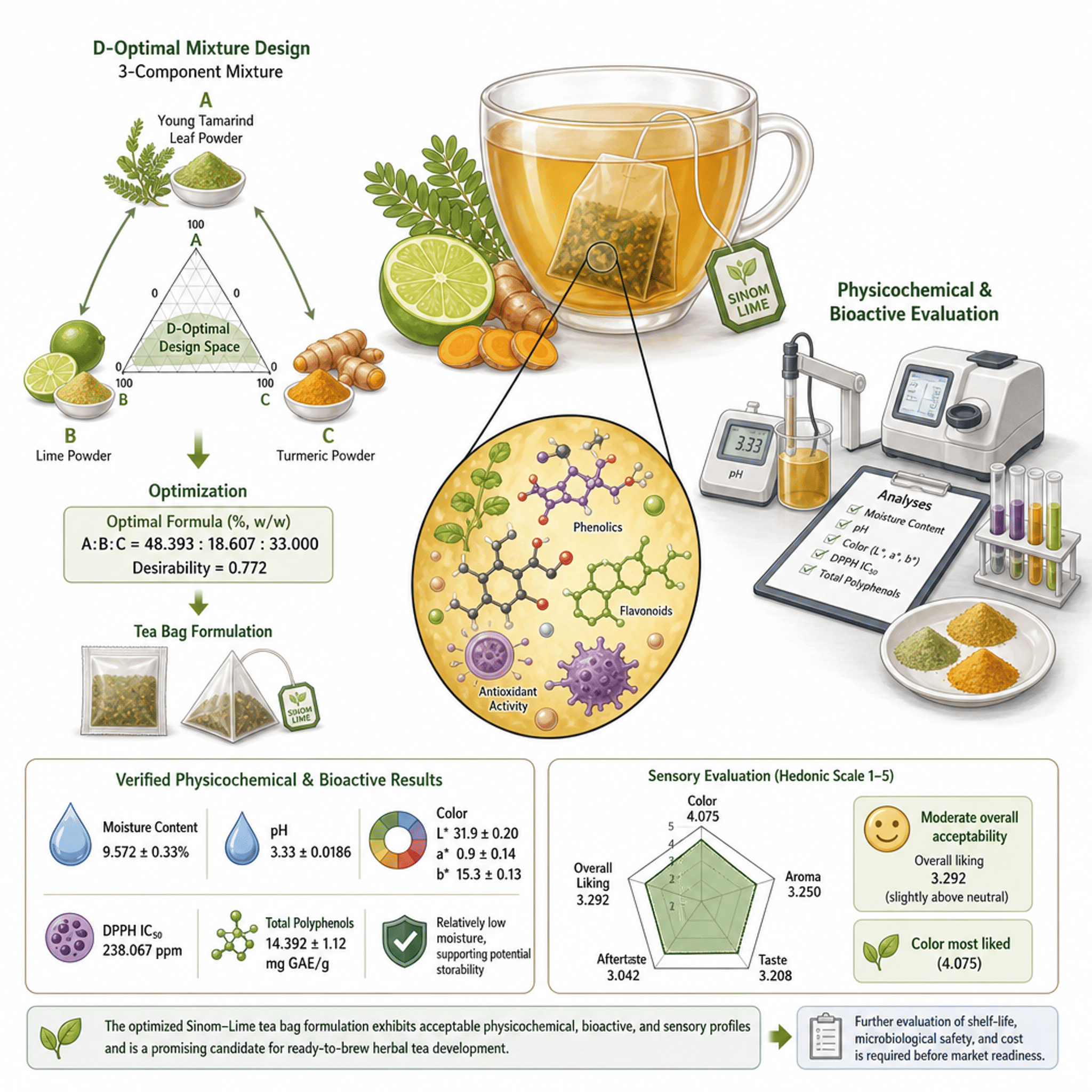
Sinom is a traditional beverage composed of turmeric (Curcuma longa) and young tamarind leaves (Tamarindus indica L.), recognized for its phenolic compounds. To address the limited shelf-life of liquid, ready-to-drink Sinom mixed with lime, this study aimed to develop a more practical, dip-type (tea-bag) formulation. A D-Optimal Mixture Design was applied to optimize the ratio of three dry ingredients: young tamarind leaf powder, lime powder, and turmeric powder. The optimization determined an ideal mixture ratio of 48.393 : 18.607 : 33.000 (% w/w), respectively, achieving a desirability value of 0.772. Physicochemical evaluation of the optimized prototype demonstrated a relatively low moisture content (9.572 ± 0.33%), which theoretically supports storability, and an acidic profile (pH 3.33 ± 0.0186). Colorimetry yielded L*, a*, and b* values of 31.9 ± 0.20, 0.9 ± 0.14, and 15.3 ± 0.13. The antioxidant capacity was moderate, indicated by a DPPH IC₅₀ value of 238.067 ppm and a total polyphenol content of 14.392 ± 1.12 mg GAE/g. Furthermore, hedonic sensory evaluation revealed a moderate overall consumer acceptance (scored 3.292), with the beverage's color receiving the highest preference rating. In conclusion, the D-Optimal Mixture Design successfully produced a ready-to-brew herbal tea candidate with acceptable physicochemical parameters and moderate functional properties. While this dry formulation presents a practical alternative to liquid preparations, further comprehensive investigations—specifically regarding shelf-life profiling, microbiological safety, and cost evaluations—are essential before establishing definitive claims about its long-term stability or market readiness.
Downloads
References
Widyawati. Kemenkes (Generasi Sehat, Masa Depan Hebat). 2021 [cited 2025 Nov 12]. Konsumsi Jamu Jadi Upaya Promotif Preventif, Ini Manfaatnya. Available from: https://kemkes.go.id/id/konsumsi-jamu-jadi-upaya-promotif-preventif-ini-manfaatnya
Akbar DF, Sumarian SH, Susilo B. Analisa Rasio Massa Rimpang Kunyit ( Curcuma longaL.) dan Daun Asam Sinom (Tamarindus indica L.) pada Proses Produksi Bubuk Sinom Legen di PT. Petrokimia Gresik. Jurnal Keteknikan Pertanian Tropis dan Biosistem [Internet]. 2018 [cited 2025 Nov 12];6(2):179–88. Available from: https://jkptb.ub.ac.id/index.php/jkptb/article/view/470
Wiradnyani NK. Dosage Antioxidant Drink Sinom of β Cell Langerhans Islet White Mice Spraque Dawley Diabetes Mellitus. IOP Conf Ser Mater Sci Eng. 2018 Dec 4;434:012325.
Rizeki NW, Olivia Z. Potensi Minuman Sinom terhadap Perubahan Kadar Asam Urat Tikus Hiperurisemia. HARENA: Jurnal Gizi. 2021;1(2):1–9.
Kusumaningsih P, Wiradnyani NK. Identifikasi Fraksi Air Senyawa Antioksidan Minuman Sinom (Curcuma domestica Val.- Tamarindus indica L.) . Jurnal Kesehatan Terpadu. 2019;3(1):36–44.
Elwekeel A, Hassan M, Almutairi E, AlHammad M, Alwhbi F, Abdel-Bakky M, et al. Anti-Inflammatory, Anti-Oxidant, GC-MS Profiling and Molecular Docking Analyses of Non-Polar Extracts from Five Salsola Species. Separations. 2023 Jan 19;10(2):72.
Estiasih T, Maligan JM, Witoyo JE, Mu’alim AAH, Ahmadi K, Mahatmanto T, et al. Indonesian Traditional Herbal Drinks: Diversity, Processing, and Health Benefits. Journal of Ethnic Foods. 2025 Feb 21;12(1):7.
Bodoira R, Rossi Y, Velez A, Montenegro M, Martínez M, Ribotta P, et al. Impact of Storage Conditions on the Composition and Antioxidant Activity of Peanut Skin Phenolic‐based Extract. Int J Food Sci Technol. 2022 Oct 30;57(10):6471–9.
Mileina W, Gabriella M. Minumen Herbal: Temulawak Serai. In: Herbal untuk Kalangan Muda [Internet]. Universitas Katolik Soegijapranata; 2021 [cited 2025 Nov 12]. p. 174–96. Available from: https://repository.unika.ac.id/28625/
Harris H, Fadli M. Determination of Pundang Seluang (Rasbora sp) Shelf Life which Packed using Vacuum and Non Vacuum Packaging. Saintek Perikanan : Indonesian Journal of Fisheries Science and Technology. 2014;9(2):53–62.
Jayani NIE, Hean MR, Krisnayanthi NLA, Islamie R, Rani KC, Parfati N. Evaluation of Stability and Quality Characteristics of Moringa (Moringa oleifera) Herbal Tea during Storage. Food Res. 2022 Aug 28;6(4):399–406.
Prabowo MF, Bimantio MP, Widyowanti RA. Formulasi The Rempah dengan Penambahan Pewarna Alami. BIOFOODTECH : Journal of Bioenergy and Food Technology. 2022 Jul 19;1(1):20–39.
Sahin YB, Demirtaş EA, Burnak N. Mixture Design: A Review of Recent Applications in the Food Industry. Pamukkale University Journal of Engineering Sciences. 2016;22(4):297–304.
Peter EL, Sesaazi CD. D-optimal Mixture Design Optimized Solid Formulation Containing Fruits Extracts of Momordica charantia and Abelmoschus esculentus. PLoS One. 2022 Jun 24;17(6):e0270547.
Zen NIM, Gani SSA, Shamsudin R, Masoumi HRF. The Use of D‐Optimal Mixture Design in Optimizing Development of Okara Tablet Formulation as a Dietary Supplement. The Scientific World Journal. 2015 Jan 11;2015(1).
Kusuma AP. Flexibility of Custom Design over Simplex Lattice Design in Co-Processed Excipient Formulations. Science and Technology Indonesia. 2018 Jan 15;3(1):30–4.
Deepak, Hiremath US, Yadav DKK, Suguna M. Nutrient Composition of Dehydrated Tender Tamarind Leaves (Tamarinds indicia L.) Powder. Indian J Sci Technol. 2016 Oct 10;9(37).
Komonsing N, Khuwijitjaru P, Nagle M, Müller J, Mahayothee B. Effect of drying temperature together with light on drying characteristics and bioactive compounds in turmeric slice. J Food Eng. 2022 Mar;317:110695.
Vuong Q V., Pham HNT, Negus C. From Herbal Teabag to Infusion—Impact of Brewing on Polyphenols and Antioxidant Capacity. Beverages. 2022 Dec 8;8(4):81.
Leng L, Nadzri N, Shaari A, Abdul Razak N, Yee K. Antioxidant Capacity and Total Phenolic Content of Fresh, Oven-Dried and Stir-Fried Tamarind Leaves. Current Research in Nutrition and Food Science Journal. 2017 Dec 24;5(3):282–7.
Maithilikarpagaselvi N, Sridhar MG, Sripradha R. Evaluation of Free Radical Scavenging Activities and Phytochemical Screening of Curcuma longa Extracts. Journal of Young Pharmacists. 2020 Jul 10;12(2):113–7.
Winiarska-Mieczan A, Baranowska-Wójcik E. The Effect of Brewing Time on the Antioxidant Activity of Tea Infusions. Applied Sciences. 2024 Feb 29;14(5):2014.
Badan Standardisasi Nasional. SNI 01-2891-1992 tentang Cara Uji Makanan dan Minuman. 1992.
Jittanit W, Chantara-In M, Deying T, Ratanavong W. Production of Tamarind Powder by Drum Dryer using Maltodextrin and Arabic Gum as Adjuncts. SONGKLANAKARIN JOURNAL OF SCIENCE AND TECHNOLOGY (SJST) [Internet]. 2011 [cited 2025 Nov 12];33(1):33–41. Available from: https://doaj.org/article/9fbd1883cde74def8ba1eff6c3ed1501
Zubaidah E, Dewi CN, Yua ES, Putri NV. Microbiology, Antioxidant, and Antibacterial Activity of Sinom Kombucha. Advances in Food Science, Sustainable Agriculture and Agroindustrial Engineering. 2024 Mar 31;7(1):56–66.
Irwinsyah AD, Assa JR, Oessoe YYE. Analisis Aktivitas Antioksidan dengan Metode DPPH serta Tingkat Penerimaan Kopi Arabika Koya. COCOS. 2022;14.
Sulistyani M, Mahatmanti FW, Huda N, Prasetyo R. Optimization of Microplate Type Uv-vis Spectrophotometer Performance as an Antioxidant Activity Testing Instrument. Indonesian Journal of Chemical Science. 2024;13(1):93–102.
Siagian IDN, Bintoro VP, Nurwantoro. Karakteristik Fisik, Kimia dan Organoleptik Teh Celup Daun Tin dengan Penambahan Daun Stevia (Stevia rebaudiana Bertoni) sebagai Pemanis. Jurnal Teknologi Pangan. 2020;4:23–9.
Internasional Organization for Standarization. ISO 14502-1:2005 Determination of substances characteristic of green and black tea Part 1: Content of total polyphenols in tea — Colorimetric method using Folin-Ciocalteu reagent. 2005.
Phuyal N, Jha PK, Raturi PP, Rajbhandary S. Total Phenolic, Flavonoid Contents, and Antioxidant Activities of Fruit, Seed, and Bark Extracts of Zanthoxylum armatum DC. The Scientific World Journal. 2020 Mar 16;2020:1–7.
Hardiadana MRF, Hudi L, Budiandari RU. Effect of Inulin Concentration and Cooking Time on the Quality of Aloe Vera Jam. Journal of Tropical Food and Agroindustrial Technology. 2022 Apr 8;3(02):33–40.
Mulyani S, Harsojuwono BA, Antara NS, Putra INKP. An Assessment of Antioxidant Characteristics from different ratios Of Turmeric and Tamarind (Curcuma domestica Val.-Tamarindus indica L.) Leaves extracts. Aust J Basic Appl Sci [Internet]. 2016 [cited 2025 Nov 12];10(14):347–53. Available from: https://www.ajbasweb.com/old/ajbas/2016/September/347-353.pdf
Hussein AS, Rezaldi F, Zubaidah E, Wijayanti, Fadillah MF, Fathurrohim MF, et al. Biochemical Characteristics of the Formulation and Preparation of Telang Flower Kombucha Jelly as an Antioxidant, Food and Pharmaceutical Biotechnology Products. Journal of Health and Nutrition Research. 2024 Dec 11;3(3):192–200.
Abasi S, Mousavi SM, Mohebi M, Kiani S. Effect of Time and Temperature on Moisture Content, Shrinkage, and Rehydration of Dried Onion . Iranian Journal of Chemical Engineering [Internet]. 2009 [cited 2025 Nov 13];6(3):57–70. Available from: https://www.ijche.com/article_15162_afb3fe6eda0d866e52e77ac711ea8dbf.pdf
Prangpru N, Treeamnuk T, Jaito K, Vanmontree B, Treeamnuk K. Effect of Temperature on the Physicochemical Properties of Tamarind (Tamarindus Indica) Powder. ETP International Journal of Food Engineering. 2017;
Zheng Z, Wang S, Zhang C, Wu M, Cui D, Fu X, et al. Hot Air Impingement Drying Enhanced Drying Characteristics and Quality Attributes of Ophiopogonis Radix. Foods. 2023 Mar 29;12(7):1441.
Abbaspour-Gilandeh Y, Kaveh M, Fatemi H, Aziz M. Combined Hot Air, Microwave, and Infrared Drying of Hawthorn Fruit: Effects of Ultrasonic Pretreatment on Drying Time, Energy, Qualitative, and Bioactive Compounds’ Properties. Foods. 2021 May 4;10(5):1006.
Hong HT, Rami J, Rychlik M, O’Hare TJ, Netzel ME. Phytochemicals, Organic Acid, and Vitamins in Red Rhapsody Strawberry—Content and Storage Stability. Foods. 2025 Jan 24;14(3):379.
Rajkumar P, Deepa J, Chandrasekaran IR. Mathematical Modeling on Drying of Tamarind Fruits. J Sci Ind Res (India). 2023 Jun;82(06).
Nwodo UU, Obiiyeke GE, Chigor VN, Okoh AI. Assessment of Tamarindus indica Extracts for Antibacterial Activity. Int J Mol Sci. 2011 Sep 26;12(10):6385–96.
Emelike, Tamuno NJ. Functional and Physicochemical Properties of Turmeric Powder as Affected by Processing Methods. Asian Food Science Journal. 2020 Nov 20;1–10.
Raghavendra M, Reddy AM, Yadav PR, Raju AS, Kumar LS. Comparative studies on the in vitro antioxidant properties of methanolic leafy extracts from six edible leafy vegetables of India. Asian Journal of Pharmaceutical and Clinical Research [Internet]. 2013 [cited 2025 Nov 13];6(3):96–9. Available from: https://www.researchgate.net/publication/267036392_Comparative_studies_on_the_in_vitro_antioxidant_properties_of_methanolic_leafy_extracts_from_six_edible_leafy_vegetables_of_India
Kebede BH, Forsido SF, Tola YB, Astatkie T. Free radical scavenging capacity, antibacterial activity and essential oil composition of turmeric (Curcuma domestica) varieties grown in Ethiopia. Heliyon. 2021 Feb;7(2):e06239.
Gomathi R, Anusuya N, Chitravadivu C, Manian S. Antioxidant activity of lettuce tree (Pisonia morindifolia R.Br.) and tamarind tree (Tamarindus indica L.) and their efficacy in peanut oil stability. Food Sci Biotechnol. 2011 Dec 31;20(6):1669–77.
Fagbemi KO, Aina DA, Adeoye-Isijola MO, Naidoo KK, Coopoosamy RM, Olajuyigbe OO. Bioactive compounds, antibacterial and antioxidant activities of methanol extract of Tamarindus indica Linn. Sci Rep. 2022 Jun 8;12(1):9432.
Jumina J, Siswanta D, Zulkarnain AK, Triono S, Priatmoko P, Yuanita E, et al. Development of C-Arylcalix[4]resorcinarenes and C-Arylcalix[4]pyrogallolarenes as Antioxidant and UV-B Protector. Indonesian Journal of Chemistry. 2019 Apr 9;19(2):273.
Akter J, Hossain MdA, Takara K, Islam MdZ, Hou DX. Antioxidant activity of different species and varieties of turmeric (Curcuma spp): Isolation of active compounds. Comparative Biochemistry and Physiology Part C: Toxicology & Pharmacology. 2019 Jan;215:9–17.
Mbunde M, Mdegela RH, Laswai HS, Mabiki FP. Quantification of phenolics, flavonoids and antioxidant activity of Tamarindus indica from selected areas in Tanzania. Biofarmasi Journal of Natural Product Biochemistry. 2018 Feb 1;16(1):22–8.
Obulesu M, Bhattacharya S. Color Changes of Tamarind ( Tamarindus indica L.) Pulp During Fruit Development, Ripening, and Storage. Int J Food Prop. 2011 Mar 29;14(3):538–49.
Alba TM, Tessaro E, Sobottka AM. Seasonal effect on phenolic content and antioxidant activity of young, mature and senescent leaves from Anredera cordifolia (Ten.) Steenis (Basellaceae). Brazilian Journal of Biology. 2024;84.
Putriana AE, Damayanthi E, Palupi E, Nasution Z, Handharyani E. Evaluation of Dietary Fiber, Antioxidant Capacity, Physicochemical Properties, and Consumer Acceptability of a Green Okra (Abelmoschus esculentus L.) Pudding. Journal of Health and Nutrition Research. 2025 Aug 1;4(2):718–26.
Wiyono T, Frediansyah A, Sholikhah EN, Pratiwi WR. UHPLC-ESI-MS analysis of Javanese Tamarindus indica leaves from various tropical zones and their beneficial properties in relation to antiobesity. J Appl Pharm Sci. 2022 Aug 4;137–47.
Singh K, Srichairatanakool S, Chewonarin T, Prommaban A, Samakradhamrongthai RS, Brennan MA, et al. Impact of Green Extraction on Curcuminoid Content, Antioxidant Activities and Anti-Cancer Efficiency (In Vitro) from Turmeric Rhizomes (Curcuma longa L.). Foods. 2022 Nov 14;11(22):3633.
Sıçramaz H. Turmeric-Enriched Yogurt: Increased Antioxidant and Phenolic Contents. Fermentation. 2025 Mar 5;11(3):127.
Astiningsih R, Irawan B, Noerdin A. Effect of turmeric tamarind solution on surface roughness of conventional glass ionomer cement. J Phys Conf Ser. 2018 Aug;1073:032019.
MN M, B F, BG P. Organic acid profiling in tamarind (Tamarindus indica L.) genotypes by high-performance liquid chromatography. International Journal of Advanced Biochemistry Research. 2024 Jan 1;8(8):1452–8.
Nwose SA, Edoziuno F, Osuji SO. Statistical analysis and Response Surface Modelling of the compressive strength inhibition of crude oil in concrete test cubes. Algerian Journal of Engineering and Technology. 20221;4:99–107.
Madondo NI, Rathilal S, Bakare BF. Utilization of Response Surface Methodology in Optimization and Modelling of a Microbial Electrolysis Cell for Wastewater Treatment Using Box–Behnken Design Method. Catalysts. 2022 Sep 16;12(9):1052.
Lu H, Qi Y, Zhao Y, Jin N. Effects of Hydroxyl Group on the Interaction of Carboxylated Flavonoid Derivatives with S. Cerevisiae α-Glucosidase. Curr Comput Aided Drug Des. 2020 Jan 6;16(1):31–44.
Kiamahalleh MV, Najafpour-Darzi G, Rahimnejad M, Moghadamnia AA, Kiamahalleh MV. High performance curcumin subcritical water extraction from turmeric (Curcuma longa L.). Journal of Chromatography B. 2016 Jun;1022:191–8.
Shaik MI, Hamdi IH, Sarbon NM. A comprehensive review on traditional herbal drinks: Physicochemical, phytochemicals and pharmacology properties. Food Chemistry Advances. 2023 Dec;3:100460.
Ruiz-Domínguez MC, Cerezal P, Salinas F, Medina E, Renato-Castro G. Application of Box-Behnken Design and Desirability Function for Green Prospection of Bioactive Compounds from Isochrysis galbana. Applied Sciences. 2020 Apr 17;10(8):2789.
Juwitaningsih DD, Priyono S, Saputri NE. Effect of Honey Type on Chemical and Sensory Quality of Kratom Herbal Tea (Mitragyna speciosa). Journal of Health and Nutrition Research. 2024 Apr 30;3(1):105–10.
Mahdi SA, Astawan M, Wulandari N, Muhandri T, Wresdiyati T, Febrinda AE. Formula Optimization and Physicochemical Characterization of Tempe Drink Powder. Current Research in Nutrition and Food Science Journal. 2022 Dec 20;10(3):1178–95.
Kefale B, Delele MA, Fanta SW, Abate S. Optimization of spicy red pepper paste ( Awaze ) formulation by D‐optimal mixture design. Food Sci Nutr. 2024 Mar 7;12(3):1792–807.
Chen X, Li H, Zhang B, Deng Z. The synergistic and antagonistic antioxidant interactions of dietary phytochemical combinations. Crit Rev Food Sci Nutr. 2022 Jul 8;62(20):5658–77.
Vidović S, Cvetkovic D, Ramić M, Dunjić M, Malbaša R, Tepić A, et al. Screening of changes in content of health benefit compounds, antioxidant activity and microbiological status of medicinal plants during the production of herbal filter tea. Ind Crops Prod. 2013 Oct;50:338–45.
Rashid SNAA, Hasham R, Rashid ZIAbd, Cheng KK, Aziz AA, Shafin N, et al. Formulation and characterization of the physicochemical, antioxidant activity and sensory attributes of curcuma-based herbal drink. Mater Today Proc. 2022;57:1061–6.
Yogeswari M, Baharin BS, Ganesan P. Effect of Room Temperature Storage on the Physicochemical and Antioxidant Properties of Oven Dried Young Tamarind Leaves (Tamarindus Indica) Chutney Powder. Indian J Sci Technol. 2016 Dec 29;9(48).
Indradi RB, Fidrianny I, Wirasutisna KR. DPPH Scavenging Activities and Phytochemical Content of Four Asteraceae Plants. International Journal of Pharmacognosy and Phytochemical Research. 2017 Jun 25;9(6).
Polat A, Kalcıoğlu Z, Müezzinoğlu N. Effect of infusion time on black tea quality, mineral content and sensory properties prepared using traditional Turkish infusion method. Int J Gastron Food Sci. 2022 Sep;29:100559.
Reuss L, Feng S, Hung WL, Yu Q, Gmitter FG, Wang Y. Analysis of flavor and other metabolites in lemon juice (Citrus limon) from Huanglongbing-affected trees grafted on different rootstocks. J Food Drug Anal. 2020 Jun 15;28(2):261–72.
Hasegawa T, Nakatani K, Fujihara T, Yamada H. Aroma of Turmeric: Dependence on the Combination of Groups of Several Odor Constituents. Nat Prod Commun. 2015 Jun 1;10(6).
Septiana AT, Sitoresmi I, Dewi PS. Sensory evaluation, antioxidant activity and total of microbial of tamarindturmeric herbal drink during the storage of refrigerator temperature at various packaging. Food Res. 2018 Mar 26;2(4):391–7.
Junge JY, Bertelsen AS, Mielby LA, Zeng Y, Sun YX, Byrne DV, et al. Taste Interactions between Sweetness of Sucrose and Sourness of Citric and Tartaric Acid among Chinese and Danish Consumers. Foods. 2020 Oct 9;9(10):1425.
Intiyati A, Hafid F, Taufiqurrahman T, Amsal A, Segaran Balan S, Nurdiana S, et al. Acceptability and Iron Content of a Moringa (Moringa oleifera) and Soy-Based Cereal (Keloreal) for Anemia Prevention in Adolescent Girls in Indonesia. Journal of Health and Nutrition Research. 2025 Aug 1;4(2):859–68.
Acar A, Aydın M, Arslan D. Development of infusion tea formulations with food wastes: Evaluation of temperature and time effects on quality parameters. Applied Food Research. 2022 Jun;2(1):100087
Published
How to Cite
Issue
Section
Copyright (c) 2026 Ni Ketut Wiradnyani, I Made Yoga Parwata

This work is licensed under a Creative Commons Attribution-NonCommercial-ShareAlike 4.0 International License.