Exploring Predictors of Psychological Well-Being Among Women Living with Breast Cancer: A Cross-Sectional Study
Keywords:
Breast cancer, Psychological well-being, Health locus of control, MastectomyAbstract
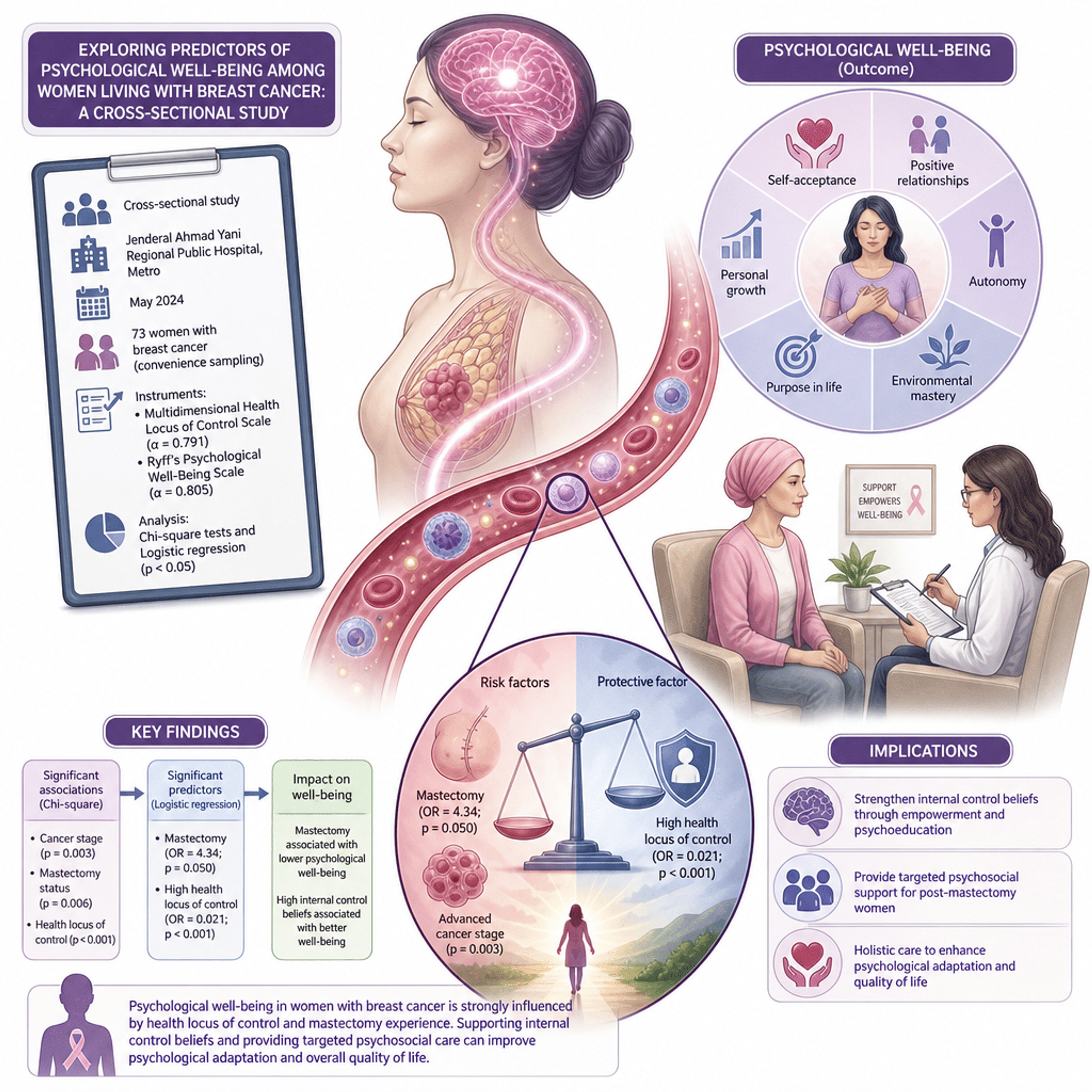
Psychological well-being plays a crucial role in the recovery and quality of life of women diagnosed with breast cancer. Understanding the factors influencing well-being is essential for developing effective psychosocial interventions. This study aims to evaluate the association of several factors with the psychological well-being of women with cancer. A quantitative cross-sectional design was employed at Jenderal Ahmad Yani Regional Public Hospital, Metro, in May 2024. A total of 73 respondents were selected through convenience sampling from a population of 273 patients. Data were collected using the Multidimensional Health Locus of Control Scale (Cronbach’s α = 0.791) and Ryff’s Psychological Well-Being Scale (Cronbach’s α = 0.805). Data were analyzed using Chi-square tests and logistic regression with a significance level of p < 0.05. Chi-square analysis showed that cancer stage (p = 0.003), mastectomy status (p = 0.006), and health locus of control (p < 0.001) were significantly associated with psychological well-being. Logistic regression identified mastectomy and health locus of control as significant predictors. Women who underwent mastectomy were more likely to experience lower psychological well-being (OR = 4.34; p = 0.050), while those with a high health locus of control were more likely to report better well-being (OR = 0.021; p < 0.001). Psychological well-being in women with breast cancer is strongly influenced by health locus of control and mastectomy experience. Enhancing patients’ internal control beliefs and providing targeted psychosocial support, particularly for post-mastectomy patients, may improve psychological adaptation and overall quality of life.
Downloads
References
Bray F, Laversanne M, Sung H, Ferlay J, Siegel RL, Soerjomataram I, et al. Global cancer statistics 2022: GLOBOCAN estimates of incidence and mortality worldwide for 36 cancers in 185 countries. CA Cancer J Clin. 2024;74(3):229–63.
Sung H, Ferlay J, Siegel RL, Laversanne M, Soerjomataram I, Jemal A, et al. Global Cancer Statistics 2020: GLOBOCAN Estimates of Incidence and Mortality Worldwide for 36 Cancers in 185 Countries. CA Cancer J Clin. 2021;71(3):209–49.
Putri RH, Afiyanti Y, Ungsianik T, Milanti A. Supportive care needs and quality of life of patients with gynecological cancer undergoing therapy. Enferm Clin. 2018;28:222–6.
Amalia L, Wulansari I, Yusuf NAR, Haji Jafar CPS. Supportive Care Needs Among Breast Cancer Patients Undergoing Chemotherapy in Gorontalo. J Heal Nutr Res. 2025;4(1):317–27.
Rosenberg SM, Dominici LS, Gelber S, Poorvu PD, Ruddy KJ, Wong JS, et al. Association of Breast Cancer Surgery with Quality of Life and Psychosocial Well-being in Young Breast Cancer Survivors. JAMA Surg. 2020;155(11):1035–42.
Ryff CD. Psychological well-being revisited: Advances in the science and practice of eudaimonia. Psychother Psychosom. 2013;83(1):10–28.
Mishra A, Nair J, Sharan AM. Coping in Post-Mastectomy Breast Cancer Survivors and Need for Intervention: Systematic Review. Breast Cancer Basic Clin Res. 2023;17.
Verri V, Pepe I, Abbatantuono C, Bottalico M, Semeraro C, Moschetta M, et al. The influence of body image on psychological symptomatology in breast cancer women undergoing intervention: a pre-post study. Front Psychol. 2024;15(June):1–15.
Sun L, Ang E, Ang WHD, Lopez V. Losing the breast: A meta-synthesis of the impact in women breast cancer survivors. Psychooncology. 2018;27(2):376–85.
Wallston KA. The validity of the Multidimensional Health Locus of Control scales. J Health Psychol. 2005;10(5):623–31.
Botha F, Dahmann SC. Locus of control, self-control, and health outcomes. SSM - Popul Heal. 2024;25(July 2023):101566.
Ndetei D, Musyimi C, Tele A, Musau A, Gitonga I, Mutiso V. Psychological Well-Being and Social Functioning Across the Cancer Stages: Implications for Palliative Care. J Soc Work End-of-Life Palliat Care. 2018;14(2–3):194–208.
Yang Y, Zhao Y, Yao K, Li W, Sun H. The influence of cancer treatments on long-term psychological outcomes and quality of life in breast cancer patients. BMC Cancer. 2025;25(1).
Bioku AA, Jimeta-Tuko JD, Harris P, Lu B, Kareem A, Sarimiye FO, et al. Psychosocial wellbeing of patients with breast cancer following surgical treatment in Northern Nigeria. BMC Psychiatry. 2025;25(1).
Forbes H, Carreira H, Funston G, Andresen K, Bhatia U, Strongman H, et al. Early, medium and long-term mental health in cancer survivors compared with cancer-free comparators: matched cohort study using linked UK electronic health records. eClinicalMedicine. 2024;76:102826.
Sharif SP. Locus of control, quality of life, anxiety, and depression among Malaysian breast cancer patients: The mediating role of uncertainty. Eur J Oncol Nurs. 2017;27:28–35.
Alwhaibi M, AlRuthia Y, Sales I. The Impact of Depression and Anxiety on Adult Cancer Patients’ Health-Related Quality of Life. J Clin Med. 2023;12(6).
Rat LA, Ghitea TC, Maghiar AM. Psychological Distress and Quality of Life in Patients with Colon Cancer: Predictors, Moderating Effects, and Longitudinal Impact. Healthcare. 2025;13(7).
Fatima I, Yaqoob S, Jamil F, Butt A. Relationship between loci of control and health-promoting behaviors in Pakistani women with polycystic ovary syndrome: coping strategies as mediators. BMC Womens Health. 2021;21(1):1–7.
Zhou K, Wang W, Li M, An J, Huo L, He X, et al. Body image mediates the relationship between post-surgery needs and health-related quality of life among women with breast cancer: A cross-sectional study. Health Qual Life Outcomes. 2020;18(1):1–11.
Alsdfan RM. Research title : Coping Skills and its Associated Factors Among Breast Cancer Women in Iraq : A Cross-Sectional Study. 2024;1–15.
Ha EH, Cho YK. The mediating effects of self-esteem and optimism on the relationship between quality of life and depressive symptoms of breast cancer patients. Psychiatry Investig. 2014;11(4):437–45.
Jones TL, Edbrooke L, Rawstorn JC, Hayes SC, Maddison R, Denehy L, et al. Self-efficacy, motivation, and habits: psychological correlates of exercise among women with breast cancer. Support Care Cancer. 2023;31(10):1–9.
Avis NE, Levine B, Naughton MJ, Case LD, Naftalis E, Van Zee KJ. Age-related longitudinal changes in depressive symptoms following breast cancer diagnosis and treatment. Breast Cancer Res Treat. 2013 May 16;139(1):199–206.
Tao L, Xiang Y, Zeng X, Fu L, Li J, Chen H. Incidence and risk factors for psychological distress in adult female patients with breast cancer: a systematic review and meta-analysis. Front Psychiatry. 2024;15(March).
Sutton TL, Koprowski MA, Grossblatt-Wait A, Brown S, McCarthy G, Liu B, et al. Psychosocial distress is dynamic across the spectrum of cancer care and requires longitudinal screening for patient-centered care. Support Care Cancer. 2022;30(5):4255–64.
Broadbridge E, Greene K, Venetis MK, Lee LE, Banerjee SC, Saraiya B, et al. Facilitating psychological adjustment for breast cancer patients through empathic communication and uncertainty reduction. Patient Educ Couns. 2023;114(January):107791.
Christaputri STW, Triyanto A, Tsauroh SF, Mulyainuningsih WOS, Effendy C. The Types of Support That Enhance Body Image in Patients with Breast Cancer: A Scoping Review. J Heal Nutr Res. 2025 Dec 1;4(3):1225–37.
Su HM, Ismail S, Prasetyo A. Effectiveness of Spiritual-Based Interventions in Enhancing Quality of Life Among Breast Cancer Patients: A Systematic Review. J Heal Nutr Res. 2025;4(2):491–503.
Published
How to Cite
Issue
Section
Copyright (c) 2026 Riska Hediya Putri, Rini Palupi, Feri Kameliawati, Salsabila Nurfadhilah Tsany

This work is licensed under a Creative Commons Attribution-NonCommercial-ShareAlike 4.0 International License.