Estimation of Food Waste and Nutrient Loss in The Free Nutritious Meal Program for Students in East Aceh, Indonesia
Keywords:
Food waste, Free Nutritious Meals Program, Nutritional lossAbstract
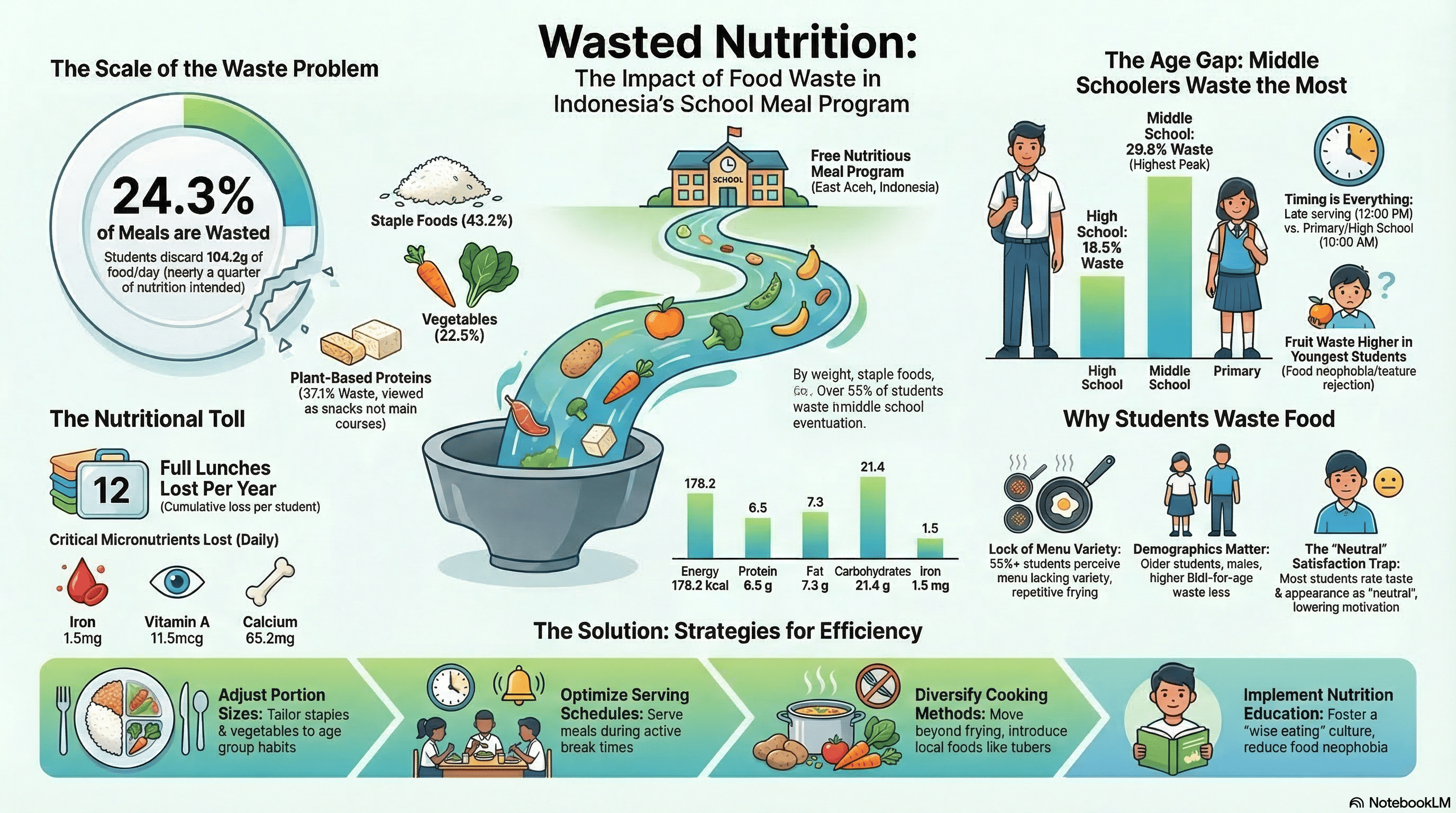
Food waste remains a major challenge in school meal programs, as it not only causes economic losses but also leads to resource inefficiency, and reduced nutritional benefits. This study aims to analyze differences in food waste amounts across free nutritious meal programs at the elementary, middle, and high school levels, estimate nutrient loss, and identify related factors of food waste among students in East Aceh Regency. A cross-sectional design was employed involving 106 students purposively selected from three schools participating in the free nutritious meal programs. Data were collected using a weighing method over a 10-day menu cycle, anthropometric measurements, structured interviews on student characteristics, and food preferences. Data were analyzed using the Kruskal-Wallis test, Pearson and Spearman correlations, and linear regression. The results showed that the average food waste was 24,3% of the served portion, with the highest amount in middle school (29,8%) and the lowest in high school (16,5%). The largest proportion of waste came from staple foods, vegetables, and plant-based side dishes. Nutrient loss due to food waste was equivalent to 12 complete lunch portions for a child per year. Factors significantly associated with food waste were age, gender, BMI-for-age, pocket money, and menu variety (p<0,05). Older students, males, who perceived the menu as more varied, tended to waste less food. These findings highlight the importance of portion adjustment, appropriate serving times, diversified menus, and nutrition education to reduce food waste and optimize the benefits of the Free Nutritious Meal program
Downloads
References
United Nations Environment Programme. Food Waste Index Report 2024. Nairobi: UNEP; 2024. Available from: https://wedocs.unep.org/handle/20.500.11822/45230
Economist Intelligence Unit. Toward more sustainable food system. Fixing Food. 2017;41:26–8.
Food and Agriculture Organization. Food wastage footprint and climate change. Rome: FAO; 2015. Available from: https://www.fao.org/fileadmin/templates/nr/sustainability_pathways/docs/FWF_and_climate_change.pdf
Kementerian Kesehatan Republik Indonesia. SKI 2023 dalam angka. Jakarta: Kemenkes RI; 2024. Available from: https://www.badankebijakan.kemkes.go.id/ski-2023-dalam-angka/
Republic of Indonesia. Presidential Regulation No. 83 of 2024 concerning the National Nutrition Agency (Badan Gizi Nasional) [Internet]. Jakarta: The President of the Republic of Indonesia; 2024 [cited 2025 Oct 6]. Available from: https://peraturan.go.id/
Derqui B, Fernandez V, Fayos T. Towards more sustainable food systems: Addressing food waste at school canteens. Appetite. 2018;129:1–11. Available from: https://doi.org/10.1016/j.appet.2018.06.022
Boschini M, Falasconi L, Giordano C, et al. Food waste in school canteens: A reference methodology for large-scale studies. J Clean Prod. 2018;182:1024–32. Available from: https://doi.org/10.1016/j.jclepro.2018.02.040
García-Herrero L, De Menna F, Vittuari M. Food waste at school: The environmental and cost impact of a canteen meal. Waste Manag. 2019;100:249–58. Available from: https://doi.org/10.1016/j.wasman.2019.09.001
Shanks CB, Milodragovich A, Smith E, et al. Preference for fruits and vegetables is linked to plate waste among preschool children. SSM Popul Health. 2021;15:100908. Available from: https://doi.org/10.1016/j.ssmph.2021.100908
Petchoo J, Kaewchutima N, Tangsuphoom N. Nutritional quality of lunch meals and plate waste in school lunch programme in Southern Thailand. J Nutr Sci. 2022;11:e35. Available from: https://doi.org/10.1017/jns.2022.31
Feng L, Luo R, Liu X, et al. Global school plate waste estimates highlight the need for building a sustainable food education system. Nat Food. 2024;5:860–8. Available from: https://doi.org/10.1038/s43016-024-00732-6
Liu Y, Cheng S, Liu X, Cao X, Xue L, Liu G. Plate waste in school lunch programs in Beijing, China. Sustainability. 2016;8(12):1288. Available from: https://doi.org/10.3390/su8121288
Chapman LE, Cohen J, Canterberry M, Carton TW. Factors associated with school lunch consumption: Reverse recess and school “brunch”. J Acad Nutr Diet. 2017;117(9):1413–8. Available from: https://doi.org/10.1016/j.jand.2017.04.016
Poelman AAM, Delahunty CM, de Graaf C. Vegetables and other core food groups: A comparison of key flavour and texture properties. Food Qual Prefer. 2017;5:1–7. Available from: https://doi.org/10.1016/j.foodqual.2016.09.004
Túróczi Z, Bittsánszky A, Fülöp L, Dunay A, Tóth JA. Examination of plate waste in school catering. In: Dunay A, editor. Proceedings of the 5th International Conference on Management: Management, leadership and strategy for SMEs’ competitiveness. Gödöllő (HU): Szent István University Publishing House; 2015. p. 497–500.
Ilic A, Bituh M, Brečić R, Colić Barić I. Relationship between plate waste and food preferences among primary school students aged 7–10 years. J Nutr Educ Behav. 2022. Available from: https://doi.org/10.1016/j.jneb.2022.04.003
Jinnah DB. A comprehensive review of minerals and vitamins synergy: Impacts on childhood and adolescent bone development. Am J Health Med Nurs Pract. 2023;8:12–30. Available from: https://doi.org/10.47672/ajhmn.1534
Reda Abdel FM, Qasim F, Zaid M, Saleh H, Kazem LQR. Impact of micronutrient deficiencies on child development. Eur J Med Genet Clin Biol. 2024;1(6):261–7. Available from: https://doi.org/10.61796/jmgcb.v1i6.674
Cooper J, Smith A, Jones R. Assessment of wasted nutrient days in food systems. J Nutr Sci. 2018;10(2):123–35. Available from: https://doi.org/10.1017/jns.2018.12
Chen C, Chaudhary A, Mathys A. Nutrition and environmental losses embedded in global food waste. Resour Conserv Recycl. 2020;160:104912. Available from: https://doi.org/10.1016/j.resconrec.2020.104912
Soliha AM, Briawan D, Dwiriani CM, Swamilaksita PD. Nutrient loss due to food waste in urban households: Insights from Bogor City, Indonesia. BIO Web Conf. 2025;153:04005. Available from: https://doi.org/10.1051/bioconf/202515304005
Niaki SF, Moore CE, Chen TA, Cullen KW. Younger elementary school students waste more school lunch foods than older elementary school students. J Acad Nutr Diet. 2017;117(1):95–101. Available from: https://doi.org/10.1016/j.jand.2016.08.005
Nguyen T, van den Berg M, Nguyen M. Food waste in primary schools: Evidence from peri-urban Viet Nam. Appetite. 2023;183:106485. Available from: https://doi.org/10.1016/j.appet.2023.106485
Wang D, Zhang K, Lv X, Xue L, Yang Z, Li P. Analysis of factors influencing college students’ food waste behavior and evaluation of labor education intervention. Front Public Health. 2024;12:1372430. Available from: https://doi.org/10.3389/fpubh.2024.1372430
Qian L, Li F, Liu H, Wang L. Are the slimmer more wasteful? The correlation between body mass index and food wastage among Chinese youth. Sustainability. 2022;14(3):1411. Available from: https://doi.org/10.3390/su14031411
Vici G, Giustozzi D, Camilletti D, Zufolino S, et al. An evaluation and optimization of nutrition, environmental footprint, and food waste in Italian primary school menus: A case study. J Transl Med. 2025;23(1):643. Available from: https://doi.org/10.1186/s12967-025-05862-9
Cohen J, Hecht A, McLoughlin G, Turner L, Schwartz MB. Universal school meals and associations with student participation, attendance, academic performance, diet quality, food security, and body mass index: A systematic review. Nutrients. 2021;13(9):911. Available from: https://doi.org/10.3390/nu13030911
Antón-Peset A, Fernandez-Zamudio MA, Pina T. Promoting food waste reduction at primary schools: A case study. Sustainability. 2021;13(2):600. Available from: https://doi.org/10.3390/su13020600
Ang WZ, Narayanan S, Hong M. Responsible consumption: Addressing individual food waste behavior. Br Food J. 2021;123(9):3245–63. Available from: https://doi.org/10.1108/BFJ-03-2021-0328
Published
How to Cite
Issue
Section
Copyright (c) 2026 Fatimah Zuhra, Ikeu Tanziha, Cesilia Meti Dwiriani, Muhammad Rizki Ramadhani

This work is licensed under a Creative Commons Attribution-NonCommercial-ShareAlike 4.0 International License.
Most read articles by the same author(s)
- Arfah Husna, Hardinsyah Hardinsyah, Cesilia Meti Dwiriani, Lilik Kustiyah, The Association of Breakfast Consumption with Blood Glucose Levels and Short-Term Memory in Primary School Children: A Cross-Sectional Study , Journal of Health and Nutrition Research: Vol. 5 No. 1 (2026)
- Nur Laily Ramdhani, Cesilia Meti Dwiriani, Ali Khomsan , Determinants of Iron Supplementation Compliance Among Adolescent Girls in Kuningan Regency, Indonesia , Journal of Health and Nutrition Research: Vol. 4 No. 3 (2025)