Development and Evaluation of Local Snack-Based Complementary Foods for Toddlers Aged 12–23 Months: Nutritional Adequacy, Acceptability, and Cost Feasibility
Keywords:
Acceptability, Complementary foods, Cost feasibility, Local snacks, Nutritional valueAbstract
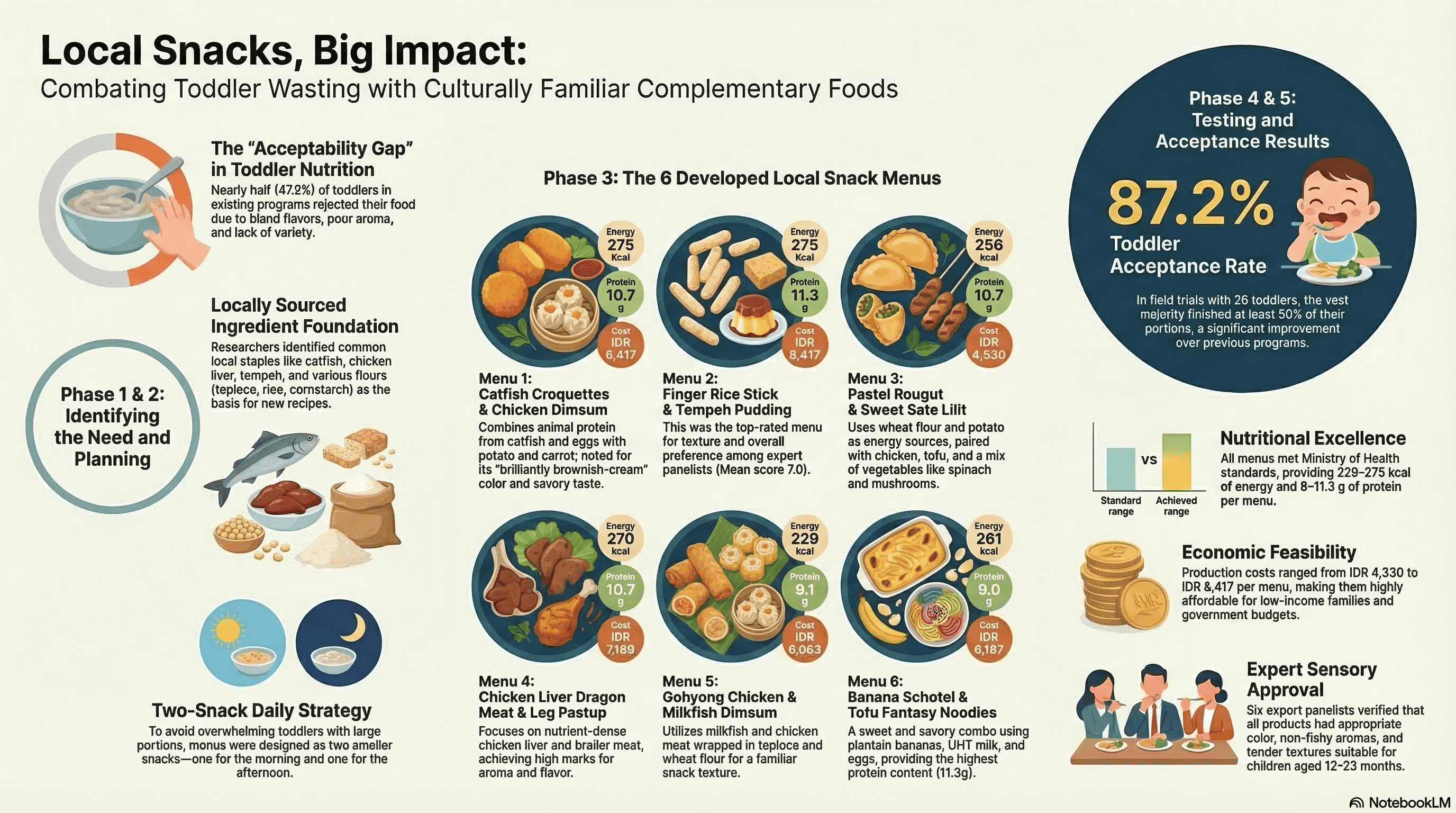
Screening data from 412 toddlers in the Tlogosari Wetan Community Health Center area in 2024 revealed a 9.7% prevalence of wasting, with 45% of cases occurring in children aged 12–23 months. Furthermore, 47.5% of toddlers in local supplementary feeding programs did not consume their full portions, primarily due to limited flavor variety and poor taste acceptability. This study aimed to develop and evaluate the nutritional adequacy, sensory acceptability, and cost feasibility of local snack-based complementary foods (CF) for toddlers aged 12–23 months. A five-stage Research and Development (R&D) design was employed, encompassing preliminary research, planning, product development, expert testing, and field testing. Sensory evaluation was conducted by six expert panelists using hedonic and hedonic quality tests. Field trials involved 26 toddlers to assess acceptance using the Comstock method for food residue analysis. Data were analyzed using Repeated Measures ANOVA and Fisher’s Exact tests. Six CF menus were successfully developed, all meeting national nutritional standards, with an energy content of 229–275 kcal, protein 9–11.3 g, fat 11.2–17.2 g, and a protein-energy ratio (PER) of 13.8–16.4%. The "Finger Rice Stick & Tempe Pudding" menu achieved the highest hedonic score for texture and overall preference (p = 0.009). Toddler acceptance reached 87.2%, with intake levels ranging from 58.9% to 81.3% for energy and protein. Cost analysis indicated the products were affordable, with production costs ranging from IDR 4,330 to IDR 8,417 per menu. The developed local snack-based complementary foods are nutritionally adequate, organoleptically acceptable, and economically feasible. These findings suggest their potential for integration into community-level nutrition programs to support stunting and wasting prevention efforts
Downloads
References
World Health Organization. WHO guideline for complementary feeding of infants and young children 6–23 months of age. World Health Organization, editor. Geneva: World Health Organization; 2023.
UNICEF. Improving young children’s diets during the complementary feeding period: UNICEF programming guidance. Julia D’Aloisio, editor. New York: United Nations Children’s Fund; 2020.
Perpres RI. Peraturan Presiden No.72. 2021.
Rini Puji Lestari T. Evaluasi Kebijakan dan Strategi Penurunan Angka Stunting pada Tahun 2024. J Masal Sos. 2025;16(1):71–86.
Kementerian Kesehatan RI. Survei Kesehatan Indonesia (SKI). Kemenkes. Jakarta: Kemenkes RI; 2023.
Sunarto, Pertiwi ED, Subandriyani DN. Identifikasi Masalah, Pembuatan Makanan Tambahan Berbasis Pangan Lokal, dan Efektifitasnya Untuk Pemulihan Balita Stunting Usia 6-23 Bulan. 2024.
Thurstans S, Sessions N, Dolan C, Sadler K, Cichon B, Isanaka S, et al. The relationship between wasting and stunting in young children: A systematic review. Matern Child Nutr. 2022 Jan;18(1):e13246.
Van Beekum M, Berger J, Van Geystelen J, Hondru G, Som SV, Theary C, et al. The associations between stunting and wasting at 12 months of age and developmental milestones delays in a cohort of Cambodian children. Sci Rep. 2022 Oct;12(1):17859.
Sugiyono. Metode Penelitian Kuantitatif, Kualitatif, dan R&D. Bandung: Alfabeta; 2011. 407 p.
Borg WR, Gall MD. Educational Research: An Introduction. 5th ed. New York: Longman, White Plains, NY; 1989. 783–785 p.
Garnida Y. Uji Inderawi dan Sensori pada Industri Pangan. pertama. Hamidin AS, editor. Bandung: Manggu Makmur Tanjung Lestari; 2020. 315–324 halaman p.
Dede Robiatul Adawiyah. Evaluasi Sensori Produk Pangan. Jakarta: Bumi Aksara; 2024.
Badan Standarisasi Nasional. Petunjuk Pengujian Organoleptik dan Sensori. Jakarta; 2005.
Comstock EM, St Pierre RG, Mackiernan YD. Measuring individual plate waste in school lunches. Visual estimation and children’s ratings vs. actual weighing of plate waste. J Am Diet Assoc. 1981 Sep;79(3):290–6.
Kementrian Kesehatan RI. Petunjuk Teknis Pemantauan Praktik MP-ASI Anak Usia 6-23 Bulan. Jakarta: Kemenkes RI; 2024. 126 p.
Aulia R, Suryani N, Norhasanah, Solechah SA. Daya Terima dan Nilai Gizi MP-ASI Berbahan Pangan Lokal Sebagai Upaya Mencegah Stunting Anak Baduta. J Kesehat. 2023;16(3):234–46.
Kementerian Kesehatan RI. Petunjuk Teknis PMT Kemenkes 2023. Jakarta: Kementerian Kesehatan RI Direktorat Jenderal Kesehatan Masyarakat; 2023.
Hassan T, Mata IBM. Effect of Sorghum Flour and Anchovy Meal Substitution on Organoleptic Properties of Biscuits. J Heal Nutr Res. 2024;3(3):185–91.
Ratnawati R, Satriani S. The Effect of Giving Biscuits Made from Haruan Fish Flour and Yellow Pumpkin on the Nutritional Status of Toddlers. J Heal Nutr Res. 2024;3(2):144–8.
Sudiyanti N, Nailufar F, Wahyunigrum DR, Saraheni S. The Effect of Infant and Young Child Feeding (IYCF) on the Knowledge and Attitudes of Integrated Healthcare Center Cadres. J Heal Nutr Res. 2023;2(3):172–80.
Palinggi M, Rau MJ, Buchair NH, Jannah AR, Rahmania, Dg Sirata MF. Factors Associated with Decreasing Incidence of Stunting in the Working Area of the Palu Health Center. J Heal Nutr Res. 2023;2(1):27–32.
Published
How to Cite
Issue
Section
Copyright (c) 2026 Sunarto Sunarto, Estuasih Dyah Pertiwi, Dyah Nur Subandriani, Addina Rizky Fitriyanti, Zuhria Ismawanti, Arwin Muhlihsoh, Mohamad Reza Assidhiq

This work is licensed under a Creative Commons Attribution-NonCommercial-ShareAlike 4.0 International License.
Most read articles by the same author(s)
- Estuasih Dyah Pertiwi, Sunarto Sunarto, Mohamad Reza Assidhiq, Arwin Muhlihsoh, Arvina Dian Wahyu Permatasari, Effect of Lemuru Fish–Based Local Snacks on HAZ and DHA Levels among Stunted Toddlers: A Quasi-Experimental Study , Journal of Health and Nutrition Research: Vol. 5 No. 2 (2026)