Eating Habits of the To Pekurehua and Javanese Tribes in Central Sulawesi: A Cultural Perspective
Keywords:
Culture, Eating Habits, Household, EthnicityAbstract
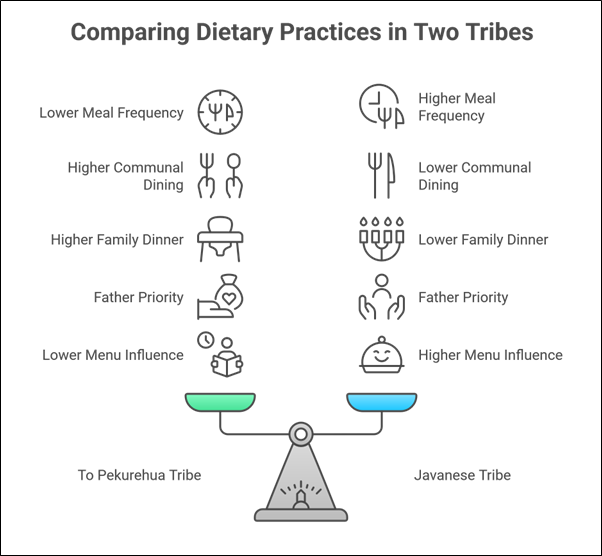
Household characteristics are defined by socioeconomic conditions and other factors, including cultural aspects. Culture dictates dietary choices, methods of preparation, locations, and timing of food preparation. This study examined cultural influences on family dietary practices among the To Pekurehua and Javanese tribes. This research was conducted over a ten-month period, from February to November 2023. The application of this equation yielded a sample of 79 respondents from the North Lore District (representing the To Pekurehua tribe) and 41 respondents from the West Pamona District (representing the Javanese tribe). The To Pekurehua and Javanese tribes possessed average meal frequencies of 2.86 and 3.00 times each day, respectively. The practice of communal dining was observed in 91.1% of the To Pekurehua tribe and 87.8% of the Javanese tribe. The To Pekurehua tribe generated a family dinner participation rate of 87.3%, whereas the Javanese tribe’s rate was 82.9%. In both tribes, fathers, as the head of the household, received priority in food distribution. In contrast, the wives in the Javanese tribe exerted greater influence over the food menu than those in the To Pekurehua tribe.
Downloads
References
Naibaho E, Aritonang EY. Hubungan pendapatan dan pengetahuan gizi ibu dengan ketahanan pangan keluarga di Kabupaten Tapanuli Tengah. TROPHICO: Tropical Public Health J. 2022 Mar 30;2(1):18–23.
Rozaki Z. Food security challenges and opportunities in indonesia post COVID-19. Advances in Food Security and Sustainability. 2021;6:119–68.
Wijaya S. Indonesian food culture mapping: a starter contribution to promote Indonesian culinary tourism. Journal of Ethnic Foods. 2019 Sept 18;6(1):9.
Firdaus N, Cahyono BD. How Food Consumption Pattern And Dietary Diversity Describe Food Security: Evidence From Yogyakarta And East Nusa Tenggara. Jurnal Ekonomi dan Pembangunan. 2017;25(1):27–38.
Fahruqi MN, Moeis JP. Kearifan Lokal Masyarakat Urang Kanekes (Baduy) untuk Ketahanan Pangan Masyaraat dan Kontribusinya untuk Ketahanan Pangan di Kabupaten Lebak dan Provinsi Banten. Jurnal Manajemen Bisnis dan Keuangan. 2024 Apr;5(1):93–106.
BPS-Statistics Indonesia. Kewarganegaraan, Suku Bangsa, Agama, dan Bahasa Sehari-hari Penduduk Indonesia. Hasil Sensus Penduduk 2010. Jakarta, Indonesia: Badan Pusat Statistik; 2011.
Kajian Etnobotani Suku Euphorbiaceae Yang Dimanfaatkan Oleh Suku Pekurehua Di Desa Wuasa Dan Kaduwaa Kecamatan Lore Utara Kabupaten Poso Sulawesi Tengah: Study of Ethnobotany Family Euphorbiaceae Used by Pekurehua Tribe in Wuasa and Kaduwaa, North Lore, Poso, Central Sulawesi | Request PDF. ResearchGate [Internet]. 2025 Aug 10 [cited 2025 Oct 9]; Available from: https://www.researchgate.net/publication/338509464_Kajian_Etnobotani_Suku_Euphorbiaceae_Yang_Dimanfaatkan_Oleh_Suku_Pekurehua_Di_Desa_Wuasa_Dan_Kaduwaa_Kecamatan_Lore_Utara_Kabupaten_Poso_Sulawesi_Tengah_Study_of_Ethnobotany_Family_Euphorbiaceae_Used_
Contento IR. Nutrition education: linking research, theory, and practice. Vol. 17. 2008.
Khomsan A, Wigna DW. Sosio-Budaya Pangan Suku Baduy (Socio-Cultural Aspects of Food of Baduy Tribe). Jurnal Gizi dan Pangan. 2009 July;4(2):63–71.
Fatchiya A, Khomsan A, Riyadi H, Mauludyani AVR, Nurhidayati VA. Food habits based on gender perspective in rural and urban of West Java. International Journal of Public Health Science. 2024 Mar;13(1):260–7.
Park SY, others. Nutritional Epidemiology Dietary Patterns Using the Food Guide Pyramid Groups Are Associated with Sociodemographic and Lifestyle Factors: The Multiethnic Cohort Study. Journal of Nutrition. 2005 Apr;135(4):843–9.
Amrullah ER, Ishida A, Pullaila A, Rusyiana A. Who suffers from food insecurity in Indonesia? International Journal of Social Economics. 2019;46(10):1186–97.
Leyna GH, Mmbaga EJ, Mnyika KS, Hussain A, Klepp KI. Food insecurity is associated with food consumption patterns and anthropometric measures but not serum micronutrient levels in adults in rural Tanzania. Public Health Nutrition. 2010;1438–44.
Vhurumuku E. Food Security Indicators. 2014.
Yusuf WP, Saptorini ES, Suwijah S. Tradisi dan kebiasaan makan pada masyarakat tradisional di Jawa Tengah [Internet]. Departemen Pendidikan dan Kebudayaan; 1997 [cited 2025 Oct 10]. Available from: https://repositori.kemendikdasmen.go.id/13019/
Diana R, Rachmayanti RD, Khomsan A, Riyadi H. Influence of eating concept on eating behavior and stunting in Indonesian Madurese ethnic group. Journal of Ethnic Foods. 2022;9(1).
Rayanti RE, Ubro MS, Sasi GA. Kebiasaan Makan Suku Alune Dengan Hiperurisemia. Jurnal Ilmiah Keperawatan IMELDA [Internet]. 2023;9(2). Available from: http://jurnal.uimedan.ac.id/index.php/JURNALKEPERAWATAN
Ramadhan G, Witono A. Komunikasi Antar Pribadi Anggota Keluarga. Jurnal Komunikasi Bisnis dan Manajemen. 2022 July;9(2).
Wibowo Y, Sutrisna B, Hardinsyah H, Djuwita R, Korib M M, Syafiq A, et al. Relationship between intra-household food distribution and coexistence of dual forms of malnutrition. Nutr Res Pract. 2015 Apr;9(2):174–9.
Vaezghasemi M, Öhman A, Ng N, Hakimi M, Eriksson M. Concerned and conscious, but defenceless - the intersection of gender and generation in child malnutrition in Indonesia: a qualitative grounded theory study. Glob Health Action. 13(1):1744214.
Morrison J, others. Formative qualitative research to develop community-based interventions addressing low birth weight in the plains of Nepal. Public Health Nutrition. 2018 Feb;21(2):377–84.
Harris-Fry HA, others. Status and determinants of intra-household food allocation in rural Nepal. European Journal of Clinical Nutrition. 2018 Nov;72(11):1524–36.
Jaiyeola EF, Aladegbola IA. Patriarchy and Colonization: The ‘Brooder House’ for Gender Inequality in Nigeria. Journal of Research on Women and Gender. 2020 May;10:3–22.
Tanziha I, Khomsan A, Sumarti T, Dina RA, Diana R, Rohmaeni Y. Kebiasaan Makan Balita dan Ketahanan Pangan Rumah Tangga di Daerah Kesetaraan Gender Rendah dan Tinggi di Indonesia: Children’s Food Habits and Food Security among Households in Low and High Gender Equality in Indonesia. Amerta Nutrition. 2023 Sept 5;7(3):365–76.
Tanziha I, Khomsan A, Sumarti T, Dina RA, Diana R, Rohmaeni Y. Children’s Food Habits and Food Security among Households in Low and High Gender Equality in Indonesia. Amerta Nutrition. 2023 Sept;7(3):365–76.
Nurbaiti L, Adi AC, Devi SR, Harthana T. Kebiasaan makan balita stunting pada masyarakat Suku Sasak: Tinjauan 1000 hari pertama kehidupan (HPK) Dietary habit in stunting toddler in Sasak people: Observation of 1000 first day of life. Jurnal Masyarakat, Kebudayaan dan Politik. 2014;27(2):104–12.
Wei W, Sarker T, Roy R, Sarkar A, Rabbany MG. Women’s empowerment and their experience to food security in rural Bangladesh. Sociology of Health & Illness. 2021 May;43(4):971–94.
Ingkadijaya R, Sanim B, Maulana A. Peran Anggota Keluarga Dalam Pemilihan Restoran Di Kawasan Puncak, Kabupaten Bogor. Jurnal Manajemen dan Agribisnis. 2007 Oct;4(2):57–66.
Lufuke M, Bai Y, Fan S, Tian X. Women’s Empowerment, Food Security, and Nutrition Transition in Africa. International Journal of Environmental Research and Public Health. 2023;
Karim R, Lindberg L, Wamala S, Emmelin M. Men’s Perceptions of Women’s Participation in Development Initiatives in Rural Bangladesh. American Journal of Men’s Health. 2018 Mar;12(2):398–410.
Published
How to Cite
Issue
Section
Copyright (c) 2025 Rustam Abd. Rauf, Shintami R. Malik , Lien Damayanti , Aulia Rahman, Chitra A. Salingkat , Hardiyanti Sultan, Erny Erny

This work is licensed under a Creative Commons Attribution-NonCommercial-ShareAlike 4.0 International License.