Physician Knowledge and Training as Determinants of Informed Consent Implementation: A Cross-Sectional Study in Two Indonesian Hospitals
Keywords:
Informed consent, Knowledge, Training, Completeness of implementationAbstract
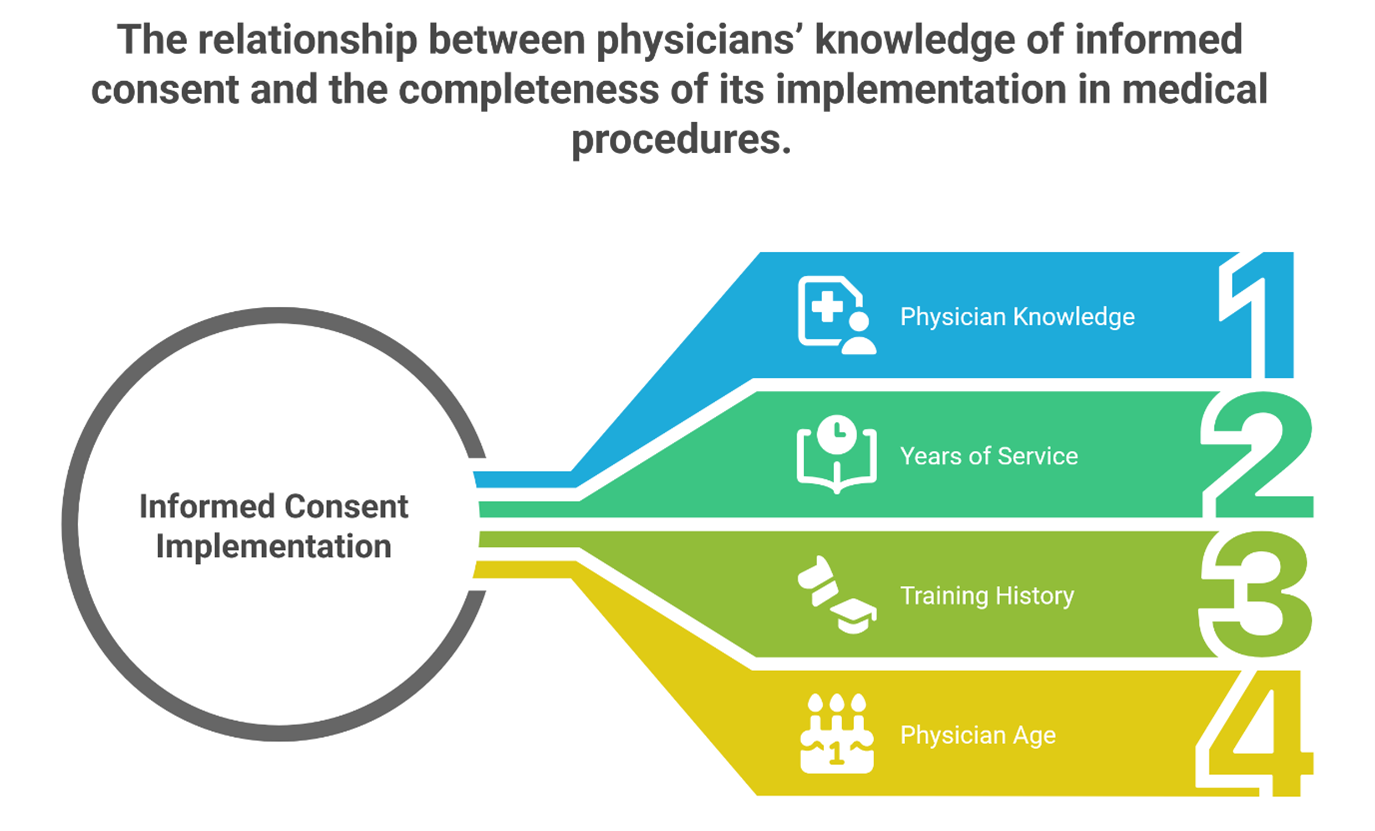
This study aims to analyze the relationship between physicians’ knowledge of informed consent and the completeness of its implementation in medical procedures. The research employed an observational analytic approach with a cross-sectional design and quantitative methods. The study population consisted of general practitioners, specialists, dentists, and dental specialists working at Banten Provincial General Hospital and Dr. Drajat Prawiranegara Regional General Hospital. A total of 94 physicians were included as respondents. The variables examined included physicians’ knowledge of informed consent, the completeness of its implementation, and respondent characteristics such as age, years of service, and training history. Data were analyzed using the chi-square test with a significance level of p < 0.05. The results indicated a significant association between physicians’ knowledge, years of service, and prior training with the completeness of informed consent implementation. Physicians with good knowledge demonstrated a higher likelihood of complete implementation (OR 10.6; 95% CI 3.7–30.4) compared to those with poorer knowledge. Similarly, physicians with less than five years of service had a higher rate of complete informed consent implementation (78%) compared to those with five or more years of service (57.1%). Moreover, those who had received training were significantly more likely to implement informed consent completely (OR 6.95; 95% CI 1.51-31.94) than those without training experience. In contrast, physician age was not significantly associated with informed consent completeness. In conclusion, enhancing physician knowledge and promoting ongoing training are essential to improving the quality of informed consent practices in clinical settings.
Downloads
References
Beauchamp TL. Informed Consent: Its History, Meaning, and Present Challenges. Camb Q Healthc Ethics. 2011 Oct;20(4):515–23.
Indina F. Kajian Yuridis Persetujuan Tindakan Medis (Informed Consent) Dalam Perspektif Undang-Undang No 17 Tahun 2023 Tentang Kesehatan. J Cahaya Mandalika ISSN 2721-4796 Online. 2024 Sept 26;3(1):633–8.
Filia M. Aspek Hukum Persetujuan Tindakan Medis (Informed Consent) Dalam Penerapan Teknik Operasi Bedah Jantung. J Esensi Huk. 2019 Dec 18;1(1):96–108.
Busro A. Aspek Hukum Persetujuan Tindakan Medis (Inform Consent) Dalam pelayanan Kesehatan. Law Dev Justice Rev. 2018 Nov 9;1(1):1–18.
Wahyuni CID, Laskarwati B, Al Qulub NM. Informed Consent in Health Services: How are the Patients’ Rights Protected? J Law Leg Reform. 2020 July 31;1(4):591–604.
Novita AI. Tingkat Pengetahuan Dokter Terhadap Kelengkapan Penyampaian Informasi Dalam Pelaksanaan Informed Consent Di Rumah Sakit Wilayah Kota Surakarta [Internet] [Skripsi]. [Yogyakarta]: Universitas Gadjah Mada; 2014 [cited 2025 Mar 2]. Available from: https://etd.repository.ugm.ac.id/penelitian/detail/73835
Fikriya K, Sriatmi A, Jati SP. Analisis Persetujuan Tindakan Kedokteran (Informed Consent) Dalam Rangka Persiapan Akreditasi Rumah Sakit di Instalasi Bedah Sentral RSUD Kota Semarang. J Kesehat Masy. 2016 Mar 2;4(1):44–54.
Zewudie BT, Tenaw SG, Mesfin Y, Abebe H, Mekonnen Z, Mengist ST, et al. Practice and factors affecting informed consent among healthcare workers for major surgical procedures at Gurage zone hospitals, South Ethiopia, 2022: a facility-based cross-sectional study. BMJ Open. 2025 Jan 1;15(1):e083253.
Ashraf B, Tasnim N, Saaiq M, Zaman KU. An audit of the knowledge and attitudes of doctors towards Surgical Informed Consent (SIC). Int J Health Policy Manag. 2014 Oct 27;3(6):315–21.
Hall DE, Prochazka AV, Fink AS. Informed consent for clinical treatment. CMAJ. 2012 Mar 20;184(5):533–40.
Wood F, Martin SM, Carson‐Stevens A, Elwyn G, Precious E, Kinnersley P. Doctors’ perspectives of informed consent for non‐emergency surgical procedures: a qualitative interview study. Health Expect Int J Public Particip Health Care Health Policy. 2016 June;19(3):751–61.
Saptanty D, Anwari AZ, Norfai N, Irianty H. Hubungan Usia dan Masa Kerja Dengan Kelengkapan Pengisian Rekam Medis Pasien Rawat Inap Di RSUD Ulin Banjarmasin. -Nadaa J Kesehat Masy E-J. 2022 June 5;9(1):73–8.
Nurmalasari Y, Aryanti W. Analisis Faktor Ketenagaan Yang Berhubungan Dengan Kelengkapan Pengisian Rekam Medis Pada Pasien Rawat Inap Di RS Pertamina Bintang Amin Bandar Lampung. J Ilmu Kedokt Dan Kesehat. 2017;4(4):271–6.
Anderson TN, Aalami LR, Lee EW, Merrell SB, Sgroi MD, Lin DT, et al. Perception and confidence of medical students in informed consent: A core EPA. Surgery. 2020 Apr 1;167(4):712–6.
Fasya F, Umar Z. Sosialisasi Tata Laksana Pengisian Informed Consent di Klinik Umum dan Bersalin Ramlah Parjib 1. J Pengabdi Kpd Masy Nusant. 2024 Sept 30;6(1):462–6.
Published
How to Cite
Issue
Section
Copyright (c) 2025 Diyanthie Aulia Putrihamidah, Baety Adhayati, Melva Louisa

This work is licensed under a Creative Commons Attribution-NonCommercial-ShareAlike 4.0 International License.
Most read articles by the same author(s)
- Baety Adhayati, Diyanthie Aulia Putrihamidah, Melva Louisa, Ali Sodikin, The Accuracy of Information Recipients and Consent Givers for Informed Consent in Hospitals , Journal of Health and Nutrition Research: Vol. 3 No. 3 (2024)