Enhancing Anthocyanin Butterfly Pea Stability using Encapsulation: A Scoping Review of Coating Materials and Techniques
Keywords:
Anthocyanin, Coating Agent, Encapsulation, Stability, TechniqueAbstract
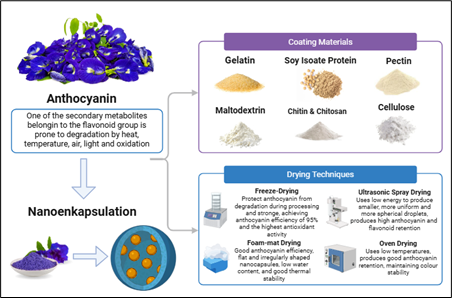
Butterfly pea flowers are rich in anthocyanin and have therapeutic benefits, particularly due to their antioxidant properties. However, their use in the food and pharmaceutical industries is still limited due to their low stability in environmental conditions, which causes degradation, decreased stability and bioavailability. Nanoencapsulation is a potential method for improving the stability and effectiveness of anthocyanin. This review aims to identify various coating materials and encapsulation techniques used to protect anthocyanin in butterfly pea flowers, as well as to evaluate their effects on the final product's stability, characteristics, and physicochemical properties. Literature search were conducted through PubMed, ScienceDirect, Scopus, and SpringerLink using structured keywords, following the inclusion criteria based on the Population, Concept, Context (PCC) framework and the PRISMA-ScR protocol. A total 7 published articles met the inclusion criteria. The results show that combination gelatin with coating materials such as pectin or maltodextrin was effective and commonly used. The use combination of gelatin+pectin or gelatin+maltodextrin with freeze drying is capable of forming a strong film, binding anthocyanin, stabilising colour, and proceting anthocyanin from degradation due to its low-temperature process, resulting in high encapsulation efficiency, high retention, and good morphology and particele size. In conclusion, no ideal coating material and encapsulation techniques. Further in vivo bioavailability studies are warranted to evaluate the most promising combinations, gelatin + pectin or gelatin + maltodextrin with freeze drying.
Downloads
References
Grzebieniarz W, Tkaczewska J, Juszczak L, Kawecka A, Krzyściak P, Nowak N, et al. The influence of aqueous butterfly pea (Clitoria ternatea) flower extract on active and intelligent properties of furcellaran Double-Layered films - in vitro and in vivo research. Food Chem [Internet]. 2023 Jul 1 [cited 2025 Jun 2];413:135612. Available from: https://www.sciencedirect.com/science/article/pii/S0308814623002285
Widowati W, Wargasetia TL, Zakaria TM, Marthania M, Gunadi MS, Halim N, et al. Antioxidant Activities of Ginger (Zingiber officinale Roscoe) and Telang Flower (Clitoria ternatea L.) Combination Tea. Maj Kedokt Bandung. 2022;54(3):154–60.
Chayaratanasin P, Allen C, Chturong S, Saenset S, Pasukampnset P, Suanpairintr N, et al. Clitoria ternatea Flower Petal Extract Inhibits Adipogenesis and Lipid Accumulation in 3T3-L1 Preadipocytes by Downregulating Adipogenic Gene Expression. Molecules. 2019;24:1894.
Daveri E, Cremonini E, Mastaloudis A, Hester SN, Wood SM, Waterhouse AL, et al. Cyanidin and delphinidin modulate inflammation and altered redox signaling improving insulin resistance in high fat-fed mice. Redox Biol. 2018;18(April):16–24.
Multisona RR, Shirodkar S, Arnold M, Gramza-Michalowska A. Clitoria ternatea Flower and Its Bioactive Compounds: Potential Use as Microencapsulated Ingredient for Functional Foods. Appl Sci 2023, Vol 13, Page 2134 [Internet]. 2023 Feb 7 [cited 2025 Jun 2];13(4):2134. Available from: https://www.mdpi.com/2076-3417/13/4/2134/htm
Vidana Gamage GC, Lim YY, Choo WS. Anthocyanins From Clitoria ternatea Flower: Biosynthesis, Extraction, Stability, Antioxidant Activity, and Applications. Front Plant Sci. 2021;12(December):1–17.
Gómez-Gaete C, Avendaño-Godoy J, Escobar-Avello D, Campos-Requena VH, Rogel-Castillo C, Estevinho LM, et al. Revolutionizing fruit juice: exploring encapsulation techniques for bioactive compounds and their impact on nutrition, flavour and shelf life. Food Prod Process Nutr [Internet]. 2024;6(1). Available from: https://doi.org/10.1186/s43014-023-00190-9
Yudiono K. Effect of Maltodextrin Concentrations and Drying Temperature on the Physico-chemical Characteristics and Color Measurements of Butterfly Pea Flowers (Clitoria ternatea L) Powder. Turkish J Agric - Food Sci Technol. 2024;12(4):657–65.
Alu’datt MH, Alrosan M, Gammoh S, Tranchant CC, Alhamad MN, Rababah T, et al. Encapsulation-based technologies for bioactive compounds and their application in the food industry: A roadmap for food-derived functional and health-promoting ingredients. Food Biosci [Internet]. 2022;50(PA):101971. Available from: https://doi.org/10.1016/j.fbio.2022.101971
Taouzinet L, Djaoudene O, Fatmi S, Bouiche C, Amrane-Abider M, Bougherra H, et al. Trends of Nanoencapsulation Strategy for Natural Compounds in the Food Industry. Processes. 2023;11(5):1–31.
Fuzetti CG, de Castilhos MBM, Nicoletti VR. Microencapsulation of natural blue dye from butterfly pea (Clitoria ternatea L.) flowers: The application of different carriers. J Food Process Preserv. 2022;46(4):1–12.
Andrade D, Maldonado-Bravo F, Alburquerque A, Pérez C, Gamboa A, Caro N, et al. Nanoencapsulation of Maqui (Aristotelia chilensis) Extract in Chitosan–Tripolyphosphate and Chenopodin-Based Systems. Antioxidants 2024, Vol 13, Page 273 [Internet]. 2024 Feb 23 [cited 2024 Sep 10];13(3):273. Available from: https://www.mdpi.com/2076-3921/13/3/273/htm
Westphaln KK, Regoeczi W, Masotya M, Vazquez-Westphaln B, Lounsbury K, McDavid L, et al. From Arksey and O’Malley and Beyond: Customizations to enhance a team-based, mixed approach to scoping review methodology. MethodsX [Internet]. 2021;8:101375. Available from: https://doi.org/10.1016/j.mex.2021.101375
Tricco AC, Lillie E, Zarin W, O’Brien KK, Colquhoun H, Levac D, et al. PRISMA extension for scoping reviews (PRISMA-ScR): Checklist and explanation. Ann Intern Med [Internet]. 2018 Oct 2 [cited 2025 Jun 17];169(7):467–73. Available from: /doi/pdf/10.7326/M18-0850?download=true
MacFarlane A, Russell-Rose T, Shokraneh F. Search strategy formulation for systematic reviews: Issues, challenges and opportunities. Intell Syst with Appl [Internet]. 2022;15:200091. Available from: https://doi.org/10.1016/j.iswa.2022.200091
Maneeratanachot S, Chetpattananondh P, Kungsanant S. Encapsulation of anthocyanin from butterfly pea flowers (Clitoria ternatea L.) extract using foam-mat drying. Food Bioprod Process [Internet]. 2024 May 1 [cited 2025 Jun 11];145:105–15. Available from: https://www.sciencedirect.com/science/article/abs/pii/S0960308524000622
Liew SY, Mohd Zin Z, Mohd Maidin NM, Mamat H, Zainol MK. Effect of the different encapsulation methods on the physicochemical and biological properties of clitoria ternatea flowers microencapsulated in gelatine. Food Res. 2020 Aug 1;4(4):1098–108.
Narayanan GP, Radhakrishnan P, Baiju P, S AM. Fabrication Of Butterfly Pea Flower Anthocyanin-Incorporated Colorimetric Indicator Film Based On Gelatin/Pectin For Monitoring Fish Freshness. Food Hydrocoll Heal [Internet]. 2023 Dec 15 [cited 2025 Jun 3];4. Available from: https://www.sciencedirect.com/science/article/pii/S2667025923000432
Hailu FW, Fanta SW, Tsige AA, Delele MA. Development of simple and biodegradable pH indicator films from cellulose and anthocyanin. Discov Sustain. 2025 Dec 1;6(1).
Koshy RR, Reghunadhan A, Mary SK, Pillai PS, Joseph S, Pothen LA. pH indicator films fabricated from soy protein isolate modified with chitin nanowhisker and Clitoria ternatea flower extract. Curr Res Food Sci [Internet]. 2022 Jan 1 [cited 2025 Jun 11];5:743–51. Available from: https://www.sciencedirect.com/science/article/pii/S2665927122000570
Lyn FH, Dini Batrisyia · J Nur, Adilah · A Nor, Hanani · Z A Nur. Gelatin/Butterfly Pea (Clitoria ternatea) Extract Film as Intelligent Packaging: Effects of Storage Temperature. J Packag Technol Res 2024 83 [Internet]. 2024 Nov 5 [cited 2025 Jun 17];8(3):217–28. Available from: https://link.springer.com/article/10.1007/s41783-024-00177-y
Punbusayakul N, Jaisan C, Kaewprachu P, Yarnpakdee S, Chakrabandhu Y. Improvement of the physicochemical and mechanical properties of intelligent gelatin/butterfly pea films using coconut milk residue. Appl Food Res [Internet]. 2025 Jun 1 [cited 2025 Jun 3];5(1). Available from: https://www.sciencedirect.com/science/article/pii/S2772502225001246
Tan Y, Zi Y, Peng J, Shi C, Zheng Y, Zhong J. Gelatin as a bioactive nanodelivery system for functional food applications. Food Chem. 2023 Oct 15;423:136265.
Lu Y, Luo Q, Chu Y, Tao N, Deng S, Wang L, et al. Application of Gelatin in Food Packaging: A Review. Polymers (Basel). 2022;14(3).
Cao Y, Song Z, Dong C, Zhang L, Yu Q, Han L. Potato oxidized hydroxypropyl starch/pectin-based indicator film with Clitoria ternatea anthocyanin and silver nanoparticles for monitoring chilled beef freshness. Int J Biol Macromol [Internet]. 2024;273(P2):133106. Available from: https://doi.org/10.1016/j.ijbiomac.2024.133106
Rosales TKO, Fabi JP. Pectin-based nanoencapsulation strategy to improve the bioavailability of bioactive compounds. Int J Biol Macromol. 2023;229(July 2022):11–21.
Sari DP, Aditiyarini D, Ariestanti CA, Ariestanti CA. Stabilitas Ekstrak Bunga Telang ( Clitoria ternatea L .) Terenkapsulasi Maltodekstrin dan Gelatin dan Potensi Prebiotiknya. J Ilmiiah Ilmu-Ilmu Hayati. 2024;9(3):226–37.
Enaru B, Drețcanu G, Pop TD, Stǎnilǎ A, Diaconeasa Z. Anthocyanins: Factors Affecting Their Stability and Degradation. Antioxidants [Internet]. 2021 Dec 1 [cited 2025 Jun 13];10(12):1967. Available from: https://pmc.ncbi.nlm.nih.gov/articles/PMC8750456/
Published
How to Cite
Issue
Section
Copyright (c) 2025 Jihan Firdaus, Dono Indarto, Shanti Listyawati

This work is licensed under a Creative Commons Attribution-NonCommercial-ShareAlike 4.0 International License.
Most read articles by the same author(s)
- Gladya Lady Liana, Dono Indarto, Yuliana Heri Suselo, The Development of Snack Bars from Salak Seed Flour and Red Beans as Potential Supplementary Food for Anemic Adolescent Girls , Journal of Health and Nutrition Research: Vol. 4 No. 3 (2025)