Analysis of Micro-Level Social Determinants on The Incidence of Stunting in Kediri City: A Qualitative Study
Keywords:
Stunting, Child Nutrition, Maternal Knowledge, Social DeterminantsAbstract
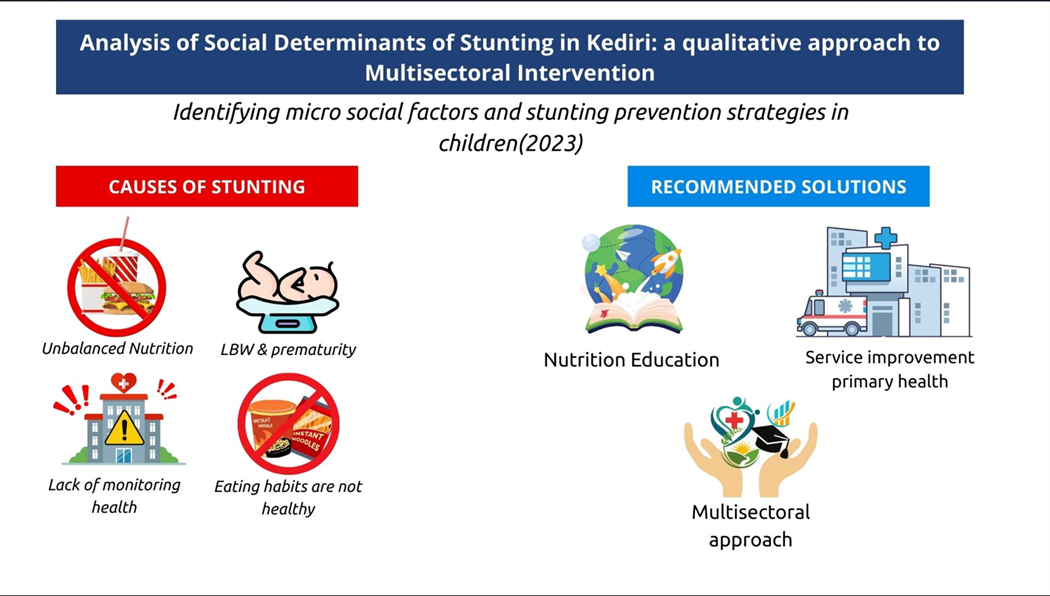
Stunting is a serious health problem that has long-term impacts on children's physical and cognitive growth and national progress. This study aims to explore micro-level social determinants, such as maternal knowledge, caregiving practices, household food access, and health service utilization, that influence stunting in Kediri City, and to formulate context-based strategies to address these issues. The design of this study uses a qualitative approach with a case study method; Data were collected through in-depth interviews and participatory observations of mothers who have toddlers or school-age children. Based on research, the incidence of stunting in Kediri City is influenced by various factors, including: lack of understanding of balanced nutrition, inadequate nutritional intake, malnutrition from an early age, lack of monitoring during pregnancy, Low Birth Weight (LBW), unhealthy eating habits, to recurring child health problems, lack of food variety and limited time and knowledge of mothers also exacerbate the situation. These findings emphasize the importance of nutrition education from pregnancy, improving primary health services such as routine visits to health centers, and continuous monitoring of child growth and development. This study recommends a multisectoral and participatory approach to accelerate the reduction of stunting at the community level.
Downloads
References
Sudarsana IK. Membentuk karakter anak sebagai generasi penerus bangsa melalui pendidikan anak usia dini. Purwadita: Jurnal Agama dan Budaya. 2018;1(1):41-8.
WHO. Stunting prevalence among children under 5 years of age (%) (model-based estimates) [Internet]. Geneva: World Health Organization; 2020 [cited 2025 May 17]. Available from: https://datatracker.ietf.org/doc/rfc6020/
WHO. Levels and trends in child malnutrition: UNICEF/WHO/the World Bank Group joint child malnutrition estimates (Key findings of the 2021 edition [Internet]. Geneva: World Health Organization; 2023 [cited 2025 May 17]. Available from: https://datatracker.ietf.org/doc/rfc6020/
Kementerian Kesehatan RI. Buku Saku: Hasil Survei Status Gizi Indonesia (SSGI) 2022. Badan Kebijakan Pembangunan Kesehatan, Kementerian Kesehatan RI. Jakarta; 2023.
Nshimyiryo A, Hedt-Gauthier B, Mutaganzwa C, Kirk CM, Beck K, Ndayisaba A, et al. Risk factors for stunting among children under five years: a cross-sectional population-based study in Rwanda using the 2015 Demographic and Health Survey. BMC Public Health. 2019;19:1-10. doi: https://doi.org/10.1186/s12889-019-6504-z.
Soekatri MY, Sandjaja S, Syauqy A. Stunting was associated with reported morbidity, parental education and socioeconomic status in 0.5–12-year-old Indonesian children. International Journal of Environmental Research and Public Health. 2020;17(17):6204.
Usman M, Kopczewska K. Spatial and machine learning approach to model childhood stunting in Pakistan: role of socio-economic and environmental factors. International Journal of Environmental Research and Public Health. 2022;19(17):10967.
Dinas Kesehatan Kota Kediri. Profil Kesehatan Kota Kediri tahun 2022. Kediri; 2023.
Setianingsih, Permatasari D, Sawitri E. Impact of Stunting on Development of Children Aged 12-60 Months. Proceedings of the 1st International Conference on Science, Health, Economics, Education and Technology (ICoSHEET 2019); 2020.
Mustakim MR, Irawan R, Irmawati M, Setyoboedi B. Impact of Stunting on Development of Children between 1-3 Years of Age. Ethiopian Journal of Health Sciences. 2022;32(3). doi: http://dx.doi.org/10.4314/ejhs.v32i3
Habir LA, Kadir S, Boekoesoe L. Risk Factors for Stunting In the First 1000 Days of Life. International Journal of Medical Science and Clinical Research Studies. 2023;3(9):2112-6. doi: https://doi.org/10.47191/ijmscrs/v3-i9-55
Silvermann D. Doing qualitative research: A practical handbook. 5th ed. Verlag nicht ermittelbar; 2020.
Rutledge P, Hogg JLC. In‐Depth Interviews. International Encyclopedia of Media Psychology. 2020:1-7. doi: 10.1002/9781119011071.iemp0019.
Kristina K. The Effect of Health Education on Balanced Nutrition in Preventing Stunting in Toddlers on Mother's Knowledge in the Work Area of Pagurawan Health Center, Batu Bara Regency in 2021. Science Midwifery. 2021;10(1, October):395-402.
Tahreem A, Rakha A, Anwar R, Rabail R, Maerescu CM, Socol CT, et al. Impact of maternal nutritional literacy and feeding practices on the growth outcomes of children (6–23 months) in Gujranwala: a cross-sectional study. Frontiers in Nutrition. 2025;11:1460200.
De Sanctis V, Soliman A, Alaaraj N, Ahmed S, Alyafei F, Hamed N. Early and Long-term Consequences of Nutritional Stunting: From Childhood to Adulthood. Acta Biomed. 2021;92(1):e2021168. doi: 10.23750/abm.v92i1.11346.
Djupegot IL, Nenseth CB, Bere E, Bjørnarå HBT, Helland SH, Øverby NC, et al. The association between time scarcity, sociodemographic correlates and consumption of ultra-processed foods among parents in Norway: a cross-sectional study. BMC Public Health. 2017;17(1):447. doi: 10.1186/s12889-017-4408-3.
Suratri MAL, Putro G, Rachmat B, Nurhayati, Ristrini, Pracoyo NE, et al. Risk Factors for Stunting among Children under Five Years in the Province of East Nusa Tenggara (NTT), Indonesia. Int J Environ Res Public Health. 2023;20(2). doi: 10.3390/ijerph20021640.
Kementerian Kesehatan RI. Riset Kesehatan Dasar (RISKESDAS) 2018. Jakarta; 2018.
Khotimah K. Hubungan Status Gizi Dengan Kejadian Infeksi Saluran Pernafasan Akut (ISPA) Pada Anak Balita:(Di Posyandu Puri, Desa Puri, Kecamatan Puri Kabupaten Mojokerto) STIKes Bina Sehat PPNI]. Mojokerto; 2020.
Reinhardt K, Fanzo J. Addressing chronic malnutrition through multi-sectoral, sustainable approaches: a review of the causes and consequences. Frontiers in Nutrition. 2014;1:13.
Hendraswari CA, Purnamaningrum YE, Maryani T, Widyastuti Y, Harith S. The determinants of stunting for children aged 24-59 months in Kulon Progo District 2019. Kesmas: National Public Health Journal. 2021;16(2):71-7.
Rochmawati L, Kuswanti I, Prabawati S, Melina F, Wulandari SR. Upaya Pencegahan Stunting Melalui Pemantauan Kesehatan, Edukasi, dan Pendampingan pada Ibu Hamil di Wilayah Bintaran dan Surokarsan Yogyakarta. Journal Of Philanthropy: The Journal of Community Service. 2024;2(1):23-9.
Supadmi S, Laksono AD, Kusumawardani HD, Ashar H, Nursafingi A, Kusrini I, et al. Factor related to stunting of children under two years with working mothers in Indonesia. Clinical Epidemiology and Global Health. 2024;26:101538.
Saleh A, Syahrul S, Hadju V, Andriani I, Restika I. Role of maternal in preventing stunting: a systematic review. Gaceta Sanitaria. 2021;35:S576-S82.
Goudet SM, Bogin BA, Madise NJ, Griffiths PL. Nutritional interventions for preventing stunting in children (birth to 59 months) living in urban slums in low‐and middle‐income countries (LMIC). Cochrane Database of Systematic Reviews. 2019(6).
Munir DA, Hikmayani NH, Sumardiyono S. Puskesmas Accreditation Status And Asset Ownership Potentially Lowering Stunting : Multilevel Analysis In Jeneponto and Barru Districts, South Sulawesi. Journal of Health and Nutrition Research. 2025 Aug 1;4(2):504–17
Ode D, Murti B, Budihastuti UR. Correlation between Low Birth Weigth and Stunting in Children Under Five: Meta Analysis. Journal of Maternal and Child Health. 2022;7(5):498-509.
Budhathoki SS, Bhandari A, Gurung R, Gurung A, Kc A. Stunting Among Under 5-Year-Olds in Nepal: Trends and Risk Factors. Matern Child Health J. 2020;24(Suppl 1):39-47. doi: 10.1007/s10995-019-02817-1.
Garina LA, Dewi MK, Trusda SAD, Purbaningsih W, Muflihah H, Tursina A, et al. Maternal, Child, and Household Risk Factors for Children with Stunting. The Open Public Health Journal. 2024;17(1).
Wandira BA, Hermiyanty, Suwendro NI, Rakhman A. Factors Associated with the Incidence of Post-Disaster Stunting in Toddlers Aged 25-59 Months in Posyandu Biromaru Health Centre Working Area. Journal of Health and Nutrition Research. 2023 Apr 16;2(1):5–14
Published
How to Cite
Issue
Section
Copyright (c) 2025 Eko Winarti, Susmiati Susmiati, Moh Alimansur, Indah Jayani, Erna Susilowati

This work is licensed under a Creative Commons Attribution-NonCommercial-ShareAlike 4.0 International License.
Similar Articles
- Huntari Harahap, Armaidi Darmawan, Anggelia Puspasari, Esa Indah Ayudia, I Made Dwi Mertha Adnyana, Asrica Fitri Yonera, Nurul Uswatun Hasanah, Multifactorial Predictors of Stunting Among Children Under Five Years: Evidence from Batanghari District, Jambi, Indonesia , Journal of Health and Nutrition Research: Vol. 5 No. 1 (2026)
- I Made Tangkas, Abdul Rahim, Ummu Aiman, Aulia Rakhman, Sociodemographic, Economic, and Gender Determinants of Household Food and Nutrition Security in Central Sulawesi , Journal of Health and Nutrition Research: Vol. 5 No. 1 (2026)
- Desmon Wirawati, Fischa Awalin, Sumarmi Sumarmi, Factors Associated with Toddler Nutritional Status and Stunting: A Cross-Sectional Study of Maternal Knowledge, Parenting Styles, and Family Support , Journal of Health and Nutrition Research: Vol. 5 No. 2 (2026)
You may also start an advanced similarity search for this article.