The Relationship Between Dietary Adherence and Random Blood Glucose Levels in Type 2 Diabetes Mellitus Patients at Malinau Regional General Hospital, North Kalimantan
Keywords:
Type 2 Diabetes Mellitus, Dietary Adherence, Blood Glucose Levels, Diabetes ManagementAbstract
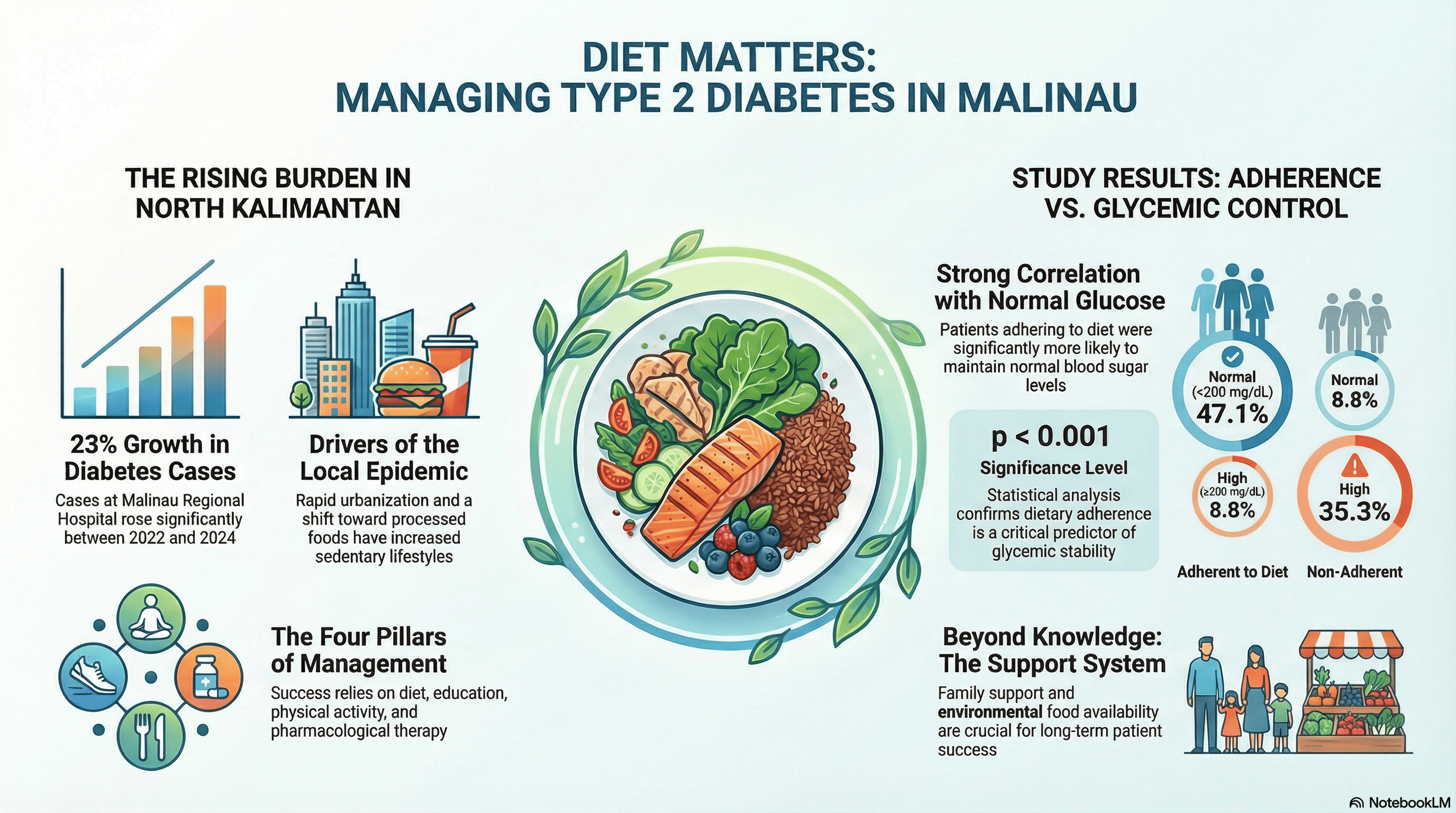
Type 2 diabetes mellitus (T2DM) is a significant chronic disease characterized by insulin resistance and impaired insulin secretion. It is a leading cause of microvascular and macrovascular complications, including blindness, kidney failure, and cardiovascular disease. Records from Malinau Regional General Hospital in North Kalimantan documented 2,300 cases, a 23% increase from 2022 to 2024. One key strategy in T2DM management is dietary intervention, which plays a critical role in maintaining stable blood glucose levels. This study aimed to analyze the relationship between dietary adherence and random blood glucose levels among patients with T2DM at Malinau Regional General Hospital. An analytical cross-sectional survey design was employed, involving 34 outpatients with T2DM selected by convenience sampling. As accidental sampling is a form of convenience sampling, it inherently introduces selection bias, which serves as a limitation of this study. Dietary adherence was assessed using a questionnaire based on the MMAS-8 and the 2021 PERKENI guidelines. Random blood glucose levels were categorized as normal (< 200 mg/dL) or high (\ge 200 mg/dL). The results showed that patients who adhered to dietary recommendations were more likely to have normal random blood glucose levels (p < 0.001), indicating a significant association between dietary adherence and glycemic control.
Downloads
References
Mohebi S, Parham M, Sharifirad G, Gharlipour Z. Social Support and Self ‑ Care Behavior Study. 2018;(January):1–6.
Kumanyika S, Dietz WH. Solving Population-wide Obesity — Progress and Future Prospects. 2020;2197–200.
Ong KL, Stafford LK, McLaughlin SA, Boyko EJ, Vollset SE, Smith AE, et al. Global, regional, and national burden of diabetes from 1990 to 2021, with projections of prevalence to 2050: a systematic analysis for the Global Burden of Disease Study 2021. Lancet. 2023;402(10397):203–34.
Care D, Suppl SS. 2. Diagnosis and Classification of Diabetes: Standards of Care in Diabetes—2025. Diabetes Care. 2025;48(January):S27–49.
Lu X, Xie Q, Pan X, Zhang R, Zhang X, Peng G, et al. Type 2 diabetes mellitus in adults: pathogenesis, prevention and therapy. Signal Transduct Target Ther. 2024;9(1):1–25.
Tomic D, Shaw JE, Magliano DJ. The burden and risks of emerging complications of diabetes mellitus. Nat Rev Endocrinol. 2022;18(9):525–39.
Arifah FH, Nugroho AE, Rohman A, Sujarwo W. A review of medicinal plants for the treatment of diabetes mellitus: The case of Indonesia. South African J Bot [Internet]. 2022;149:537–58. Available from: https://doi.org/10.1016/j.sajb.2022.06.042
Alfaqeeh M, Alfian SD, Abdulah R. Factors associated with diabetes mellitus among adults: Findings from the Indonesian Family Life Survey-5. Endocr Metab Sci [Internet]. 2024;14(September 2023):100161. Available from: https://doi.org/10.1016/j.endmts.2024.100161
Natesan V, Kim SJ. Diabetic nephropathy – A review of risk factors, progression, mechanism, and dietary management. Biomol Ther. 2021;29(4):365–72.
Nursyifa AS, Rumijati T, Suheti T. Kepatuhan Diet terhadap Kadar Gula Darah Sewaktu pada Penderita Diabetes Melitus Tipe II. J Keperawatan Indones Florence Nightingale. 2023;3(1):12–6.
Febriana NR, Fayasari A. Hubungan antara kepatuhan diet, dukungan keluarga, dan motivasi diri dengan kadar gula darah pada pasien diabetes mellitus di Puskesmas Kecamatan Cisauk Kabupaten Tangerang. Ilmu Gizi Indones. 2023;7(1):21.
Nanda GM, Rosyid FN. The relationship between dietary compliance and blood sugar levels in diabetes mellitus patient’s. J eduHealth [Internet]. 2024;15(01):123–9. Available from: https://ejournal.seaninstitute.or.id/index.php/healt/article/view/3821
Abose S, Dassie GA, Megerso A, Charkos TG. Adherence to recommended diet among patients with diabetes mellitus type 2 on follow-up at Adama Hospital Medical College, Ethiopia. Front Med. 2024;11(November):1–9.
Strydom H, Muchiri J, Delport E, White Z. Adherence to Personalised Nutrition Education Based on Glycemic and Food Insulin Index Principles and Their Association with Blood Glucose Control in Individuals with Type 2 Diabetes Mellitus. Int J Environ Res Public Health. 2025;22(6).
Che T, Yan C, Tian D, Zhang X, Liu X, Wu Z. Time-restricted feeding improves blood glucose and insulin sensitivity in overweight patients with type 2 diabetes: a randomised controlled trial. Nutr Metab [Internet]. 2021;18(1):1–10. Available from: https://doi.org/10.1186/s12986-021-00613-9
Susanti N, , Nursalam N, Nadatien I. Pengaruh Pengaruh Education and Support Group Berbasis Teori Self Care Terhadap Kepatuhan, Kemandirian Perawatan Kaki Dan Kadar Glukosa Darah Pada Pasien Diabetes Melitus Tipe 2. J Keperawatan Suaka Insa. 2023;8(1):21–9.
Wilson D, Diji AKA, Marfo R, Amoh P, Duodu PA, Akyirem S, et al. Dietary adherence among persons with type 2 diabetes: A concurrent mixed methods study. PLoS One [Internet]. 2024;19(5 May):1–22. Available from: http://dx.doi.org/10.1371/journal.pone.0302914
Published
How to Cite
Issue
Section
Copyright (c) 2026 Serfina Serfina, Resti Kusumarini Samben, Maurizka Pitria Putranti

This work is licensed under a Creative Commons Attribution-NonCommercial-ShareAlike 4.0 International License.
All published articles are licensed under the Creative Commons Attribution-NonCommercial-ShareAlike 4.0 International License.

You are free to:
- Share — copy and redistribute the material in any medium or format
- Adapt — remix, transform, and build upon the material
- The licensor cannot revoke these freedoms as long as you follow the license terms.
Under the following terms:
- Attribution — You must give appropriate credit, provide a link to the license, and indicate if changes were made. You may do so in any reasonable manner, but not in any way that suggests the licensor endorses you or your use.
- NonCommercial — You may not use the material for commercial purposes.
- ShareAlike — If you remix, transform, or build upon the material, you must distribute your contributions under the same license as the original.
- No additional restrictions — You may not apply legal terms or technological measures that legally restrict others from doing anything the license permits.
Most read articles by the same author(s)
- Riana Angelina, Rif’atul Amini, Resti Kusumarini Samben, The Effect of Mung Bean (Phaseolus radiatus L.) Beverage with Red Ginger (Zingiber officinale var. rubrum) Addition on Total Cholesterol Levels in Female Hypercholesterolemia Patients at Gunung Sari Ilir Public Health Center , Journal of Community Nutrition Intervention: Vol. 1 No. 1 (2025)