Examination Stress and OSCE Performance in Basic Clinical Skills: A Study Among Medical Students
Keywords:
Examination Stress, Medical Students, Objective Structured Clinical ExaminationAbstract
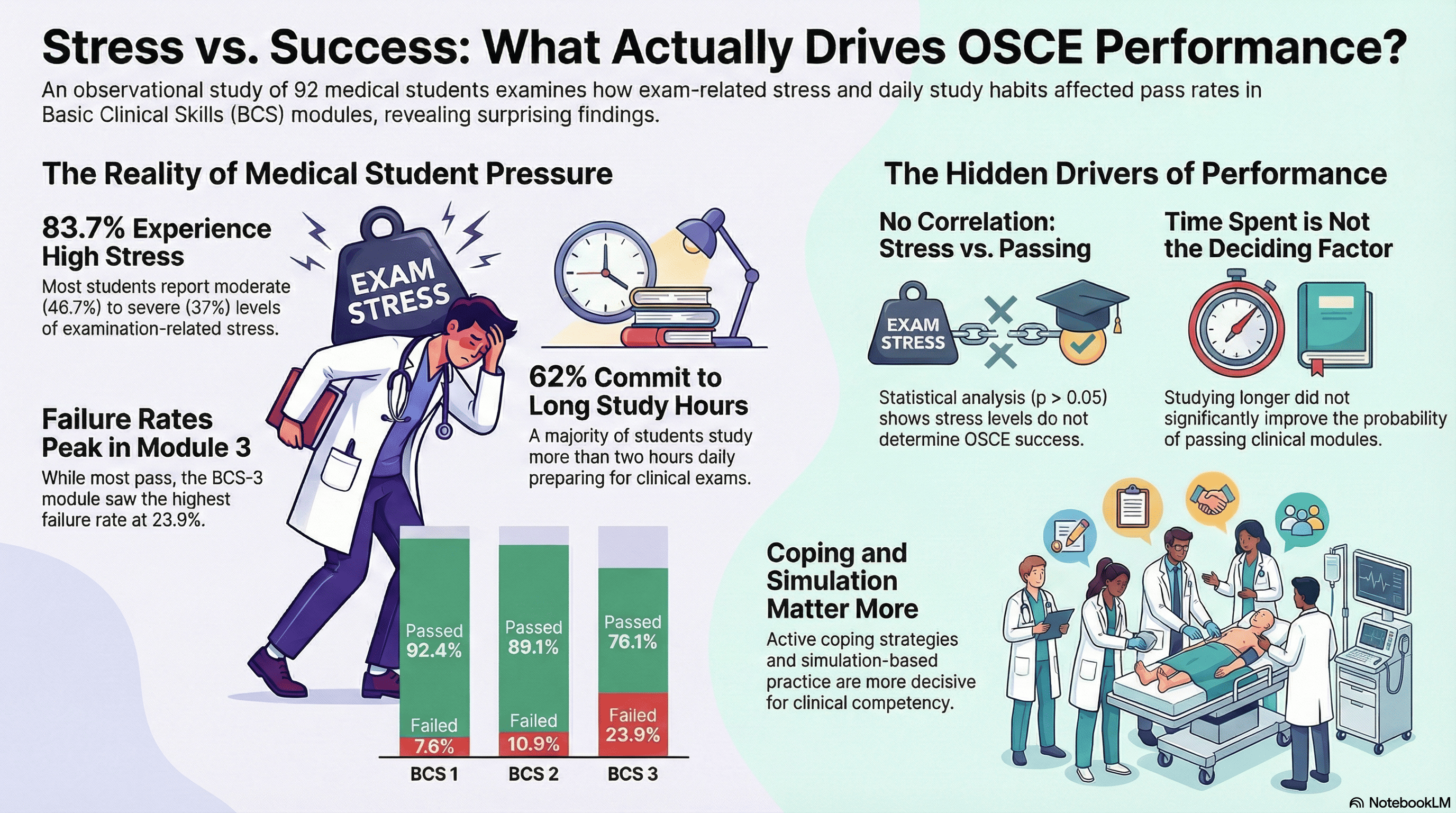
The prevalence of stress among medical students has been reported to be 31.7% across six universities in Sudan and 58% at Andalas University. Academic stress is known to affect students’ performance, including failure in the Objective Structured Clinical Examination (OSCE). This study aimed to examine the relationship between examination-related stress levels and OSCE passing outcomes in the Basic Clinical Skills (KKD) module among students of the Faculty of Medicine, Universitas Sultan Ageng Tirtayasa. This study employed an observational analytic design with a cross-sectional approach. The study participants were third- and fourth-year medical students, totaling 92. Examination stress levels were measured using the Westside Anxiety Test Scale, while OSCE passing status was obtained from secondary academic records. Bivariate analysis was conducted using the chi-square test. The most commonly reported level of examination stress was moderate (47.6%), followed by severe (37.0%) and mild (16.3%). The highest failure rate was observed in the BCS-OSCE 3 (23.9%), followed by BCS-OSCE 2 (10.9%) and BCS-OSCE 1 (7.6%). Bivariate analysis showed no significant association between examination stress levels and OSCE KKD passing status. Similarly, no significant relationship was found between daily study duration and OSCE passing outcomes.
Downloads
References
Christian O E, Obiageli O E. Overview of Stress and Stress Management. ARC Journal of Nursing and Healthcare. 2019;5(2):12–8. doi:10.20431/2455-4324.0502002
Eva EO, Islam MZ, Mosaddek ASM, Rahman MF, Rozario RJ, Iftekhar AFMH, et al. Prevalence of stress among medical students: a comparative study between public and private medical schools in Bangladesh. BMC Res Notes. 2015 Jul 30;8:327. doi:10.1186/s13104-015-1295-5 PubMed PMID: 26223786; PubMed Central PMCID: PMC4520268.
Rahmayani RD, Liza RG, Syah NA. Gambaran Tingkat Stres Berdasarkan Stressor pada Mahasiswa Kedokteran Tahun Pertama Program Studi Profesi Dokter Fakultas Kedokteran Universitas Andalas Angkatan 2017. Jurnal Kesehatan Andalas. 2019 Mar 31;8(1):103–11. doi:10.25077/jka.v8i1.977
Aamir IS. Stress Level Comparison of Medical and Nonmedical Students: A Cross Sectional Study done at Various Professional Colleges in Karachi, Pakistan. Acta Psychopathologica. 2017;3(2):1–6. doi:10.4172/2469-6676.100080
Alghifari MM. Studi Kualitatif Kecemasan Mahasiswa Kedokteran Saat Menghadapi Objective Structured Clinical Examination (OSCE) [Thesis] [Internet]. [Surakarta]: UNS (Sebelas Maret University); 2016 [cited 2025 Aug 8]. Available from: https://digilib.uns.ac.id/dokumen/55317/Studi-Kualitatif-Kecemasan-Mahasiswa-Kedokteran-Saat-Menghadapi-Objective-Structured-Clinical-Examination-OSCE
Risma GB. Kecemasan dalam Objective Structured Clinical Examination (OSCE). Jurnal Kesehatan dan Agromedicine. 2015 Nov 1;2(4):419–24.
Yanti L, Sari F, Arafah M, Apriyani W. Kecemasan Mahasiswa Keperawatan Sebelum Ujian Objective Structured Clinical Examination (OSCE). Journal of Language and Health. 2024 Sep 1;5(3):951–6. doi:10.37287/jlh.v5i3.4066
Kaur Khaira M, Raja Gopal RL, Mohamed Saini S, Md Isa Z. Interventional Strategies to Reduce Test Anxiety among Nursing Students: A Systematic Review. IJERPH. 2023 Jan 10;20(2):1233. doi:10.3390/ijerph20021233
Enny I, Estivana F, Retno WS. Hubungan Tingkat Stres Terhadap Ujian Dengan Hasil Belajar Keterampilan Klinis Dasar Mahasiswa Fakultas Kedokteran Universitas Tarumanagara [Thesis] [Internet]. [Jakarta]: Universitas Indonesia; 2016 [cited 2025 Aug 8]. Available from: https://library.fk.ui.ac.id/index.php?p=show_detail&id=20565&keywords=%20%5C
Zhang N, Rabatsky A. Effects of test stress during an objective structured clinical examination. J Chiropr Educ. 2015 Oct;29(2):139–44. doi:10.7899/JCE-14-17 PubMed PMID: 25806413; PubMed Central PMCID: PMC4582612.
Sanaba MK, Rahmah NA, Arifandi F. Hubungan Tingkat Kecemasan dengan Kelulusan Osce pada Mahasiswa Fakultas Kedokteran Universitas Yarsi Angkatan 2019 dan 2020, dan Tinjauannya Menurut Islam. Junior Medical Journal. 2022;1(1):36–46.
Dunning B, Taylor D. Physician Associate Students Perspectives of the Objective Structured Clinical Examination (OSCE), as a Form of Assessment. International Journal of Clinical Skills. 2021;15(5):184. doi:10.37532/1753-0431.2021.15(5).188
Yusuf L. Objective Structured Clinical Examination? How students perceive their learning after OSCE. Pak J Med Sci. 2021;37(4):1206–10. doi:10.12669/pjms.37.4.4005 PubMed PMID: 34290809; PubMed Central PMCID: PMC8281189.
Memon S, Shaikh S ul H. Comparison of performance on written and OSCE assessment during end semester pediatric examination. Pak J Med Sci. 2020;36(4):711–6. doi:10.12669/pjms.36.4.2026 PubMed PMID: 32494261; PubMed Central PMCID: PMC7260906.
Mukun L. The Relationship between Students’ Study Time and Academic Performance and its Practical Significance. BCP Education & Psychology. 2022;7:412–5.
Published
How to Cite
Issue
Section
Copyright (c) 2026 Maulana Nur Zaka, Rukman Abdullah, Rita Mustika

This work is licensed under a Creative Commons Attribution-NonCommercial-ShareAlike 4.0 International License.
All published articles are licensed under the Creative Commons Attribution-NonCommercial-ShareAlike 4.0 International License.

You are free to:
- Share — copy and redistribute the material in any medium or format
- Adapt — remix, transform, and build upon the material
- The licensor cannot revoke these freedoms as long as you follow the license terms.
Under the following terms:
- Attribution — You must give appropriate credit, provide a link to the license, and indicate if changes were made. You may do so in any reasonable manner, but not in any way that suggests the licensor endorses you or your use.
- NonCommercial — You may not use the material for commercial purposes.
- ShareAlike — If you remix, transform, or build upon the material, you must distribute your contributions under the same license as the original.
- No additional restrictions — You may not apply legal terms or technological measures that legally restrict others from doing anything the license permits.