The Effect of Emotional Demonstration on Maternal Knowledge and Attitudes Regarding Infant and Young Child Feeding in Samarinda, Indonesia
Keywords:
Infant and Young Child Feeding, Emotional Demonstration, Booklet PINTAR, knowledge, attitude, mothers of children under fiveAbstract
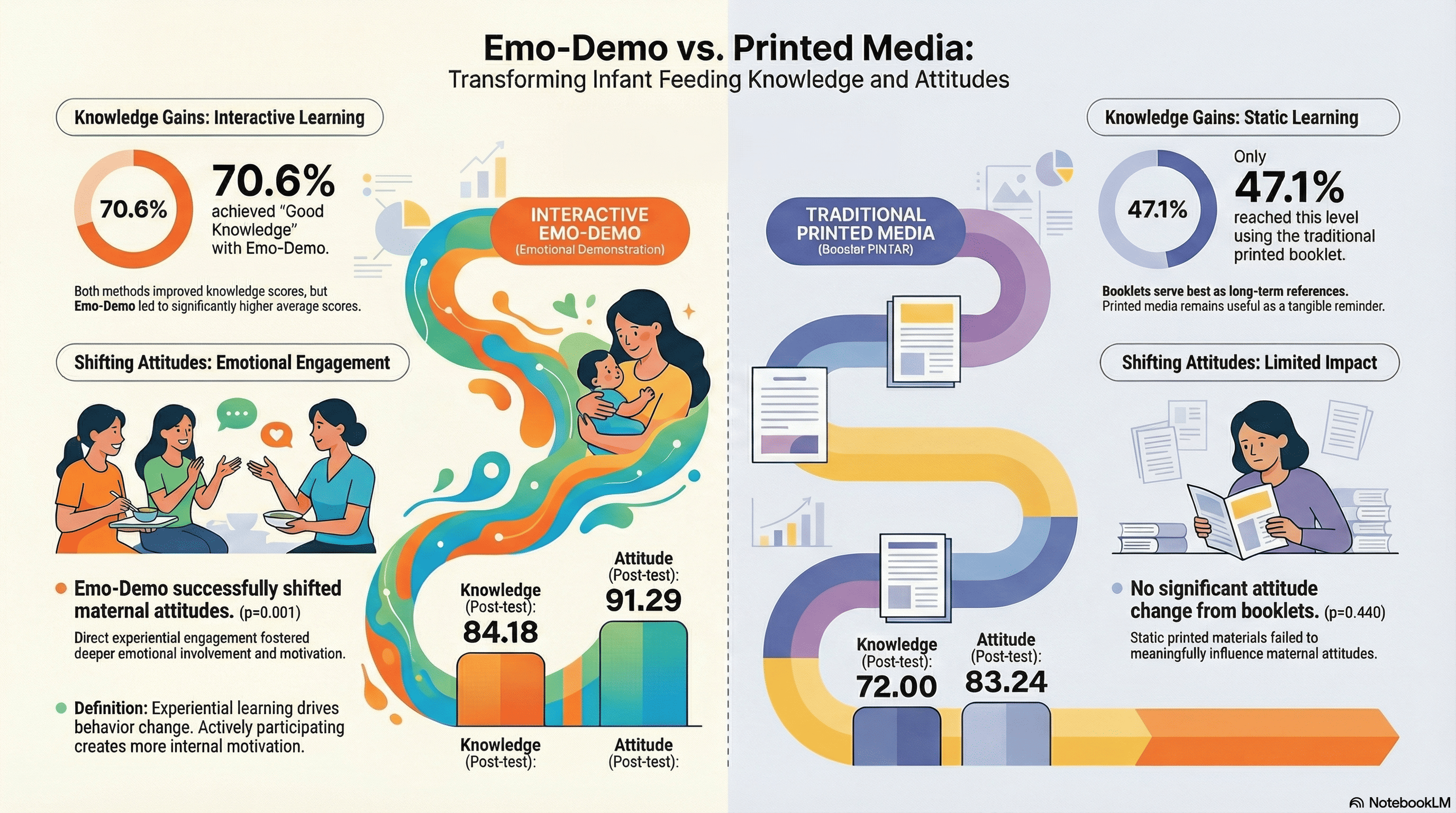
Nutritional problems among children under five, particularly stunting, remain a major public health challenge in East Kalimantan, especially in Samarinda. Findings from a preliminary study indicated that one contributing factor is the low level of maternal knowledge and attitudes regarding Infant and Young Child Feeding (IYCF). This study aimed to analyze the effect of IYCF education using the Emotional Demonstration (Emo-Demo) method on the knowledge and attitudes of mothers with children under five in the service area of Mangkupalas Primary Health Center. This study employed a quasi-experimental design with a pretest–posttest control group approach. A total of 34 mothers of children under five were recruited and divided equally into a control group (Booklet PINTAR, n = 17) and an intervention group (Emo-Demo, n = 17). Data on knowledge and attitudes were collected using structured questionnaires. Despite the observed improvements, it is important to note that significant sociodemographic disparities existed at baseline between the two groups, particularly regarding maternal education and household income. Data analysis was conducted using the Wilcoxon test to assess within-group changes and the Mann–Whitney test for between-group comparisons. The results showed a significant improvement in both knowledge and attitudes in the two groups; however, greater changes were observed in the intervention group. Education using the Emo-Demo method significantly increased maternal knowledge (p = 0.000) and attitudes (p = 0.001). Overall, the Emo-Demo method appeared more effective than printed media, although these findings must be interpreted with caution due to the baseline inequalities.
Downloads
References
Renggli EP, Turton B, Sokal-Gutierrez K, Hondru G, Chher T, Hak S, et al. Stunting malnutrition associated with severe tooth decay in cambodian toddlers. Nutrients. 2021;13(2):1–15. doi:10.3390/nu13020290 PubMed PMID: 33498508.
UNICEF. WHO WBG. Levels and trends in child malnutrition. Joint child malnutrition estimate. Asia-Pacific Population Journal. 2018;24(2):51–78. doi:10.18356/6ef1e09a-en
UNICEF, WHO, WORLD BANK. Level and trend in child malnutrition. World Health Organization. 2023;4.
UNICEF, WHO. Levels and trends in child malnutrition. Asia-Pacific Population Journal. 2025;24(2):51–78. doi:10.18356/6ef1e09a-en
Balitbangkes RI. Laporan Riskesdas 2018 Nasional.pdf. Lembaga Penerbit Balitbangkes. 2018.
Kemenkes RI. Survei Status Gizi SSGI 2022. BKPK Kemenkes RI. 2022;1–156.
Kesehatan BKP. Survei Kesehatan Indonesia. Kota Kediri Dalam Angka. 2023;1–68.
Beal T, Tumilowicz A, Sutrisna A, Izwardy D, Neufeld LM. A review of child stunting determinants in Indonesia. Maternal and Child Nutrition. 2018;14(4):1–10. doi:10.1111/mcn.12617 PubMed PMID: 29770565.
Abri N, Sirajuddin S, Bahar B, Jafar N, Russeng SS, Zakaria Z, et al. Determinants of Incident Stunting in Elementary School Children in Endemic Area Iodine Deficiency Disorders Enrekang Regency. Open Access Macedonian Journal of Medical Sciences. 2022;10:161–7. doi:10.3889/oamjms.2022.8083
Metwally AM, El-Sonbaty MM, El Etreby LA, El-Din EMS, Hamid NA, Hussien HA, et al. Stunting and its determinants among governmental primary school children in Egypt: A school-based cross-sectional study. Open Access Macedonian Journal of Medical Sciences. 2020;8(B):650–7. doi:10.3889/oamjms.2020.4757
Ogbo FA, Agho K, Ogeleka P, Woolfenden S, Page A, Eastwood J, et al. Infant feeding practices and diarrhoea in sub-Saharan African countries with high diarrhoea mortality. PLoS ONE. 2017;12(2):1–17. doi:10.1371/journal.pone.0171792 PubMed PMID: 28192518.
Victora CG, Bahl R, Barros AJ, França GVA, Horton S, Krasevec J, et al. Lancet Breastfeeding Series Paper 1. The Lancet. 2016;387(10017):475–90.
Graziose MM, Downs SM, O’Brien Q, Fanzo J. Systematic review of the design, implementation and effectiveness of mass media and nutrition education interventions for infant and young child feeding. Public Health Nutrition. 2018;21(2):273–87. doi:10.1017/S1368980017002786 PubMed PMID: 29081315.
Priawantiputri W, Rahmat M, Purnawan AI. Efektivitas Pendidikan Gizi dengan Media Kartu Edukasi Gizi terhadap Peningkatan Pengetahuan, Sikap dan Perilaku Makanan Jajanan Anak Sekolah Dasar. Jurnal Kesehatan. 2019;10(3):374. doi:10.26630/jk.v10i3.1469
Mwakasungura F, Mkumbwa R, Sunguya B. Facilitators and barriers for healthcare workers’ adherence to the national nutritional guidelines for people living with HIV in Dar-es-Salaam: A mixed-method study. PLOS Global Public Health. 2025;5(2):1–14. doi:10.1371/journal.pgph.0003664
Triana W, Razi P, Veriza E, Sayuti S. Learning Model Methods Emotional Demonstration (Emo Demo) in Prevention of Non-Communicable Diseases: Quasi-Experimental Study. Nsc Nursing. 2022;4(4):59–77. doi:10.32549/opi-nsc-77
Ahmed KY, Agho KE, Page A, Arora A, Ogbo FA. Interventions to improve infant and young child feeding practices in Ethiopia: A systematic review. BMJ Open. 2021;11(8). doi:10.1136/bmjopen-2021-048700 PubMed PMID: 34400457.
Kirana Ayu Palupi, Irawan AMA, Yusuf AM, Rahmawati LA, Umami Z. The Influence of Emo Demo on Mother’s Knowledge and Attitudes in Providing Infant Feeding. Journal of Health and Nutrition Research. 2024;3(2):121–7. doi:10.56303/jhnresearch.v3i2.259
Abri N. Identification of Socio-Demographic Factors with the Incidence of Stunting in Elementary School Children in Rural Enrekang. Journal of Health and Nutrition Research. 2022;1(2):88–94. doi:10.56303/jhnresearch.v1i1.20
Dukuzumuremyi J P C, Acheampong K AJ et al. Knowledge , attitude , and practice of exclusive breastfeeding among mothers in East Africa : a systematic review, https://doi.org/10.1186/s13006-020-00313-9. International Breastfeeding. 2020;9(20):1–17.
Suhandono S, Nur Khotimah Elfiyan, Yodi Christiani, Firda Dewi Yani, Octavia Mariance, Prima Setiawan. EMO- DEMO: Young Child Feeding (IYCF) Strengthening Infant and An Innovative Method of Behavior in Efforts to Reduce and Prevent Stunting. 2024.
Blum LS, Novianti Rachmi C, Ortenzi F, Gonzalez W, Mallipu A, Sutrinsa A, et al. Assessment of the Scale Up of Emotional Demonstrations in Indonesia. GAIN Working Paper n°35. 2023;(July):1–21.
Nufus,erlina, koderi H, Utama M, Ramadhan C. The Application of Experiential Learning Model Perspective David A. Kolb to Improving Students Reading Skill Tatbiq. https://accounts.google.com/SignOutOptions?hl=en&continue=https://www.google.com/webhp%3Fauthuser%3D2&ec=futura_exp_og_si_72776762_e. 2022;14(1):40–57. doi:10.24042/albayan.v
Liou D, D. Bauer K. Contrasting Obesity-Related Beliefs and Behaviors among West and East Coast Chinese Americans. Journal of Food and Nutrition Research. 2018;6(3):168–75. doi:10.12691/jfnr-6-3-5
Titaley CR, Dibley MJ, Ariawan I, Mu’asyaroh A, Paramashanti BA, Alam A, et al. The impact of a package of behaviour change interventions on breastfeeding practices in East Java Province, Indonesia. Maternal and Child Nutrition. 2022;18(3). doi:10.1111/mcn.13362 PubMed PMID: 35488406.
Teshome GB, Whiting SJ, Green TJ, Mulualem D, Henry CJ. Scaled-up nutrition education on pulse-cereal complementary food practice in Ethiopia: A cluster-randomized trial. BMC Public Health. 2020;20(1):1–12. doi:10.1186/s12889-020-09262-8 PubMed PMID: 32962685.
Intiyati A, Edi IS, Soesanti I, Christianingsih J, Suprihatin K, Widarti L. Enhancing Maternal Knowledge and Practices in Complementary Feeding through Emotional Demonstration Methods. Amerta Nutrition. 2024;8(2SP):49–57. doi:10.20473/amnt.v8i2SP.2024.49-57
Siqueira MSS, Nascimento PO, Freire AP. Reporting Behaviour of People with Disabilities in relation to the Lack of Accessibility on Government Websites: Analysis in the light of the Theory of Planned Behaviour. Disability, CBR and Inclusive Development. 2022;33(1):52–68. doi:10.47985/dcidj.475
Published
How to Cite
Issue
Section
Copyright (c) 2026 Nunik Purwandini, Satriani Satriani, Nur Abri Joto

This work is licensed under a Creative Commons Attribution-NonCommercial-ShareAlike 4.0 International License.
All published articles are licensed under the Creative Commons Attribution-NonCommercial-ShareAlike 4.0 International License.

You are free to:
- Share — copy and redistribute the material in any medium or format
- Adapt — remix, transform, and build upon the material
- The licensor cannot revoke these freedoms as long as you follow the license terms.
Under the following terms:
- Attribution — You must give appropriate credit, provide a link to the license, and indicate if changes were made. You may do so in any reasonable manner, but not in any way that suggests the licensor endorses you or your use.
- NonCommercial — You may not use the material for commercial purposes.
- ShareAlike — If you remix, transform, or build upon the material, you must distribute your contributions under the same license as the original.
- No additional restrictions — You may not apply legal terms or technological measures that legally restrict others from doing anything the license permits.
Most read articles by the same author(s)
- Lale Harwindi Silviana, Nur Abri, Satriani Satriani, Dwi Hendriani, PowerPoint versus Leaflet Delivery of "CEMAS" Nutrition Education for Mothers of Stunted Children: A Quasi-Experimental Study in Balikpapan, Indonesia , Journal of Community Nutrition Intervention: Vol. 2 No. 1 (2026)