Effectiveness of the Elsimil Program Supported by Family Assistance Teams on Knowledge, Attitudes, and Nutritional Expectations Among Prospective Brides: A Quasi-Experimental Study
Keywords:
Elsimil, Prospective Brides, Nutrition EducationAbstract
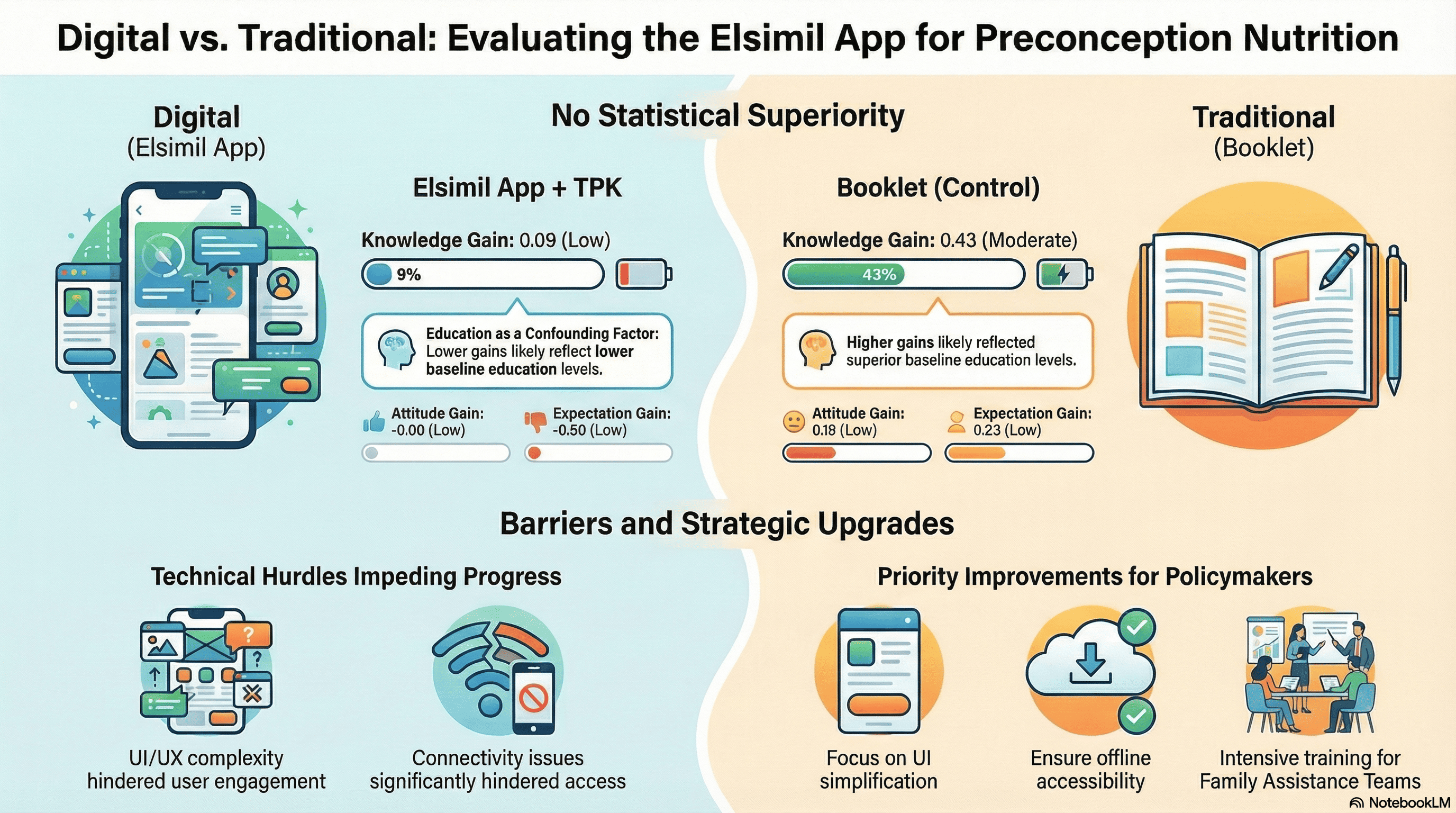
The Elsimil application (Electronic Ready for Marriage and Pregnancy) was developed as a screening, education, and assistance tool for prospective brides. This study aimed to analyze the effectiveness of the Elsimil application combined with support from the Family Assistance Team (Tim Pendamping Keluarga/TPK) on nutritional knowledge, attitudes, and expectations among prospective brides in Palu City. This study employed a quantitative approach using a quasi-experimental design with a non-randomized control group and a pretest–posttest design. The sample size was calculated using the formula for testing differences between two proportions, yielding a total of 54 respondents. Participants were randomly assigned to an intervention group (n = 27) and a control group (n = 27). Baseline data revealed significant differences in age and education level, with the control group being older and more highly educated. The intervention group received education through the Elsimil application, accompanied by TPK support, while the control group received conventional nutrition education using a booklet. Data were analyzed using the Mann–Whitney test and were supplemented with consideration of baseline confounders. Statistical analysis showed no significant differences between the intervention and control groups in terms of nutritional knowledge (p = 0.162), attitudes (p = 0.340), or nutritional expectations (p = 0.330). While the Elsimil application provides a digital platform for education, technical barriers and baseline demographic imbalances, particularly in education levels, significantly influenced the outcomes. Improvements in user interface design, offline accessibility, and targeted facilitator training are needed to enhance the application's effectiveness compared to traditional media.
Downloads
References
UNICEF Indonesia. Tackling the “triple burden” of malnutrition in Indonesia [Internet]. 2022 [cited 2026 Mar 25]. Available from: https://www.unicef.org/indonesia/nutrition
Taufiqurrahman T, Hafid F, Mujayanto M, Nuswantari A, Ratno R, Rahayuningtyas R, et al. Iron Supplement Adherence, Dietary Intake, and Anemia Risk among Adolescent Girls in Madiun Regency, Indonesia. Journal of Health and Nutrition Research. 2025 Dec 1;4(3):1354–63. doi:10.56303/jhnresearch.v4i3.723
Asmarani, Karlinda, Wibowo H. Pengaruh Tinggi Badan Dan Berat Badan Terhadap Kejadian Keguguran Wanita Usia Subur. Jurnal Informatika Medis. 2024 Jun 27;2(1):15–21. doi:10.52060/im.v2i1.2188
Muharram FR, Tjandra S, Madani NJ, Rokx C, Abdullah A. Trends in the double burden of malnutrition among Indonesian adults, 2007 to 2023. Sci Rep. 2025 Oct 7;15(1):34883. doi:10.1038/s41598-025-17348-9
Kemenkes RI. Riset Kesehatan Dasar (Riskesdas). Jakarta: Badan Penelitian dan Pengembangan Kesehatan Kementerian Kesehatan RI; 2018.
The Lancet Regional Health – Southeast Asia. Nutrition during preconception: laying the foundation. Lancet Reg Health Southeast Asia. 2025 May 12;36:100596. doi:10.1016/j.lansea.2025.100596 PubMed PMID: 40421125; PubMed Central PMCID: PMC12105505.
BKKBN. BKKBN [Internet]. 2025 [cited 2026 Mar 25]. Sosialisasi Aplikasi Elsimil. Available from: https://kampungkb.kemendukbangga.go.id/kampung/74952/intervensi/1709253/sosialisasi-aplikasi-elsimil
WHO. Preconception care to reduce maternal and childhood mortality and morbidity [Internet]. 2013 [cited 2026 Mar 25]. Available from: https://www.who.int/publications/i/item/9789241505000
Nurleli N, Hadju V, Indriasari R, Areni IS, Masni M, Riskyani S. Effectiveness of digital health in improving pregnancy quality among preconception women: A systematic review. Narra J. 2025 Apr 28;5(2):e993–e993. doi:10.52225/narra.v5i2.993
Zimmerman E, Woolf SH. Understanding the relationship between education and health. In. Washington (DC): Discussion Paper, Institute of Medicine; 2014. Available from: https://commed.vcu.edu/Chronic_Disease/2015/education_healthlink.pdf
Nutbeam D. The evolving concept of health literacy. Soc Sci Med. 2008 Dec;67(12):2072–8. doi:10.1016/j.socscimed.2008.09.050 PubMed PMID: 18952344.
Amelia F. Hambatan Tim Pendamping Keluarga (TPK) Dalam Pencegahan Stunting Melalui Aplikasi Elsimil (Elektronik Siap Nikah Dan Siap Hamil) Sebagai Inovasi Baru Pencegahan Stunting Bagi Pasangan Calon Pengantin [Skrisp]. [Lampung]: Universitas Lampung; 2025.
Putra GW, Pradnyani PE, Dewi KRA. Evaluasi Penggunaan Aplikasi Elektronik Siap Nikah dan Hamil (ELSIMIL) dengan Pendekatan Technology Acceptance Model (TAM) di Kabupaten Karangasem Tahun 2024. JAKADIKSI: JURNAL VOKASI. 2025 Aug 12;4(2):68–75. doi:10.36002/jdk.v4i2.4109
Bandura A. Health promotion by social cognitive means. Health Educ Behav. 2004 Apr;31(2):143–64. doi:10.1177/1090198104263660 PubMed PMID: 15090118.
Torkan N, Kazemi A, Paknahad Z, Bahadoran P. Relationship of Social Cognitive Theory Concepts to Dietary Habits of Pregnant Women. Iran J Nurs Midwifery Res. 2018;23(2):125–30. doi:10.4103/ijnmr.IJNMR_157_16 PubMed PMID: 29628960; PubMed Central PMCID: PMC5881229.
Published
How to Cite
Issue
Section
Copyright (c) 2026 Siti Maryam Syafitri, Nikmah Utami Dewi

This work is licensed under a Creative Commons Attribution-NonCommercial-ShareAlike 4.0 International License.
All published articles are licensed under the Creative Commons Attribution-NonCommercial-ShareAlike 4.0 International License.

You are free to:
- Share — copy and redistribute the material in any medium or format
- Adapt — remix, transform, and build upon the material
- The licensor cannot revoke these freedoms as long as you follow the license terms.
Under the following terms:
- Attribution — You must give appropriate credit, provide a link to the license, and indicate if changes were made. You may do so in any reasonable manner, but not in any way that suggests the licensor endorses you or your use.
- NonCommercial — You may not use the material for commercial purposes.
- ShareAlike — If you remix, transform, or build upon the material, you must distribute your contributions under the same license as the original.
- No additional restrictions — You may not apply legal terms or technological measures that legally restrict others from doing anything the license permits.
Most read articles by the same author(s)
- Rahma Rizkina, Nikmah Utami Dewi, The Relationship Between Stress Levels, Body Image, and High Sodium Eating Behavior with Nutritional Status Among Female Adolescents At SMA Negeri 2 Palu , Journal of Community Nutrition Intervention: Vol. 1 No. 1 (2025)